
(© kasto - stock.adobe.com)
BOSTON – In an effort to find a cure for the coronavirus pandemic, researchers at Boston University have developed a way to fight not only SARS-CoV-2 (the virus responsible for COVID-19), but also virtually any virus in the human body. Their new technology uses tiny bits of biofriendly plastics wrapped in cell membranes to create what are essentially fake “decoy” cells. These fake cells, which the researchers dub “nanosponges,” attract SARS-CoV-2 virus particles, diverting the virus away from real cells.
In the study, published in Nano Letters, researchers created the nanosponges using lung cell membranes, since the SARS-CoV-2 virus attacks lung cells. The nanosponge cell membranes have the same characteristics as normal lung cell membranes, which allows the virus to attach to the nanosponges. The main difference between a nanosponge and a real cell is what’s inside: the fake cells lack any normal internal cellular machinery.
Scientists ‘astonished’ by findings
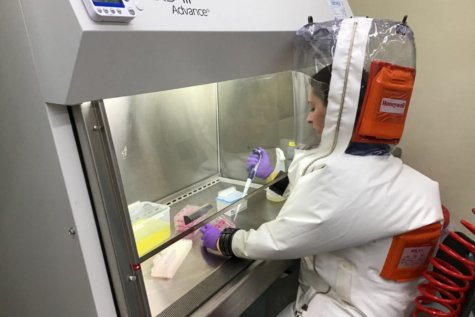
Surprisingly, the researchers found that the SARS-CoV-2 virus not only attaches to the nanosponges, but it is actually more attracted to the nanosponges than normal lung cells.
“I was skeptical at the beginning because it seemed too good to be true,” admits microbiologist and co-author of the study, Anna Honko, in a statement. “But when I saw the first set of results in the lab, I was just astonished.”
“Our guess is that it acts like a decoy, it competes with cells for the virus,” explains fellow microbiologist and co-author, Anthony Griffiths. “They are little bits of plastic, just containing the outer pieces of cells with none of the internal cellular machinery contained inside living cells. Conceptually, it’s such a simple idea. It mops up the virus like a sponge.”
While the initial findings are based on experiments using cells in petri dishes, the researchers believe that the nanosponges could also work inside human bodies. Once the SARS-CoV-2 virus binds to the nanosponge, the virus dies. Then, because the nanosponges are biodegradable, they could easily be destroyed by the immune system.
Another benefit of the nanosponges is that they attract molecules that cause inflammation. This is particularly beneficial in the case of COVID-19 given that the virus causes inflammation of the lungs. By attracting inflammatory molecules, nanosponges have the potential to reduce the body’s inflammatory response. This lessens the likelihood of severe inflammation of the lungs and eventual lung failure.
Nasal spray to keep coronavirus away
Moving forward, the researchers plan to test the nanosponge technology in animals. If these experiments prove successful, they predict that the technology could be delivered in humans using a nasal spray.
“We should be able to drop it right into the nose,” Griffiths says. “In humans, it could be something like a nasal spray.”
The technology also has the potential to be applicable to a wide variety of viral infections. Nanosponges could be created using different types of cell membranes to attract a range of viruses, such as the flu or Ebola.
“I’m interested in seeing how far we can push this technology,” Honko says.
[fb_follow /]


