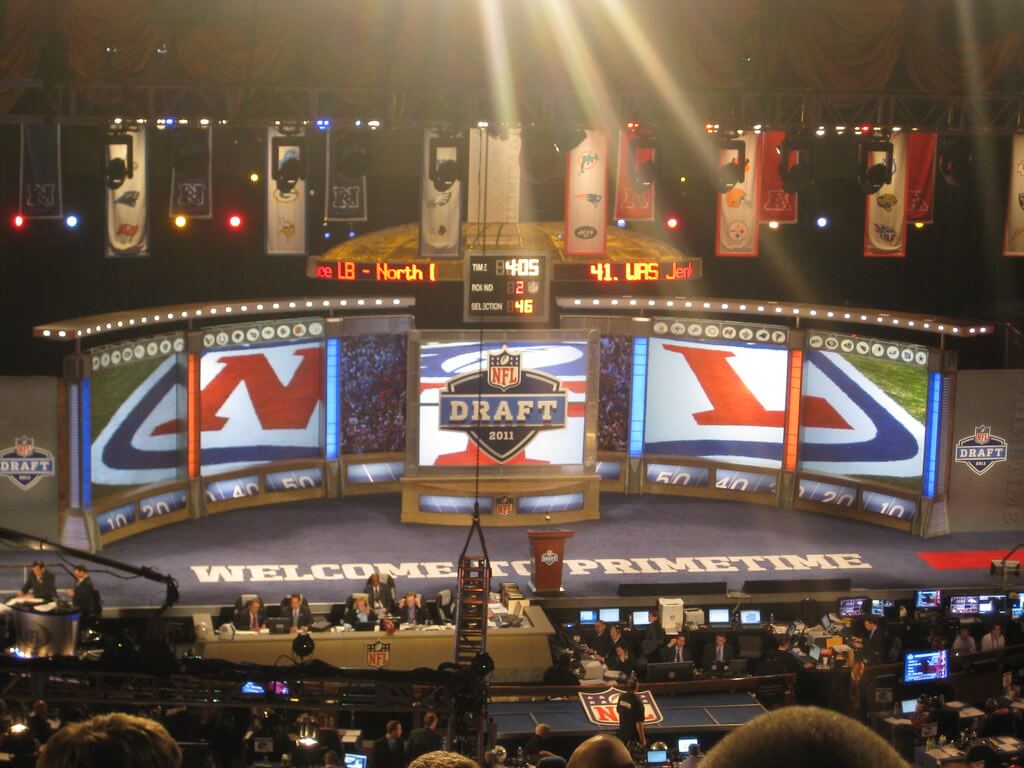
"NFL Draft 2011" by mjpeacecorps on Openverse is licensed under CC BY-NC 2.0.
Study: NFL Teams That Trade Down Win More Than Those That Trade Up
In A Nutshell
- NFL teams routinely trade significant assets to move up in the draft on the assumption that higher picks produce better players, but a new study found the data doesn’t support that belief.
- Researchers analyzed 2,544 players drafted between 2011 and 2020 and found virtually no link between a pick’s assigned trade value and how well that player actually performed.
- Fourth- and fifth-round picks performed no differently from each other despite being valued very differently on trade charts, and late first-round picks were no better than early second-round picks on average.
- In a test using 2021 NFL draft trades, the team trading down was judged the winner in 19 of 29 cases, with trading down coming out ahead in about 83% of trades when neutral outcomes were excluded.
Every spring, NFL teams sacrifice enormous amounts of money and future talent on the belief that drafting a player earlier means getting a better player. A new study says that belief is largely wrong, and that teams trading up to snag higher picks often got the worse end of the deal in the study’s test case.
Researchers at The Ohio State University analyzed a decade’s worth of NFL draft data and found that the systems teams commonly use to value draft picks, including trade charts and the rookie wage scale, have almost no connection to how well those players actually perform on the field. Paying much more for a higher pick doesn’t appear to buy the proportional performance jump that NFL draft values assume.
At stake is the NFL’s rookie pay scale, set through a labor agreement in 2011, which determines how many millions a player earns in his first four years based almost entirely on where he was drafted. This year’s top overall pick will earn $48,757,500 over four years. Pick number 10 earns just over half of that, while picks 20 and 30 earn roughly 37% and 31%, respectively. If those gaps don’t reflect actual performance, players are being paid based on a formula that doesn’t match the field.
2,544 NFL Draft Picks Later, the Data Tells a Different Story
Dennis M. Shaffer, a psychology professor at Ohio State’s Mansfield campus, and co-author Ryanne E. Shaffer analyzed data for every player drafted from 2011 to 2020, totaling 2,544 players, for a study published in The Sport Journal. They used grades from Pro Football Focus, an analytics company that scores every player on every snap and converts those into a 0-to-100 scale. Player performance was tracked across the first four years of each player’s career, the length of every rookie contract.
Researchers compared those performance grades against two widely used trade value charts, the Jimmy Johnson chart and the Rich Hill chart, as well as the NFL’s rookie pay scale. If the draft works the way NFL decision-makers assume it does, players drafted higher should consistently outperform players drafted lower, and the size of the performance gap should roughly mirror the size of the assigned value gap. It didn’t.

Higher NFL Draft Pick Values Don’t Buy Better Players
Among the more telling findings: the relationship between a pick’s assigned trade value and actual player performance was essentially zero. Researchers found moderate to substantial evidence that fourth- and fifth-round picks did not differ in Pro Football Focus grades or years played, even though trade charts assign fourth-round picks far greater value. That pattern held within rounds, too. Whether a player was taken at the top, middle, or bottom of a given round made no meaningful difference in how long they played or how well they performed.
Perhaps the most counterintuitive finding: players taken at the bottom of the first round, picks 21 through 32, performed no better on average than players taken in the top third of the second round. According to the trade charts, late first-round picks carry roughly 1.3 to 1.5 times the assigned value of early second-round picks. Actual performance data showed no difference between them.
Trading Down Is the Smarter NFL Draft Strategy
To test whether their findings held up going forward, the researchers examined every draft-pick-for-draft-pick trade made during the 2021 NFL draft, 29 trades in total. Two raters with strong football knowledge evaluated each trade based solely on how the players involved ultimately performed, using their Pro Football Focus grades. Raters were blind to which side of each trade was the “trade up” side.
Raters judged the trade-down side as the winner in 19 of 29 trades. When trades judged as “neither” were excluded, trading down came out ahead in about 83% of the remaining cases, a result the researchers described as statistically decisive.
This backs up the paper’s broader argument that teams may overvalue the appeal of moving up to grab a coveted player, when spreading bets across more picks typically yields better overall results.
A System Built on a Shaky Assumption
Authors acknowledge the study has limits. Pro Football Focus grades, while widely used by NFL teams, are not a perfect measure of player quality. Researchers also note they used trade charts and rookie salary data as a stand-in for how team executives think about draft value, rather than asking those executives directly. It’s possible that factors beyond player performance, like team chemistry, positional need, or contract flexibility, drive some of these trades.
Still, the NFL has built an entire economic and strategic infrastructure around the assumption that higher draft picks are proportionally more valuable. A decade of real performance data says that assumption doesn’t hold up nearly as well as the price tags suggest.
For fans watching the draft each spring, all the urgent phone calls, breathless TV coverage, and triumphant press conferences that follow a team trading up may be built on a foundation that simply doesn’t hold up when the games actually start.
Disclaimer: This article is based on a single peer-reviewed study published in The Sport Journal. Findings reflect player performance data from 2011 to 2020 and should not be interpreted as a universal verdict on all NFL draft strategies. Various factors beyond player performance may influence team decisions around draft trades.
Paper Notes
Limitations
Authors acknowledge that while Pro Football Focus grades are a respected and widely used tool in the industry, they are not a flawless measure of player performance. Researchers also note that trade value charts and the rookie wage scale were used as proxies for how NFL decision-makers value draft positions, rather than through direct interviews or surveys of team executives. Factors beyond player performance, such as positional need or salary cap strategy, may also influence trade decisions. Additionally, the study evaluated only a player’s first four years in the league, and the authors note that some players may develop more significantly after that window.
Funding and Disclosures
Funding and financial disclosures were not listed in the paper. Study 1 was approved by The Ohio State University Behavioral and Social Sciences Institutional Review Board (Study Number: 2023B0282). Authors thank JD Okuma and Gavin Davis for their work as raters in Study 2.
Publication Details
Authors: Dennis M. Shaffer (Department of Psychology, The Ohio State University Mansfield, Mansfield, Ohio) and Ryanne E. Shaffer (Twinsburg High School, Twinsburg, Ohio) Paper Title: “Over-promised, under-delivered: Does position in the National Football League draft matter?” Journal: The Sport Journal (ISSN: 1543-9518), published by the United States Sports Academy Published: April 29, 2026 URL: https://thesportjournal.org/article/over-promised-under-delivered-does-position-in-the-national-football-league-draft-matter/ Data Repository: https://osf.io/pf5hq/?view_only=28f7350c720f430b92270c76e5b48080


