
Amyotrophic Lateral Sclerosis (ALS) blood test (Credit: © luchschenF - stock.adobe.com)
In a Nutshell
- A 19-protein blood panel could forecast whether an ALS gene carrier in the study group would develop the disease within windows from 6 months to 5 years, beating the leading single marker, NEFL, across most time frames.
- The panel estimated how far off symptoms were with an average error of about 1.6 years, compared with 2.4 years for NEFL alone.
- Many of the key proteins tie to muscle biology rather than nerve damage, a sign that muscle-related changes may begin years earlier than scientists had appreciated.
For families who carry a gene linked to ALS, the wait for symptoms is one of the cruelest parts of the disease. Now researchers say a panel of proteins found in a single blood draw may be able to help predict which carriers will develop ALS, and roughly when, years before the first symptom strikes, within the specific gene-carrier groups studied.
A study published in Nature Medicine pinpointed 19 proteins measurable in blood plasma that, taken together, could forecast whether a person carrying an ALS-linked gene would go on to develop the disease. That shift from carrying the gene to showing clinical symptoms has a name: phenoconversion. Tested across windows ranging from six months to five years, the panel could also estimate how long a person had before that shift, with an average error of about 1.6 years in the group studied. Researchers caution that the panel is not ready for the clinic. It would need more validation first, along with testing on simpler, more widely available lab methods.
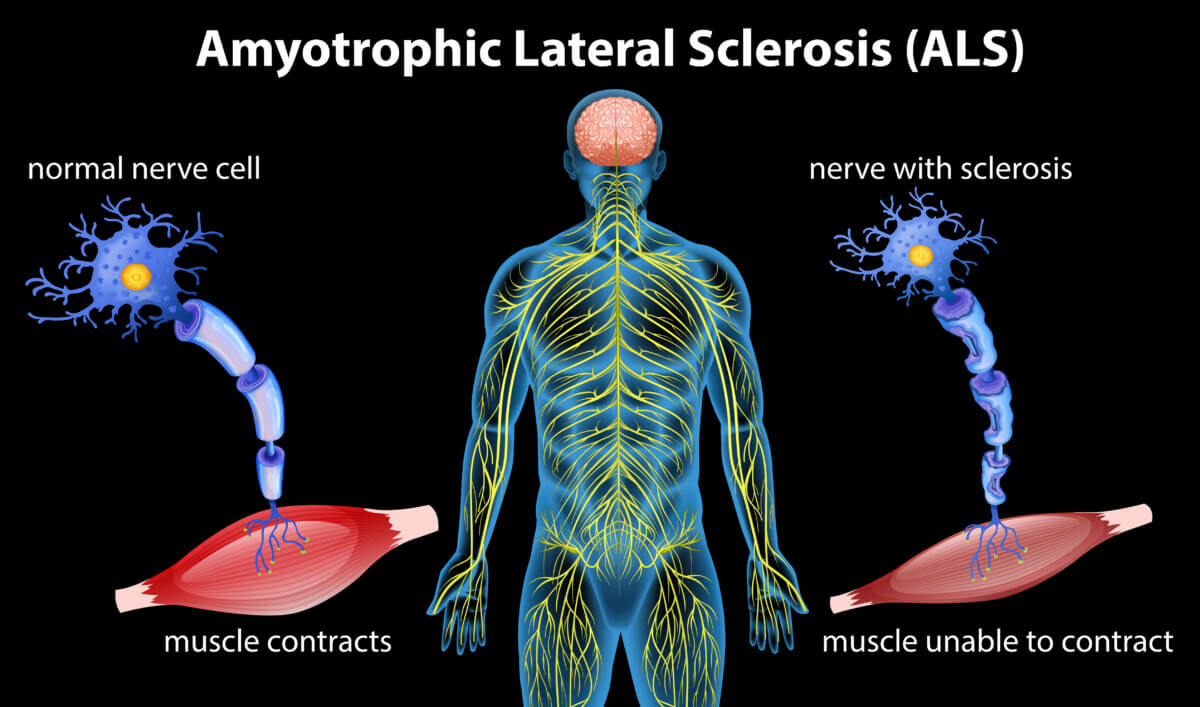
ALS, commonly called Lou Gehrig’s disease, is a progressive and fatal illness that destroys the nerve cells controlling movement. No cure exists, and doctors have limited ability to slow it. A growing recognition holds that stepping in before symptoms appear offers the best shot at meaningful treatment. Until now, though, physicians have had almost no reliable way to identify which gene carriers would actually get sick, let alone predict when.
How the ALS Blood Test Study Was Done
Researchers drew on roughly 18 years of data from the Pre-Symptomatic Familial ALS (Pre-fALS) study, which has followed people carrying ALS-linked gene variants before and after they developed the disease. For the main analysis, the team examined 516 blood plasma samples from 137 participants across four groups: 33 people who eventually developed ALS, 35 who already had it, 10 gene carriers who had not yet developed symptoms, and 59 healthy controls without ALS-related variants.
A single platform measured the levels of more than 5,400 proteins in each blood sample, and roughly 5,300 of those proteins passed quality checks. Researchers then tracked how each carrier’s protein levels changed in the months and years before symptoms began, measuring them against healthy controls. Of all the proteins examined, 137 showed meaningful differences between ALS patients and healthy controls, and 92 of those changed in the blood before a carrier developed symptoms. A series of prediction models, including several machine learning approaches, then sorted out which combination of proteins best forecast who would develop ALS, and when.

A 19-Protein Panel Beats the Leading ALS Marker
For years, a protein called NEFL, which reflects the breakdown of nerve fibers, has been the best single blood-based marker for pre-symptomatic ALS. It rises sharply in the months just before symptoms begin and already anchors the ATLAS trial, the first clinical trial aimed at preventing ALS onset in gene carriers.
This new study confirms NEFL as the most useful individual protein. The 19-protein panel, though, outperformed NEFL alone across most time frames tested. For predicting phenoconversion within one year, the panel reached a cross-validated accuracy score of 0.889 on a scale of 0 to 1, compared with 0.775 for NEFL alone. At the five-year mark, the panel scored 0.802 versus 0.712. Only for the shortest window, six months, did NEFL alone roughly match the full panel, likely because it spikes so dramatically in those final months that it becomes sufficient on its own.
Many of the 19 proteins are not markers of nerve damage at all. A large share tie to muscle biology, including proteins involved in muscle structure, maintenance, and breakdown. Proteins linked to muscle wasting began rising in the blood many years before symptoms appeared, a sign that muscle-related changes may begin far earlier than scientists had appreciated.
That detail carries real weight. Conventional thinking about ALS has long centered on the death of nerve cells. If muscle-related changes show up in the blood years earlier, it raises genuine questions about the disease’s earliest stages, though researchers caution that reading too much into what circulating proteins reveal about underlying biology is a mistake.

What the ALS Blood Test Reveals About Timing
Beyond predicting whether someone would develop ALS, the research tackled a harder question: predicting when. Using a model trained only on data from the 33 people who eventually developed the disease, the 19-protein panel estimated each person’s time to phenoconversion with an average error of 1.6 years, compared with 2.4 years for NEFL alone.
That gap matters for clinical trial design. Prevention trials need to recruit people who are likely to develop symptoms within a defined period. If researchers can estimate that a gene carrier is roughly 2 years from onset, they can design trials with realistic timelines and enroll the right candidates. A prevention trial targeting people estimated to be within two years of onset would need a follow-up period of about 3.6 years, a span the authors consider realistic given experience from the ATLAS trial.
To check whether the results would hold beyond the original group, the team turned to the UK Biobank, a large British health database with genetic information and stored blood samples from hundreds of thousands of participants. Because that data was not collected with ALS prevention in mind, the timing of phenoconversion had to be estimated by working backward from hospital records, specifically a first hospitalization with an ALS diagnosis, rather than measured directly. That introduced real uncertainty. Results there offered partial, directional agreement with the original findings: several key proteins, including NEFL, EDA2R, and CA3, were already elevated before symptoms, and a multi-protein panel again outperformed NEFL alone in estimating timing. Because those samples were a single snapshot rather than repeated measurements over time, this replication reads as preliminary support rather than firm confirmation.
What Comes Next for ALS Early Detection
Researchers are clear that the findings need more validation. That main dataset, though unmatched for its long-term pre-symptomatic data, included only a modest number of people who went on to develop ALS, most carrying specific gene variants. Whether the panel performs as well across a wider range of genetic backgrounds, including the many people who develop ALS with no known genetic cause, remains untested.
The equipment is another hurdle. The specialized high-throughput platform behind this study is not a routine clinical tool, so the panel could not simply be dropped into a doctor’s office as-is.
Still, the prospect of predicting who will get sick, and when, years before symptoms appear, is a meaningful step forward. How quickly that ability can be turned into drugs that stop the disease before it ever appears is the question researchers are now racing to answer.
Disclaimer: This article summarizes findings from a peer-reviewed study for a general audience and is for informational purposes only. It is not medical advice. The blood test panel described is a research tool that has not been validated for clinical use or approved for diagnosing or predicting ALS. Anyone with concerns about ALS risk, genetic testing, or symptoms should consult a qualified healthcare professional.
Paper Notes
Limitations
Researchers acknowledge several important limitations. Most significantly, the discovery cohort was relatively small, particularly the number of people who went on to develop ALS, which could affect how robust the prediction models are. Most participants came from families with known ALS genetic variants, so the findings may not carry over to people who develop ALS without a known genetic cause, who make up the majority of cases. An independent, comparable cohort for true replication was not available. While UK Biobank data supported a partial replication, that data was a single snapshot rather than repeated measurements over time, and the timing of symptom onset had to be estimated from hospital records rather than measured directly, adding real uncertainty. Researchers also caution against drawing firm biological conclusions from blood protein data alone, given how hard it is to interpret what circulating proteins actually reflect about disease processes. Additionally, the Olink platform used tends to overrepresent well-characterized, higher-abundance proteins, which may have skewed which proteins were available for discovery.
Funding and Disclosures
Funding for the Pre-fALS study came from the Muscular Dystrophy Association (grant nos. 4365 and 172123), the ALS Association (grant no. 2015), the National Institutes of Health (grant no. R01 NS105479), the ALS Recovery Fund, and the Kimmelman Estate. The CReATe PGB1 study was funded through the CReATe Consortium (grant no. U54 NS092091), a member of the NIH Rare Diseases Clinical Research Network. The CReATe Biorepository received support from the ALS Association (grant no. 16-TACL-242). UK Biobank data were accessed under application no. 847687. No support was received from Olink, which had no role in study design, data analysis, interpretation, or manuscript preparation. Several co-authors disclosed consulting relationships, board memberships, or employment with pharmaceutical and biotechnology companies; full disclosures appear in the published paper.
Publication Details
Paper Title: “Longitudinal plasma proteomics predict phenoconversion to clinically manifest ALS”
Authors: Ximing Ran, Joanne Wuu, Zhaohui S. Qin, Michael P. McDermott, Johnathan Cooper-Knock, Yindi Li, Volkan Granit, Anne-Laure Grignon, Elizabeth Lin, Maria Catalina Fernandez, Danielle Colato, Nathan Carberry, Christina M. Lill, Paolo Piazza, Andrea Malaspina, and Michael Benatar
Journal: Nature Medicine
DOI: 10.1038/s41591-026-04528-x
Corresponding Author: Michael Benatar, University of Miami Miller School of Medicine ([email protected])
Received: December 1, 2025; Accepted: June 17, 2026; Published online: July 27, 2026


