(Credit: AlexLMX/Shutterstock)
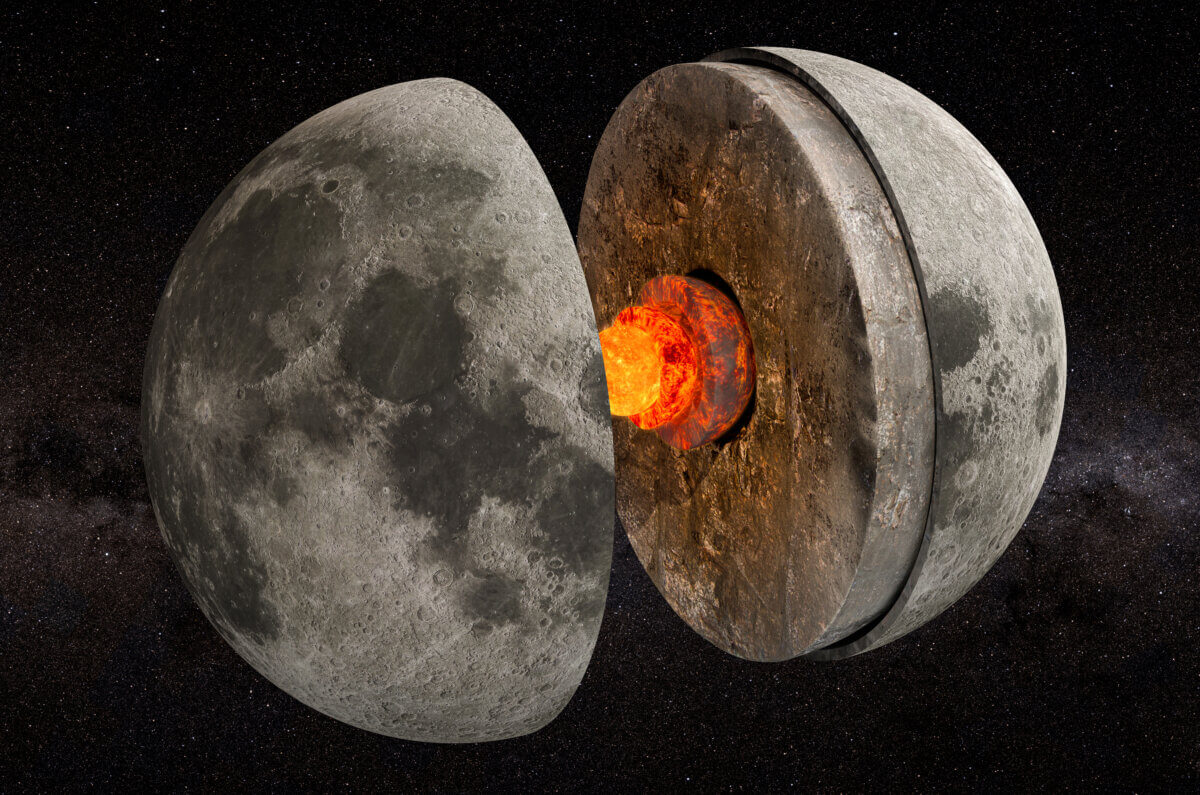
GREENBELT, Md. — The Moon may not be made of cheese, but it still may have something surprising hiding at its core. In a groundbreaking study, scientists have uncovered evidence that the Moon might have a soft, gooey layer deep within its interior. This unexpected discovery challenges our understanding of Earth’s celestial companion and could have far-reaching implications for lunar science.
The research, published in the journal AGU Advances, presents the first-ever measurements of the Moon’s yearly tidal response. Just as the Moon causes tides on Earth, the Earth and Sun exert tidal forces on the Moon, causing it to deform slightly. By analyzing these deformations, scientists can peek into the Moon’s inner structure.
The study’s lead author, Sander Goossens, and his team used data from two NASA spacecraft: the Gravity Recovery and Interior Laboratory (GRAIL) mission and the Lunar Reconnaissance Orbiter (LRO). By combining GRAIL’s short-term, high-precision measurements with LRO’s long-term observations, the researchers were able to detect subtle changes in the Moon’s gravity field at both monthly and yearly intervals.
What they found was completely unexpected. The Moon’s response to these tidal forces suggests the presence of a low-viscosity zone (LVZ) at the base of its mantle. Simply put, there might be a layer of partially molten rock deep within the Moon, just above its core.
This revelation compares to discovering that a hard-boiled egg has a runny yolk. It challenges the common perception of the Moon as a cold, solid body and suggests that its interior is more complex and dynamic than previously thought.
To understand the significance of this discovery, imagine squeezing a stress ball. A solid ball would quickly return to its original shape, while a ball with a gooey center would take longer to bounce back. Similarly, the Moon’s response to tidal forces provides clues about its internal structure.
The presence of this soft layer could have profound implications for our understanding of the Moon’s thermal history and evolution. It suggests that there must be a heat source maintaining this partially molten layer, which raises new questions about the Moon’s mysterious internal structure.
Moreover, the researchers also drew an intriguing parallel between the Moon and Mars. Recent seismic data from the Red Planet also hinted at the presence of partially molten material in its interior. This similarity could provide new insights into the formation and evolution of rocky bodies in our solar system.
The study’s findings could also impact future missions to the Moon. Understanding the Moon’s internal structure is crucial for planning human expeditions, especially if humanity aims to build a long-term colony on the Moon’s surface.
Paper Summary
Methodology
The researchers used radio tracking data from two NASA spacecraft: GRAIL and LRO. GRAIL provided precise gravity measurements over short periods, while LRO offered long-term observations. By analyzing how the Moon’s gravity field changed over time due to tidal forces from Earth and the Sun, the team could infer details about the Moon’s internal structure. They used complex mathematical models to interpret these gravity variations and relate them to the Moon’s internal properties.
Key Results
The study produced the first measurements of the Moon’s tidal response at yearly intervals, complementing existing monthly measurements. These results showed that the Moon’s response to tidal forces is frequency-dependent, meaning it responds differently to monthly and yearly cycles. This behavior is best explained by the presence of a low-viscosity zone deep within the Moon, likely composed of partially molten material.
Study Limitations
While the study provides compelling evidence for a low-viscosity zone, there are limitations. The yearly measurements have larger uncertainties compared to the monthly ones due to the longer observation period required. Additionally, the study relies on indirect measurements and mathematical models, which always involve some degree of uncertainty and simplification of complex natural processes.
Discussion & Takeaways
The presence of a low-viscosity zone in the Moon has significant implications for our understanding of lunar evolution and current state. It suggests that the Moon’s interior is still warm enough to maintain partial melting, which requires a heat source. This challenges previous models of lunar thermal evolution. The findings also draw parallels between the Moon and Mars, potentially offering insights into the internal structures of rocky bodies in general. The study underscores the importance of long-term, high-precision measurements in planetary science and demonstrates how combining data from different missions can yield new insights.
Funding & Disclosures
The research was funded by NASA’s Planetary Science Division’s Lunar Data Analysis Program. The authors declared no conflicts of interest relevant to this study.


