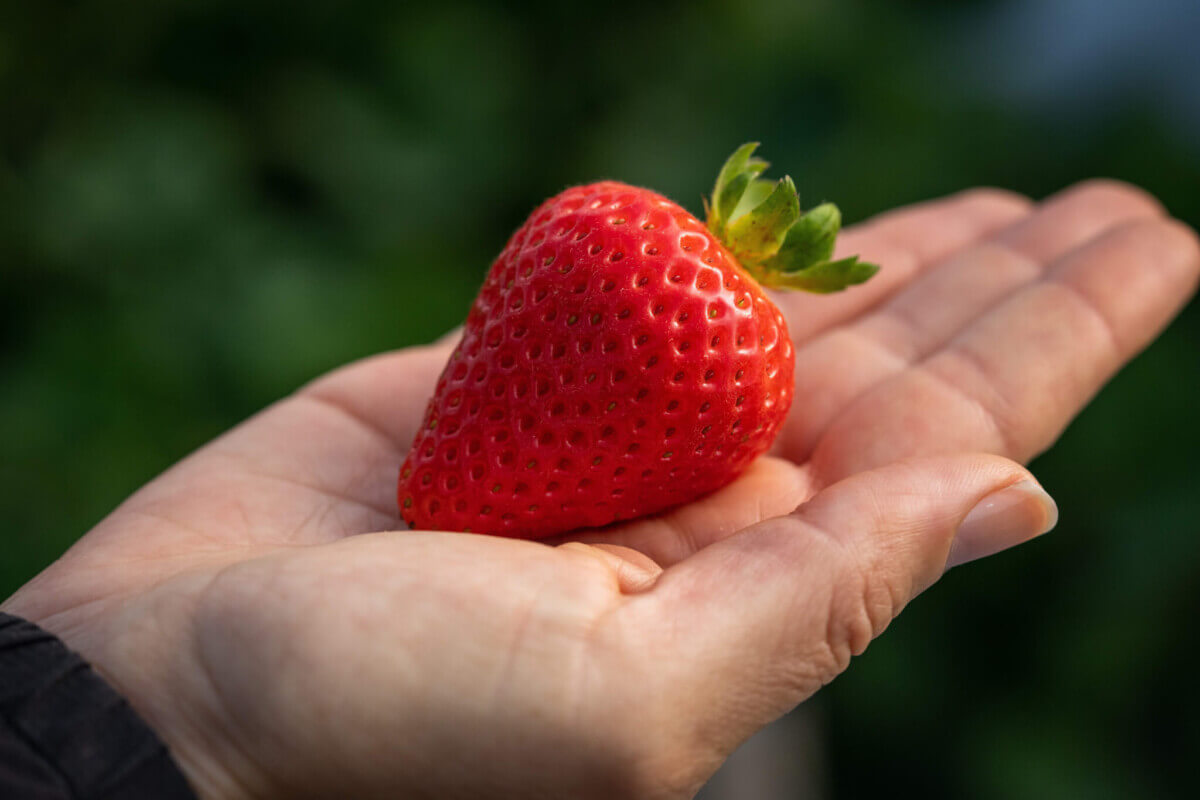
UC Eclipse strawberry is one of the new varieties resistant to Fusarium Wilt. (Credit: Jael Mackendorf / UC Davis)
WATERLOO, Ontario — California’s strawberry fields, once a symbol of agricultural abundance, may soon face a bitter harvest. A new study published in the journal Sustainability reveals that rising temperatures could spell trouble for the state’s strawberry crops, potentially leading to significant yield losses in the coming years and higher prices for consumers.
The research, conducted by scientists from the University of Waterloo in Canada, focused on strawberry production in Santa Maria, California — a region responsible for a substantial portion of the state’s $3 billion strawberry industry. Their findings paint a concerning picture of how climate change, particularly temperature anomalies, could impact this lucrative crop.
“This research shows how climate change can directly impact the foods we love, emphasizing the importance of sustainable farming practices to maintain a stable food supply for everyone,” says lead author Dr. Poornima Unnikrishnan, a postdoctoral fellow in the Department of Systems Design Engineering at Waterloo, in a statement.
Temperature anomalies, simply put, are deviations from the average temperature in a given area. As our planet continues to warm due to climate change, these anomalies are becoming more frequent and intense. For strawberry farmers, this spells trouble.
The study found that as temperature anomalies increase, so does the probability of strawberry yield loss. This means that unusually warm weather could lead to fewer strawberries being produced, potentially affecting both farmers’ livelihoods and consumers’ access to this popular fruit.
What makes this research particularly noteworthy is its focus on extreme yields — both the highest and lowest levels of production. These extremes are crucial for understanding the full impact of climate change on agriculture, as they represent the best and worst-case scenarios for farmers.
Using advanced statistical techniques, the researchers quantified the relationship between temperature anomalies and strawberry yields. Their results suggest that when temperatures rise just a few degrees above normal, the chance of significant yield loss increases dramatically.
In fact, the study found that a rise in temperature of just three degrees Fahrenheit could reduce strawberry yields by up to 40%. This staggering figure underscores the vulnerability of our food systems to even small changes in climate.

These findings have implications far beyond just strawberries. They highlight the vulnerability of our food systems to climate change and the need for adaptive strategies in agriculture. As temperatures continue to rise globally, other crops could face similar challenges, potentially threatening food security on a broader scale.
The study also underscores the importance of considering climate variability in agricultural planning and crop management. Farmers may need to adjust their growing practices, consider new strawberry varieties more resistant to heat stress, or even explore alternative crops better suited to warmer conditions.
The researchers suggest several sustainable farming practices that could help mitigate the impact of rising temperatures. These include optimizing irrigation to ensure adequate water supply during heatwaves, using drip irrigation, scheduling operations to avoid peak periods of hot weather, and using shading plants or installing shade structures to reduce heat stress on the crops.
For consumers, this research serves as a reminder of the complex relationship between climate and the food on our plates. Those juicy strawberries we enjoy in our smoothies or atop our desserts are the result of a delicate balance between plant biology and environmental conditions — a balance that climate change threatens to disrupt.
The impact could be felt far beyond California’s borders. Canada, for instance, is a major importer of strawberries from California, with imports worth $322.8 million in 2022 alone. As yields decrease and prices potentially rise, consumers in many countries could find themselves paying more for their favorite berries.
“We hope the better understanding of the influence of rising temperatures on crop yield will help in the development of sustainable agriculture responses from the government and farmers,” says Dr. Kumaraswamy Ponnambalam, another researcher involved in the study. “There is an urgent need for farmers to adopt new strategies to cope with global warming.”
Paper Summary
Methodology
The researchers used a sophisticated statistical approach called multivariate copula analysis to study the relationship between temperature anomalies and strawberry yields. They collected daily strawberry yield data and temperature data for Santa Maria, California from 2011 to 2019. The team then calculated temperature anomalies by comparing observed temperatures to historical averages. They standardized the yield data and categorized yield losses into low, moderate, and high levels.
The copula analysis allowed them to model the complex dependencies between temperature anomalies and strawberry yields, providing a more accurate picture of how extreme temperatures affect crop production.
Key Results
The study found a strong relationship between temperature anomalies and strawberry yields. As temperature anomalies increased, so did the probability of yield loss. For temperature anomalies between 1°F and 2°F above normal, the probability of any yield loss was 58.4%. This increased to 56% for anomalies between 2°F and 3°F, and jumped to 80% for anomalies above 3°F.
More strikingly, the probability of high yield loss (defined as yields more than 1.5 standard deviations below average) was 0.06% for anomalies between 1°F and 2°F, 0.05% for anomalies between 2°F and 3°F, but skyrocketed to 63% for anomalies above 3°F.
Study Limitations
First, it focused solely on temperature anomalies and did not account for other climate factors like precipitation or soil moisture, which could also impact strawberry yields. Second, the study period (2011-2019) is relatively short in climate terms, which may limit its ability to capture long-term trends.
Third, the research was specific to Santa Maria, California, and its findings may not be directly applicable to other strawberry-growing regions with different climates or agricultural practices. Finally, the study did not consider potential adaptations or technological improvements in strawberry cultivation that might mitigate the effects of temperature anomalies.
Discussion & Takeaways
This study highlights the vulnerability of strawberry crops to climate change, particularly to temperature anomalies. It emphasizes the need for farmers and policymakers to consider climate variability in agricultural planning and decision-making.
The research also underscores the importance of developing climate-resilient crop varieties and adaptive farming practices. Moreover, it demonstrates the value of using advanced statistical techniques like copula analysis in agricultural research, providing a more nuanced understanding of climate-crop relationships.
The findings have implications beyond strawberries, suggesting that other crops may face similar challenges as the climate continues to warm. This research contributes to our understanding of how climate change may impact food security and agricultural economies in the future.
Funding & Disclosures
The study was partially funded by NSERC (Natural Sciences and Engineering Research Council of Canada) and Loblaws NSERC-CRD (Collaborative Research and Development). The authors declared no conflicts of interest.


