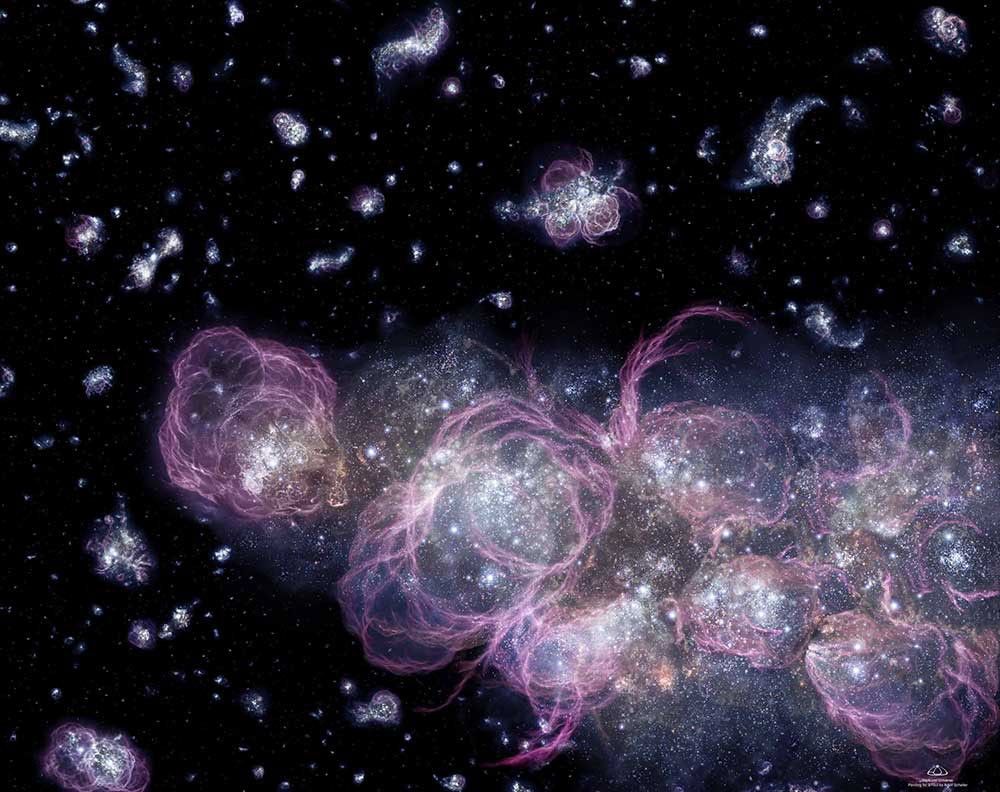
Artist’s conception of early star formation. The first stars may have formed as early as 100 million years after the big bang, when dense clouds of hydrogen and helium collapsed under their own gravitational pull. Once the pressure and temperature were high enough, hydrogen atoms began to fuse together, releasing energy in the form of light. Credit: NASA, STScI/A. Schaller
A New Clue to the Universe’s Strangest Galaxies Comes From Its Rarest Stars
In A Nutshell
- A Hubble survey called TEMPOS studied 29 massive stars in six extremely metal-poor dwarf galaxies, the largest, most carefully matched dataset of its kind.
- Stars with less than about one-tenth of the sun’s heavy-element content showed winds far weaker than a smooth trend would predict, a finding researchers call tentative.
- Iron absorption in these stars varies more than expected across galaxies, complicating the common shortcut of using oxygen to estimate metallicity.
- More than a quarter of the surveyed stars are moving strangely for their galaxy, a possible sign of a violent past involving a supernova or close stellar encounter.
Since launching in 2021, the James Webb Space Telescope has turned up early galaxies that behave nothing like the ones nearby, and astronomers have struggled to explain why. A University of Utah-led survey using the Hubble Space Telescope now points to an answer hiding in the stars themselves.
“Webb opened up a whole bunch of new questions about the evolution of these early galaxies, they’re weird,” said Grace Telford, assistant professor of physics and astronomy at the University of Utah and lead author of the study, published in The Astrophysical Journal Supplement Series. “That’s the scientific motivation behind the TEMPOS program: to help understand what is going on in these early galaxies.”
Massive stars, those weighing more than ten times as much as the sun, are rare but powerful engines of galactic change. “They burn very hot, bright and fast and they end their short lives as supernova explosions that deposit a lot of energy and material into the surrounding gas,” Telford said. “They govern the evolution of their host galaxies by heating and essentially regulating the gas that’s then available to cool and form into new stars.” A galaxy’s metallicity, astronomers’ term for its supply of elements heavier than hydrogen and helium, shapes how those stars behave, and the earliest galaxies carried far less of it than the Milky Way does today.
Those same massive stars are also the main source of radiation strong enough to strip electrons off hydrogen atoms, a process central to reionization, the era when the universe’s fog of neutral gas first became transparent to light.
Each Faint Target Demanded Dozens of Hours of Hubble Time
Because astronomers cannot study those first galaxies directly, TEMPOS, short for the Treasury of Extremely Metal-Poor O Stars, turned to six nearby dwarf galaxies with similarly sparse chemistry, all below one-fifth of the sun’s metallicity. Using Hubble’s Cosmic Origins Spectrograph, the team studied 29 massive O-type stars there, combining 12 newly observed targets with archived data into the largest, most carefully matched dataset of its kind.
“It’s a sample of 29 stars, which doesn’t sound like a lot, but when each one costs up to 35 hours of Hubble time to observe, it gets really expensive,” Telford said.
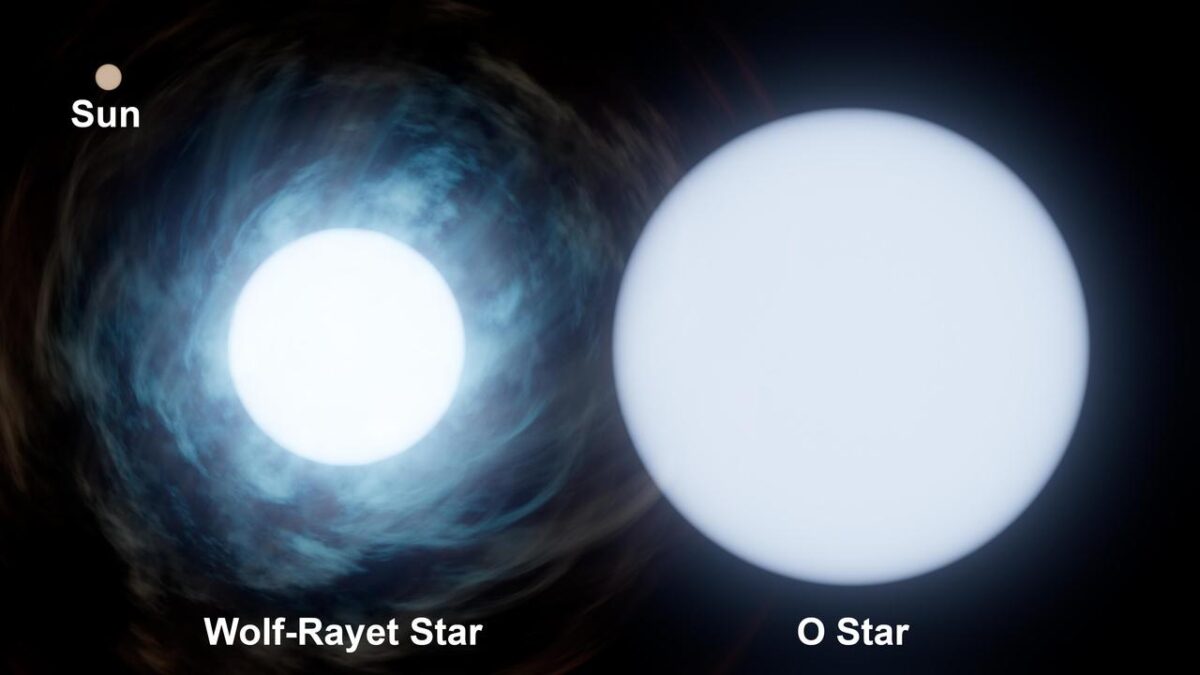
O-type stars are some of the biggest and brightest stars in the universe and live relatively short lives. Wolf-Rayet stars are O-type stars near the end of their life that release huge amounts of mass into space via stellar winds, exposing their hot, inner layers. Credit: NASA/JPL-Caltech
Fewer Heavy Elements Bring Surprisingly Weak Stellar Winds
Metal ions in a star’s atmosphere help couple its radiation to the gas around it, so astronomers have long expected lower-metallicity stars to drive weaker winds. TEMPOS confirmed that trend across a broad range of metallicities, but below roughly one-tenth of the sun’s metal content, the data hint at winds weaker than that trend would predict.
“There’s sort of a smooth trend and then suddenly for lowest-metallicity stars, the wind speed really drops off,” Telford said. “I was so excited to find that fun surprise in the data.” Because weaker winds mean a star sheds less mass over its lifetime, the finding raises the possibility that the most metal-poor stars retain more of their original bulk, altering how they evolve, die, and shape the gas around them.
Iron Chemistry Turned Out More Varied Than Expected
Iron plays an outsized role in launching stellar winds and steering how massive stars live and die, but it is notoriously hard to measure directly in metal-poor stars. Astronomers often use a galaxy’s oxygen content as a stand-in for its overall metallicity, even though iron and oxygen are not guaranteed to track each other exactly. TEMPOS measured the strength of faint iron absorption features in each star’s ultraviolet spectrum and found noticeably stronger absorption in more oxygen-rich galaxies than in oxygen-poor ones, suggesting a wider spread in iron content across the sample than expected.
A Bigger Sample Finally Revealed the Trend
Telford had previously modeled three of these stars in detail without spotting the pattern. “With only three, you don’t see these trends,” she said in a university release. “We’ve always just been stuck in this low number statistics regime, so this is our very best attempt to build a big enough sample to do something more useful.”
That work continues. Researchers are now pairing the Hubble ultraviolet spectra with visible-light data from the Keck Observatory. The goal is to pin down each star’s exact temperature, mass, and chemical makeup, information that could help astronomers interpret what Webb is finding in the early universe.
TEMPOS turned up one more surprise along the way. More than a quarter of the 29 stars are moving unusually fast or slow relative to their home galaxy’s rotation, a pattern often traced to a companion star’s supernova or a rough gravitational shove earlier in life. The team says confirming what drove each star’s odd speed will take closer follow-up.
As for the winds, whether that steep drop in strength reflects a genuine threshold or the limits of a still-modest sample is a question that future TEMPOS releases will need to settle. For now, the survey offers the biggest, best-matched look yet at how the universe’s most metal-starved stars behave. That feeds directly into the models astronomers use to interpret Webb’s view of galaxies at the dawn of time, and it offers a fresh clue to why those earliest galaxies look so strange.
Paper Notes
Limitations
Researchers describe their conclusions about weakening winds below roughly 10 percent solar metallicity as tentative, based on a still-limited number of stars in the most extreme galaxies. Spectral classifications for many targets are drawn from older ground-based studies and are expected to be updated using new optical spectroscopy planned for future TEMPOS releases. Iron and oxygen abundance measurements for individual O stars in most of the host galaxies have not yet been directly determined through detailed atmosphere modeling, so the paper’s grouping of galaxies into “metal-poor” and “extremely metal-poor” categories relies on abundances measured from other, more evolved massive stars in those galaxies. The authors also note that some targets may have unresolved companion stars that were not accounted for in this initial analysis, and that wavelength calibration issues were identified in the lower-resolution G140L grating data, which affected radial velocity measurements for some targets.
Funding and Disclosures
This work is based on observations from the NASA/ESA Hubble Space Telescope, operated by the Space Telescope Science Institute under NASA contract NAS5-26555. Support was provided by NASA through grant numbers GO-16767, GO-16920, and GO-17491 from the Space Telescope Science Institute. One author acknowledges support from a Carnegie-Princeton Fellowship through Princeton University and the Carnegie Observatories. Another author’s work was supported by the Deutsche Forschungsgemeinschaft (German Research Foundation) through an Emmy Noether Research Group. Part of the work was performed at the Aspen Center for Physics, supported by National Science Foundation grant PHY-2210452.
Publication Details
Title: “The Treasury of Extremely Metal-poor O Stars” Authors: O. Grace Telford, Christiana Erba, Kristen B. W. McQuinn, Calum Hawcroft, Andreas A. C. Sander, Julia Roman-Duval, John Chisholm, Danielle A. Berg, Varsha Ramachandran, Yong Zheng, Claus Leitherer, Abby Mintz, and Evan N. Kirby Journal: The Astrophysical Journal Supplement Series, Volume 286, Article 50 (2026) DOI: 10.3847/1538-4365/ae95f6


