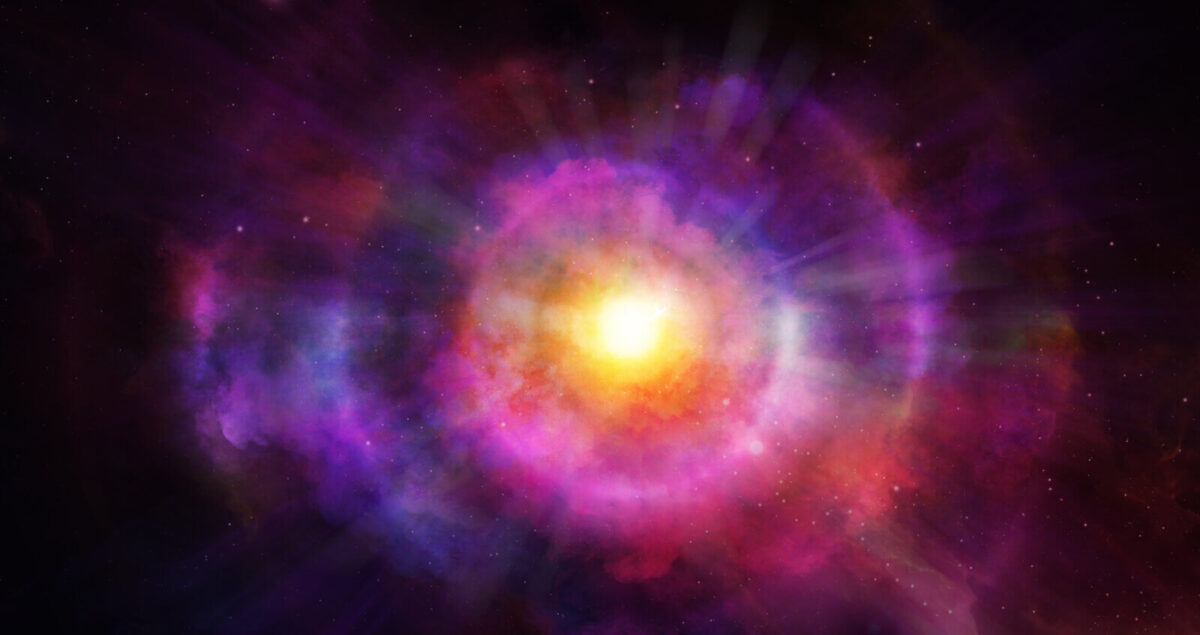
Artist's impression of a supernova explosion. (© Corona Borealis - stock.adobe.com)
In A Nutshell
- A scholar’s hypothesis links supernova explosions to Earth’s climate shifts between 3 and 2.6 million years ago.
- Cosmic rays from a nearby supernova may have triggered global cooling by altering the ozone layer and cloud cover.
- This cooling could have reshaped ecosystems, influencing the evolution of Australopithecus and the rise of Homo.
What’s the link between an exploding star, climate change and human evolution? Francis Thackeray, who has researched ancient environments and fossils for many years, sets out his ideas about what happened in the distant past – with enormous consequences.
Global cooling that happened millions of years ago was thought to be the result of ocean currents. He suggests instead it could have been due to the impacts of remnants of supernovae. The timing of supernovae, climate changes and species evolution coincides.
What Is Your Supernova Hypothesis?
My hypothesis is that remnants of a supernova – an exploding star – had an impact on the Earth’s past climate, causing global cooling, between 3 million and 2.6 million years ago and that this indirectly affected the evolution of hominins (ancient relatives of humans).
How Does This Change Assumptions Held Until Now?
It has been considered by some that global cooling in the Plio-Pleistocene might have been due to changes in ocean currents. This may well be correct to some extent, but I think that the supernova hypothesis needs to be explored.
It’s super-exciting to think that our evolution may to some extent be associated with supernovae as part of our dynamic universe.
How Did You Come To Your Supernova Hypothesis?
Supernovae include stars which are extremely massive (as much as five times the mass of our Sun) and have reached the end of their stellar evolution. These explosions are rare. On average, within our galaxy (the Milky Way), only one or two per century are visible from Earth as temporary bright stars.
As a result of such explosions, material is expelled into outer space at almost the speed of light. Chemical elements are formed, including a kind of iron (the element Fe) known as isotope Fe-60. It has 26 protons and as many as 34 neutrons.
Traces of Fe-60 iron isotopes from supernovae within the last ten million years have been discovered on Earth in marine deposits such as those drilled in cores in the east Indian Ocean.

The deep-sea deposits with Fe-60 can be dated using radioactive elements which decay at a known rate. This is called radiometric dating.
There was a regular increase in extremely small traces of Fe-60 for the period between 3 million and 2.6 million years ago. We know this from data published by Anton Wallner and his colleagues. Since this is a linear trend I have been able to extrapolate back to 3.3 million years when initial cosmic rays may have first hit Earth. I have proposed in the Quest magazine that this initial cosmic impact correlates with a major glaciation (cooling) event called M2 in an otherwise warm period.
A “near-earth” supernova could have produced cosmic rays (radiation from outer space), which might have caused a reduction in the Earth’s ozone layer. Increased cloud cover associated with cosmic radiation could have been a factor related to changes in global climate. Specifically, the change would have been global cooling.
This cooling would have affected the distribution and abundance of plant species, in turn affecting that of animals dependent on such vegetation.
What Potential New Insights Does The Hypothesis Give Us Into Human Evolution?
Populations of Australopithecus may have been indirectly affected by the decrease in temperature.
Australopithecus is the genus name for distant human relatives which lived in Africa in geological periods called the Pliocene and Pleistocene. The boundary between these time intervals is 2.58 million years ago. At that time, certain species went extinct. The period coincides closely with the maximum of Fe-60 in marine deposits and a change in Earth’s magnetic field.

The first fossil of Australopithecus to be described, 100 years ago, was placed by the paleontologist Raymond Dart in a species called A. africanus. Dubbed the “Taung Child”, it was discovered in South Africa. Its biochronological age, recently based on mathematical analyses of tooth dimensions, is about 2.6 million years – at the Plio-Pleistocene boundary.
It cannot be concluded that the death of the Taung Child was directly caused by a supernova. This would be far-fetched. There is in fact evidence that this individual, about 3 years old, was killed by an eagle.
However, it is plausible to suggest that in Africa, in the Plio-Pleistocene, populations of Australopithecus were affected by a decrease in temperature, affecting the distribution and abundance of vegetation and the animals dependent on it.
Recently, a new species of Australopithecus (as yet not named, from Ledi-Geraru) has been discovered in Ethiopia, in deposits dated at about 2.6 million years ago – also the time of the maximum in Fe-60 in deep-sea deposits.
The appearance of the genus Homo is close to the Plio-Pleistocene boundary, reflected by fossils reported recently by Brian Villmoare and his colleagues and well dated at about 2.8 million years ago. The origin of Homo may relate to changes in temperature and associated changes in habitat, as recognized five decades ago by South African palaeontologists Elisabeth Vrba and Bob Brain, although they emphasized a date of 2.5 million years ago.
Is It Possible That Cosmic Radiation Stimulated Genetic Changes?
I have been told by my peers that I am inclined to think “out of the box.” Well, in this case I would like to propose a “hominoid mutation hypothesis.” The hypothesis states that the speciation of hominoids (including human ancestors and those of chimpanzees and gorillas) was to some extent associated with mutations and genetic variability caused by cosmic rays.
It is interesting to consider the possibility that the origin of our genus Homo relates in part to cosmic radiation. Going deeper back in time, Henrik Svensmark has demonstrated that there is a correlation between supernova frequency and speciation (increased biodiversity associated with the evolution of new species), for the last 500 million years (the Phanerozoic period). I think it’s entirely possible that one important cause behind this correlation was the mutagenic (mutation-causing) effect of cosmic rays on DNA, such that rates of speciation exceeded those of extinction.
In hominoids, cosmic rays could have contributed not only to global cooling but also to genetic changes, with subsequent anatomical (morphological) changes related to speciation.
If we go back to about 7 million years ago (when Fe-60 again reflects supernova activity), we would expect to find fossils that are close to a common ancestor for chimpanzees and humans. In terms of the hominoid mutation hypothesis, the split could have been associated with cosmic radiation. One hominoid species about 7 million years old is Sahelanthropus (discovered by Michel Brunet in Chad). In my opinion this species is very close to the common ancestor for Homo sapiens (us) and chimps.
Francis Thackeray, Honorary Research Associate, Evolutionary Studies Institute, University of the Witwatersrand. He has received funding from the National Research Foundation.
This article is republished from The Conversation under a Creative Commons license. Read the original article.


