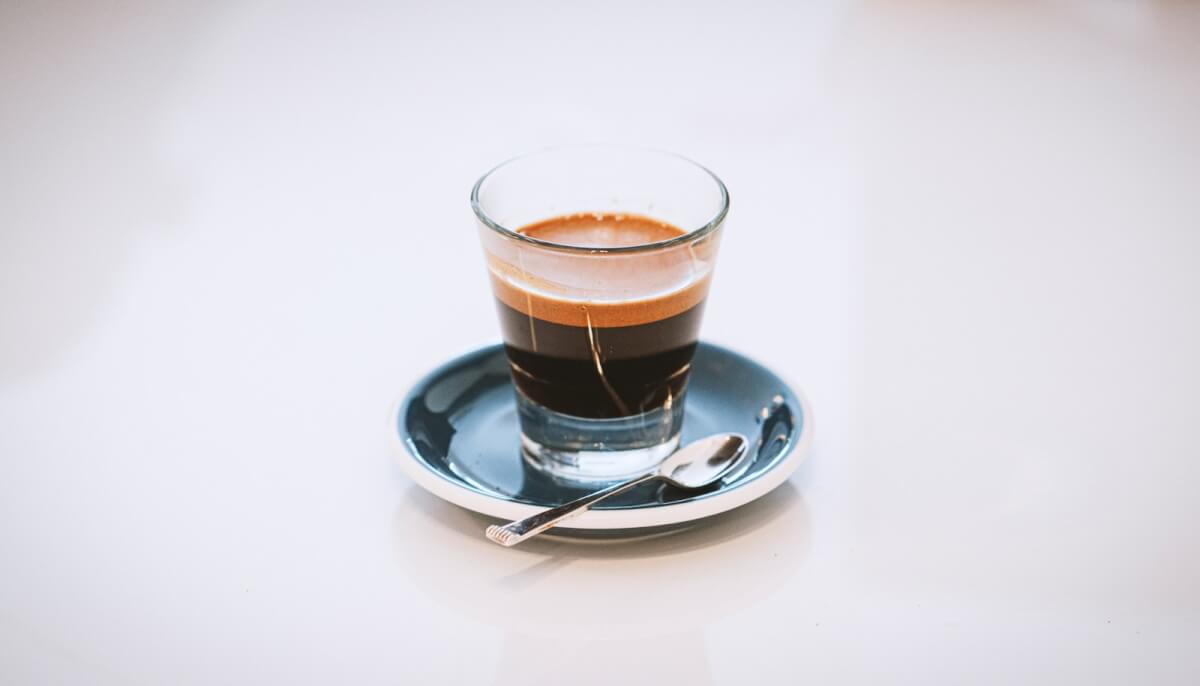
Espresso (Photo by Adi Goldstein on Unsplash)
In A Nutshell
- A sound wave-based brewing system produced espresso-strength coffee from room-temperature water, with no heating element, in just 2 to 3 minutes.
- In taste tests with 100 coffee drinkers, the ultrasound-brewed espresso was rated no differently than traditionally made espresso across aroma, flavor, bitterness, and overall liking.
- The ultrasonic system used only about 24 percent of the energy of a conventional espresso machine at matched beverage strength, a cut of roughly 75 percent.
- Testing was done in a lab with espresso served cold, not hot, so the everyday café experience remains an open question.
Coffee’s future might skip the part where water gets heated to near-boiling, forced through tightly packed grounds under crushing pressure, or held hot in a machine that hums away between cups. A new study shows that focused sound waves can pull a full-strength espresso in just 2 to 3 minutes using room-temperature water and no heating element, and the people who tasted it could not tell it apart from the real thing.
For most coffee lovers, espresso is the gold standard: thick, concentrated, rich with aroma, and built on more than a century of pressure-based brewing. Traditional machines rely on very hot water, around 94 degrees Celsius, forced through finely ground, tightly packed coffee at roughly nine times normal atmospheric pressure. It is a fast process when everything is in place, but also energy-hungry, since machines must keep large volumes of water heated even when no one needs java. Researchers at the University of New South Wales in Sydney, Australia, wanted to know whether high-intensity sound waves could do the same job without the heat or the pressure.
Their answer, published in the Journal of Food Engineering, is yes. A sound-driven system used only about 24 percent of the energy a conventional espresso machine consumed to make a drink of the same strength, a cut of roughly 75 percent.
Sound Waves and Heat-Free Espresso
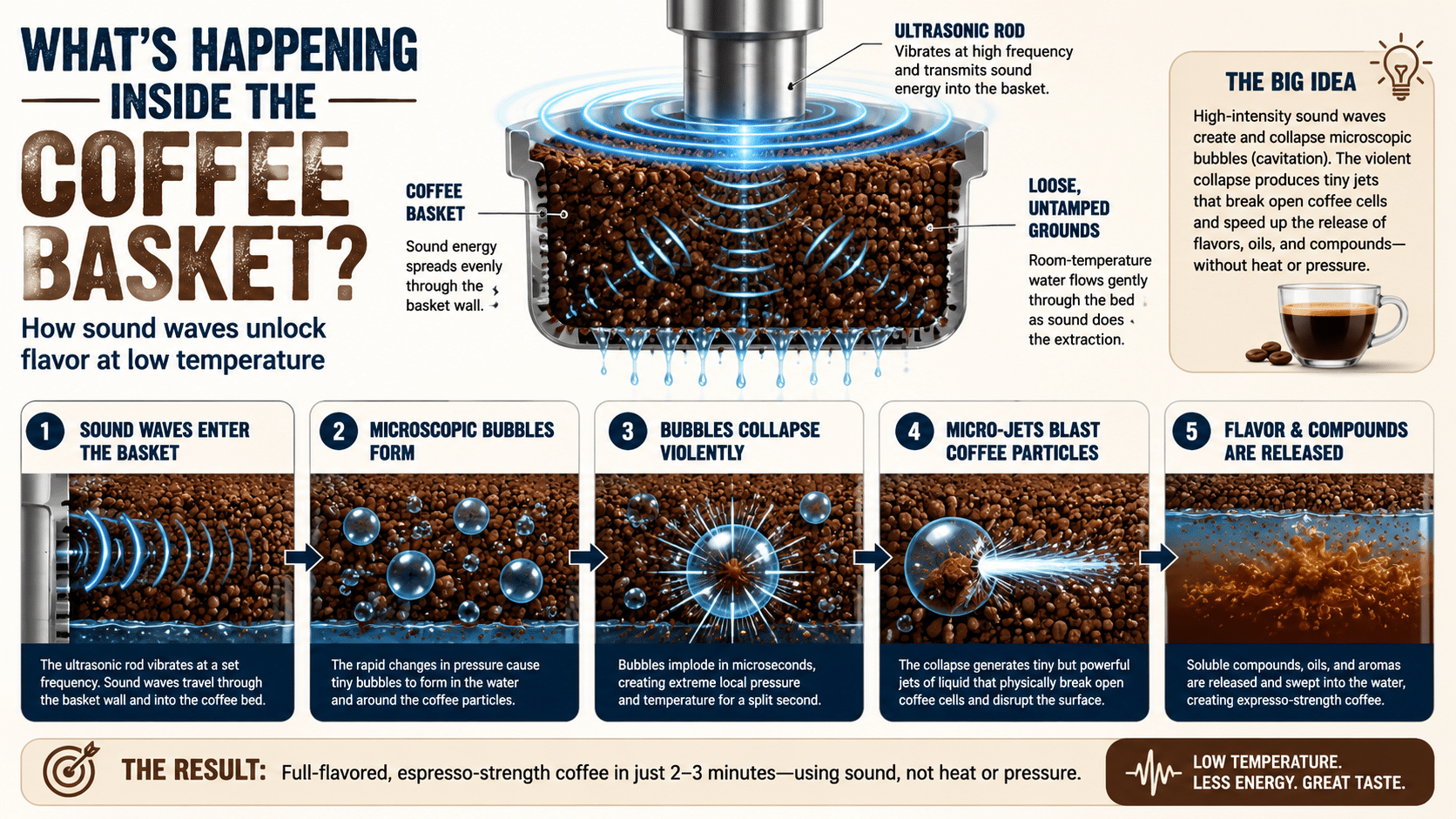
Sound, at high enough intensity, does something strange to liquids: it creates and collapses microscopic bubbles at incredible speed. That collapse fires tiny but powerful jets of liquid that physically break open surfaces and speed up the movement of dissolved substances, in this case the flavors, oils, and compounds locked inside coffee grounds.
Researchers built their system into the body of a commercial espresso machine, swapping out the heating and pressure parts for an ultrasonic device. At its core sits a precision-tuned metal rod that vibrates at a set frequency and presses against the outside of the coffee basket. Instead of heating water and forcing it through compressed grounds, the system pumps room-temperature water through loosely packed, untamped coffee while sound energy does the extraction. Sound input does warm the brew modestly along the way, to about 40 degrees Celsius by the end, still far below the near-boiling water a traditional machine uses.
A big part of the work involved reshaping that vibrating rod so it matched the natural vibration pattern of the coffee basket itself. When rod and basket vibrate in sync, sound energy spreads evenly through the grounds from several points around the basket wall, creating multiple active extraction zones at once. That tuning made the system more stable and more effective than an earlier version of the device.
Inside the Numbers on Sound-Wave Espresso
To gauge how well the brewing worked, the researchers tracked two measures coffee professionals use. One is total dissolved solids, basically how concentrated the brew is. Another is extraction yield, the percentage of the grounds’ soluble material that ends up in the cup. For a balanced, well-developed flavor, the Speciality Coffee Association defines an ideal extraction yield of 18 to 22 percent.
Run at full power for 3 minutes with the finest grind tested, the ultrasonic system pushed extraction yield to the lower edge of that ideal range. Switch the sound off, keep everything else identical, and extraction fell short of that mark even when the brew time was stretched. Under the conditions tested, brewing without ultrasound did not reach espresso-strength results at low temperature.
Grind size, brew time, and power level all moved the results. Finer grounds produced higher concentrations, and more power produced more extraction. With a standard basket, three minutes of ultrasound at the finest workable grind produced a concentration around 9 percent, within espresso range. Switching to a shorter basket that allowed an even finer grind pushed that figure close to 10 percent.
Taste Test: Could Coffee Drinkers Spot the Sound-Wave Espresso?
Getting the chemistry right is one thing. Getting coffee drinkers to enjoy the result is another. This study enrolled 100 regular coffee drinkers, people who reported drinking coffee at least once a week, including 58 men and 42 women between the ages of 18 and 60. Each rated four drinks on a 9-point scale across four traits: aroma, flavor, bitterness, and overall liking.
Both espresso samples, one made the traditional way and one made with ultrasound, were served at room temperature to keep the comparison fair. Serving one hot and one cold would have stacked the deck, since temperature alone strongly shapes how a drink tastes and smells. Researchers acknowledged that this differs from how espresso is normally consumed and said the results should be read with that in mind.
On every trait measured, no meaningful difference showed up between the ultrasound espresso and the conventional one, and tasters leaned toward neither. With filter coffee, the ultrasound-brewed version was actually preferred over the traditional pour-over.
Chemistry backed up the tasters. Measurements of caffeine and chlorogenic acid, a natural compound that adds to coffee’s flavor and is sometimes tied to bitterness, came back with no meaningful difference between the two methods. Color and acidity landed in the same place statistically, and a separate look at each brew’s aromatic compounds found no overall difference in scent.
Energy Savings Behind Sound-Wave Brewing
Arguably the most attention-grabbing result here has nothing to do with flavor. It is about electricity. Espresso machines keep large boilers of hot water ready, often for long stretches, drawing real power even when no coffee is being made. A system that relies on sound rather than a boiler needs no preheating and sidesteps that drain.
Run side by side for 20 minutes, during which three espressos were prepared, the ultrasonic system used only about 24 percent of the energy the conventional machine needed for a drink of the same strength. A standard power meter was used to measure it.
For one home machine, the gap might seem small. Coffee is poured by the tens of billions of cups a year worldwide, so if savings like these held up in commercial settings, the approach could trim the energy that espresso preparation demands. No global rollout was modeled in the study, so the larger payoff stays hypothetical for now.
All of this remains experimental. What the study describes is a laboratory prototype built into a retrofitted commercial machine. Its coffee basket needed paper filters to stop fine particles, broken loose during the ultrasonic process, from clogging the works, and the researchers noted that those filters may change the oils and suspended solids in the final cup compared with a traditional metal-filtered espresso.
Those taste tests also ran under specific conditions, with espresso served cold rather than at normal drinking temperature, and with a fairly small group. Whether drinkers would respond the same way to the ultrasound espresso served hot, or in a working café, is still unknown.
Even so, the study makes a strong case that a device using sound instead of steam can produce coffee that meets professional extraction standards, passes a blind taste test with everyday drinkers, and draws a fraction of the power. For an industry built on a 19th-century invention, that is a proof of concept worth paying attention to.
Paper Notes
Limitations
Several constraints shape how these results should be read, by the authors’ own account. Their ultrasonic system required paper filters inside the coffee basket to keep fine particles from blocking it during cavitation, which may change the suspended solids and fat content of the final drink compared with a conventional metal-filtered espresso, making a direct head-to-head comparison imperfect. Sensory evaluation served espresso at room temperature rather than the usual hot serving temperature, which the authors say alters flavor and aroma and means the results reflect taste preferences under matched, not standard, serving conditions. That sensory panel, though 100 people strong, was drawn from untrained consumers at a single university campus. Effects of different roast profiles, bean origins, and longer-term repeatability were also not tested exhaustively across every experimental condition.
Funding and Disclosures
Per the paper, the lead author received financial support through a University International Postgraduate Award from UNSW Sydney, with additional support from a top-up scholarship through the Future Food Systems Cooperative Research Centre (Project ID: P3-024) under the Australian Government’s CRC Program. On competing interests, author Francisco Trujillo has a patent (WO 2025/118023 A1) pending, assigned to the University of New South Wales, covering the ultrasonic brewing system evaluated in the study; the remaining authors declared no competing financial interests. Authors also disclosed using ChatGPT to improve the readability and language of the manuscript, after which they reviewed and edited the content and took full responsibility for it.
Publication Details
Paper title: “Ultrasound enables espresso-strength coffee brewing in 2–3 minutes at low temperature with lower energy consumption.” Authors: Nikunj Naliyadhara, Yongkai Zhu, Keyu Yue, Alison Jones, Martin Bucknall, Jayashree Arcot, and Francisco J. Trujillo. Affiliations: School of Chemical Engineering, University of New South Wales, Sydney; School of Life and Environmental Sciences, University of Sydney; and the Bioanalytical Mass Spectrometry Facility, Mark Wainwright Analytical Centre, University of New South Wales. Published in the Journal of Food Engineering, Volume 421 (2027), Article 113193, available online June 1, 2026 (open access under a CC BY license). DOI: 10.1016/j.jfoodeng.2026.113193.


