(© Uryadnikov Sergey - stock.adobe.com)
Nature Didn’t Design the Perfect Stinger. Time and Friction Did.
In A Nutshell
- Scientists may have misattributed the signature rounded tip on stingers, teeth, and thorns to evolution. Physics and daily wear may be the real sculptor.
- Researchers sharpened pencils and vibrated them against each other for hours, finding that tips always rounded into the same smooth, bowl-like curve regardless of starting shape or material hardness.
- Biological evidence backs the theory: copepod jaw structures start sharp and round off with use, and sharks evolved a full tooth-replacement system precisely because their teeth dull over time.
- The finding is a warning for engineers who copy nature’s shapes into designs: a form that looks optimized may simply be inevitable, not superior.
A cactus spine, a shark tooth, a porcupine quill, and an icicle walk into a lab. Zoom in close enough, and the rounded tip of each one follows a remarkably similar mathematical curve. For years, scientists assumed biology had carefully sculpted that shared shape through millions of years of evolutionary fine-tuning. A new study argues the real explanation is far less glamorous and far more universal.
Researchers at the Technical University of Denmark have shown that the rounded tip found on stingers, horns, teeth, and spines across the animal and plant kingdoms may not arise from natural selection at all. Instead, it could be the unavoidable result of everyday bumps, scrapes, and collisions gradually grinding pointed things into the same predictable form.
Published in the Proceedings of the National Academy of Sciences, the study challenges a prominent 2024 paper that credited evolutionary pressure, specifically optimization for puncturing soft tissue, as the reason pointed biological structures land on a single geometric profile. The new work argues that researchers may have been admiring the handiwork of physics, not biology.
How Pencils Helped Explain Stinger Tip Shape
To test whether random physical wear alone could produce nature’s signature tip shape, the researchers devised a surprisingly low-tech experiment. They sharpened ordinary graphite pencils to a cone and placed them on a vibrating porcelain plate shaking at about 15 times per second. The pencils rattled around, bumping into each other at random angles and random times, mimicking the haphazard contact that a thorn or tooth would experience over its lifetime.
Pencils offered a key advantage: uniform material properties and availability in different hardness grades. Some started with a sharp cone-shaped tip; others began with a flat, chopped-off end. Regardless of starting shape or hardness, the tips consistently settled into the same rounded profile, forming a smooth bowl-like curve called a parabola. This is the same curve measured on biological stingers spanning everything from microscopic crustacean jaws to full-sized animal horns.
To confirm the result was not a quirk of pencil lead, the team machined a cone from actual bull horn and subjected it to the same treatment, with stronger vibrations to account for the tougher material. After about eight hours, the bull horn tip had settled into the same rounded profile.

Why Stinger Tips Always Wear to the Same Curve
Behind this result lies an intuitive physical principle. A freshly sharpened point is the part of any structure most likely to collide with something, so it gets hit more often and loses material faster than any other region. As the sharpest features break away, slightly less sharp areas behind them become the most exposed and begin wearing down too. This cascading process naturally drives any pointed shape toward that same smooth parabolic curve.
A mathematical model captured this process by describing how a surface shrinks when material is removed faster in regions with higher curvature. Predictions matched experimental data on two fronts: tip shape over time and total material removed. The model also showed that the rounded tip is a stable shape that holds its form, meaning further wear does not change the curve but simply makes the tip gradually blunter. Shapes that deviate from the curve erode faster, so any pointed object caught at a random moment in its life is overwhelmingly likely to display this profile.
What Shark Teeth and Copepods Reveal About Stinger Tip Shape
Some of the most persuasive evidence came from biology itself. Tiny jaw-like feeding structures on microscopic marine crustaceans called copepods have been photographed both before and after use. In their pristine, unused state, these structures have sharp, spiky tips. After repeated feeding cycles, they display the classic rounded profile. The sharp shape came first. The universal shape came from wear.
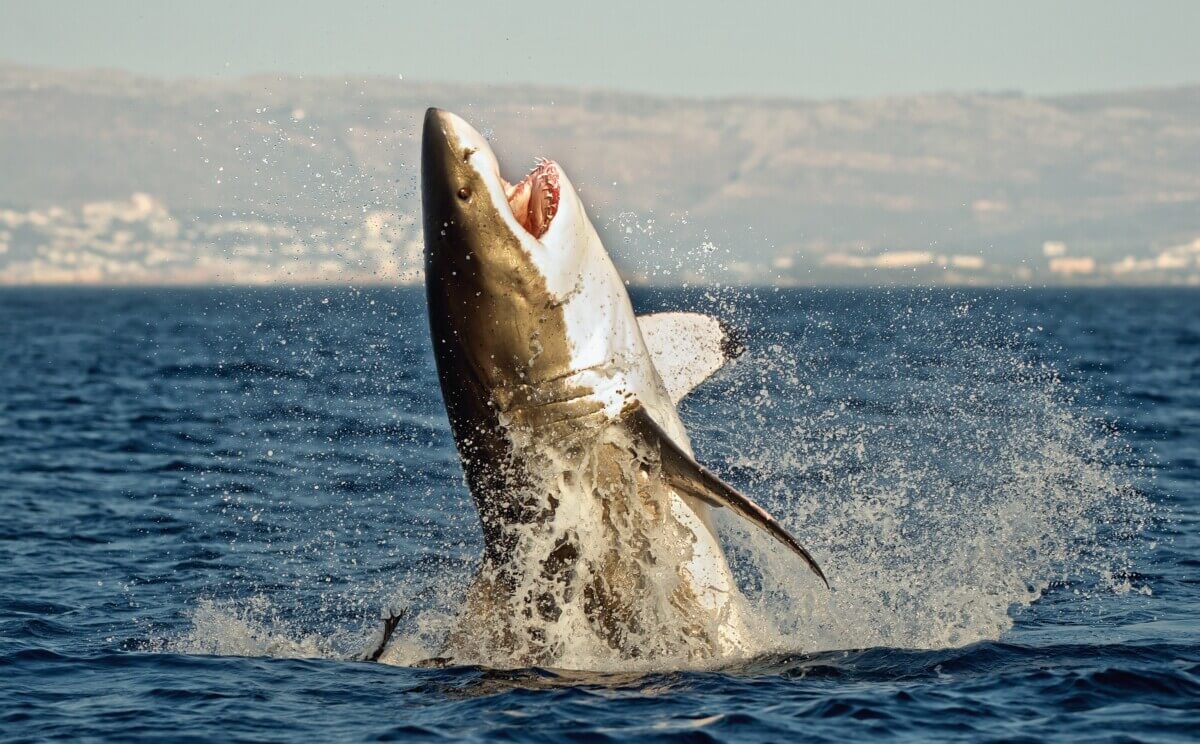
Sharks offer another telling example. These predators cycle through rows of teeth, pushing fresh replacements forward as older ones dull. Pristine shark teeth, protected beneath tissue until deployed, have distinctly sharp profiles. Worn teeth show the rounded curve. The fact that sharks evolved an entire tooth-replacement system suggests that blunting through use is a serious biological reality, not a minor nuisance.
Dissolving cylinders, melting icicles, and eroding rock towers develop a remarkably similar curve despite having no DNA and facing no evolutionary pressure. One mathematical framework unites the tip shapes of living stingers and nonliving geological formations, pointing to a basic consequence of how pointed objects interact with their environments.
As the authors noted, the discovery “offers a cautionary tale in biomimetics,” the field that designs technology inspired by nature’s forms. If a shape exists not because it’s optimal but because it’s inevitable, copying it into an engineering design might not deliver the advantages researchers expect.
Paper Notes
Limitations
The study relied on pencil tips and a machined bull horn cone as stand-ins for biological stingers. While these offered controlled and reproducible conditions, they do not fully replicate the layered material structures found in many natural forms such as teeth and horns. Biological materials with directionally dependent surface properties could wear differently, potentially requiring extensions to the model. The framework applies to low-energy collisions that remove material gradually from the surface and does not account for sudden fracture events or simultaneous chemical processes such as dissolution. Data on the progression of wear over time in living organisms remains scarce, limiting direct biological validation. Organisms with concealed stingers or those interacting primarily with soft surfaces represent cases where the extent of wear-driven shaping remains unknown.
Funding and Disclosures
The authors declared no competing interest. No specific funding sources or grant numbers were identified in the paper.
Publication Details
Title: The geometry of Nature’s stingers is universal due to stochastic mechanical wear | Authors: John Sebastian and Kaare H. Jensen, Department of Physics, Technical University of Denmark, Kongens Lyngby DK-2800, Denmark | Journal: Proceedings of the National Academy of Sciences of the United States of America (PNAS), Volume 123, Number 10 | DOI: 10.1073/pnas.2526098123 | Published: March 6, 2026 | Editor: David L. Hu, Georgia Institute of Technology (guest editor invited by the Editorial Board); accepted by Editorial Board Member John A. Rogers | Data Availability: Data deposited on GitHub at https://github.com/Jensen-Lab/sebastian2026.git | License: Creative Commons Attribution License 4.0 (CC BY)


