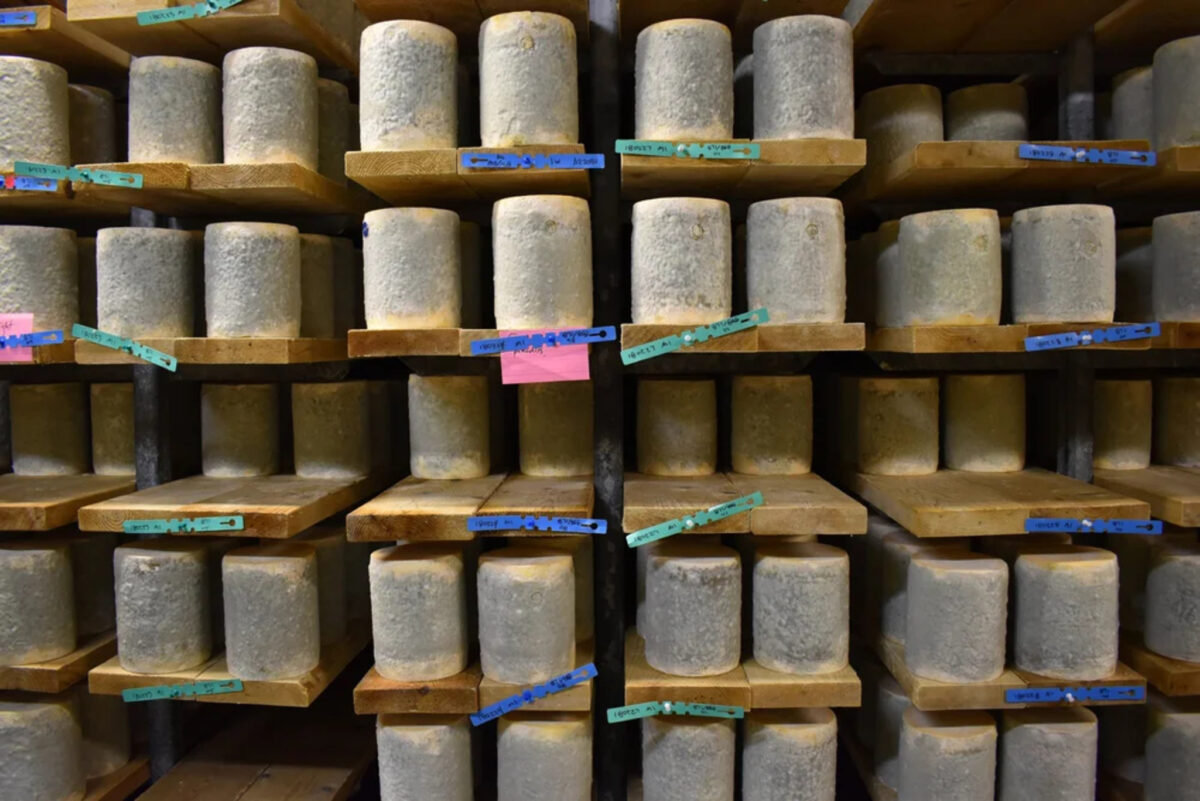
Bayley Hazen Blue Cheese at Jasper Hill Farms in Vermont. (Credit: Jasper Hill Farms)
In A Nutshell
- In a Vermont cheese cave, green Penicillium mold turned white over eight years.
- The change was driven by mutations in the alb1 gene, often caused by transposable elements.
- White strains thrived in darkness and made fewer spores and less pigment.
- The shift didn’t alter bacterial communities, but it highlights unintentional domestication in food production.
BOSTON — In a Vermont cheese cave, researchers stumbled upon one of the clearest cases of evolution in action. Over just eight years, a mold species called Penicillium solitum began changing colors, changing its biology to better fit the cave’s dark conditions. The discovery shows how quickly life can adapt when pressures align.
The transformation happened at Jasper Hill Farm’s cheese aging facility, where the rind of Bayley Hazen Blue, once mint green, turned almost entirely white between 2016 and 2024. What began as a visual oddity turned into a rare chance to watch microbial domestication happen in real time.
A Vermont Cheese Cave Becomes An Evolution Experiment
Between 2012 and 2016, the rind carried a mint-green hue caused by the fungus Penicillium solitum. White colonies were present, but rare. By 2022, the shift was unmistakable: 97 percent of colonies had turned white, and by 2024, the number reached 99.6 percent.
The pace of this change surprised scientists, since most evolutionary shifts unfold over far longer spans. Though the exact timing of the transition is uncertain due to sampling gaps, photographic evidence suggests the mix began changing between 2018 and 2019.
Researchers confirmed that P. solitum remained the dominant species throughout. The change was not due to other microbes taking over, but rather the same fungus evolving into a different form better suited to the cheese cave.
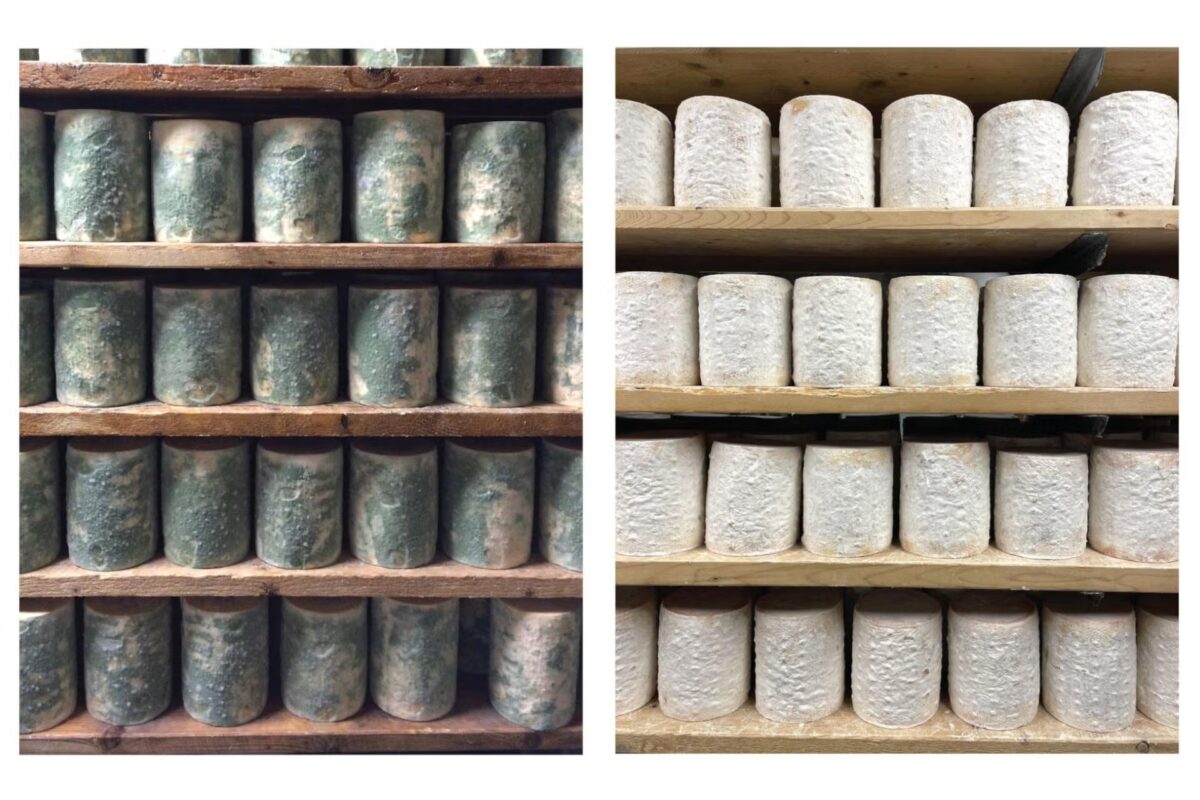
How Penicillium Mold Mutated to Lose Its Green Color
Scientists sequenced 43 strains collected from cheese wheels in 2016, 2022, and 2024. They found that every white strain carried mutations in a single pigment gene called alb1. This gene launches the pathway that produces melanin, the dark pigment that normally gives the mold its green tint. When alb1 was disrupted, colonies lost their green coloring and grew white.
The mutations varied. Some were point mutations, others deletions, and many involved insertions of transposable elements, or “jumping genes” that move around the genome and disrupt function. In fact, about half of the white strains carried the same mobile DNA sequence inserted just upstream of alb1, blocking it from functioning. Laboratory experiments deleting alb1 confirmed that losing this gene alone was enough to make colonies appear white.
Scientists say the shift was not just cosmetic. Compared to their green ancestors, white strains produced fewer spores and significantly less melanin. RNA sequencing revealed that they also expressed their genes differently. While all three tested white strains downregulated many genes overall, each did so in a unique pattern. Some altered amino acid metabolism, others tweaked carbohydrate use, and one upregulated ergosterol pathways.
The team also recreated the process in the lab. Green strains were grown under cave-like conditions for 26 weeks. By week six, a few white colonies began to appear. Genome sequencing showed that these lab-born white strains carried new insertions in alb1, echoing the natural mutations from the cave. This repeatability suggested that loss of pigment is a predictable outcome under dark, low-stress environments.
These changes mirror patterns seen in other domesticated cheese molds, like Penicillium camemberti, which evolved to invest less in survival traits such as spore production and more in traits favorable to cheesemaking.

Why White Strains Took Over in Darkness
The big question was why white molds took over. Competition experiments provided the answer. When green and white strains grew together in darkness, the white strains outcompeted their ancestors. Under light, the advantage disappeared or even reversed. This shows that producing melanin carries a cost when light is absent, and in caves, evolution rewarded the energy-saving white form.
Interestingly, the engineered alb1 knockout did not always outperform green strains. This suggests that while losing melanin was key, other genetic changes also contributed to the white strains’ success. Overall, the findings point to a fitness trade-off: melanin helps protect fungi in light-exposed environments, but in a dark cave, it becomes a costly burden.
Impact on Bacterial Communities and Flavor
Given how closely bacteria and fungi interact on cheese rinds, researchers wondered whether this shift changed the surrounding microbiome. Tests showed little effect. Bacterial communities assembled in similar ways regardless of whether they grew alongside green or white P. solitum. Levels of amino acid release from casein breakdown also showed no meaningful differences.
That means, at least so far, flavor development in Bayley Hazen Blue does not appear to have been altered by the mold’s evolution.
What This Means for Cheesemaking and Microbial Evolution
This case highlights how food environments can act as accidental evolutionary labs. In caves, breweries, bakeries, and beyond, microbes face unusual but stable pressures. Over time, this can push them toward new traits that may benefit both science and food production.
For Jasper Hill cheesemakers, the shift was welcome. Consumers often resist cheeses with green or blue rinds, so the new white surface improved market appeal. More broadly, the study hints at opportunities to harness unintentional domestication, perhaps even guiding it. For instance, changing light conditions might steer which strains dominate in a cave.
The work, published in Current Biology, also shows that domestication is not just history. It can unfold in front of us. Similar to the white molds that give Brie and Camembert their look, these Vermont strains evolved within years, not millennia. That speed shows how quickly microbes can adapt, especially in human-made niches.
Evolution is often thought of as a slow process measured in geological time. But in this Vermont cave, it took less than a decade for a population to change its color, genetics, and growth strategy. That makes cheese caves more than just storage vaults. They are living laboratories where adaptation happens fast — and where food traditions and microbial evolution intertwine.
Paper Summary
Methodology
Researchers studied a naturally occurring population of Penicillium solitum mold in a Vermont cheese cave over eight years (2016-2024). They collected rind samples from 50 different cheese wheels at three time points and used both culture-dependent methods (plating colonies to observe colors) and culture-independent methods (DNA sequencing of entire microbial communities) to track population changes. The team sequenced genomes of 43 individual strains to identify genetic mutations, performed experimental evolution studies in laboratory conditions, conducted competition experiments between green and white strains under different light conditions, and used RNA sequencing to analyze gene expression differences between ancestral and evolved strains.
Results
The study documented a dramatic shift from predominantly green (>99% in 2016) to predominantly white (99.6% in 2024) mold colonies. All white strains contained mutations in the alb1 gene responsible for melanin production, with the most common mutation type being insertions of transposable elements upstream of the gene. White strains showed reduced melanin and spore production, altered global gene expression patterns, and competitive advantages over green strains in dark conditions but not under light exposure. Competition experiments confirmed that white strains outcompeted ancestral green strains only in the absence of light. The evolutionary changes appeared to be driven primarily by jumping genes (transposable elements) rather than simple point mutations.
Limitations
The sampling design was not originally intended for temporal analysis, creating a large gap between 2016 and 2022 samples that prevented precise dating of when changes occurred. The study used only one ancestral reference strain, which may not capture the full genetic diversity of the original population. Researchers could not determine the exact rate of phenotypic change due to limited sampling frequency, and the impact of these evolutionary changes on cheese flavor properties remains unknown. The study was conducted at a single location, so results may not generalize to other cheese production environments.
Funding and Disclosures
Research was supported by the National Science Foundation (CAREER IOS/BIO 1942063) to Benjamin Wolfe and the National Institutes of Health (3R01GM112739-07W1) to Justin Eagan. One co-author, Mateo Kehler, is a producer of the cheese studied and helped coordinate research access and sampling, though the authors state he did not influence study outcomes or findings.
Publication Information
“Transposable elements facilitate the unintentional domestication of a cheese-associated Penicillium mold” was published in Current Biology on September 12, 2025. The study was conducted by researchers from Tufts University, University of Wisconsin-Madison, and Jasper Hill Farm, with Benjamin Wolfe from Tufts University serving as the corresponding author.


