
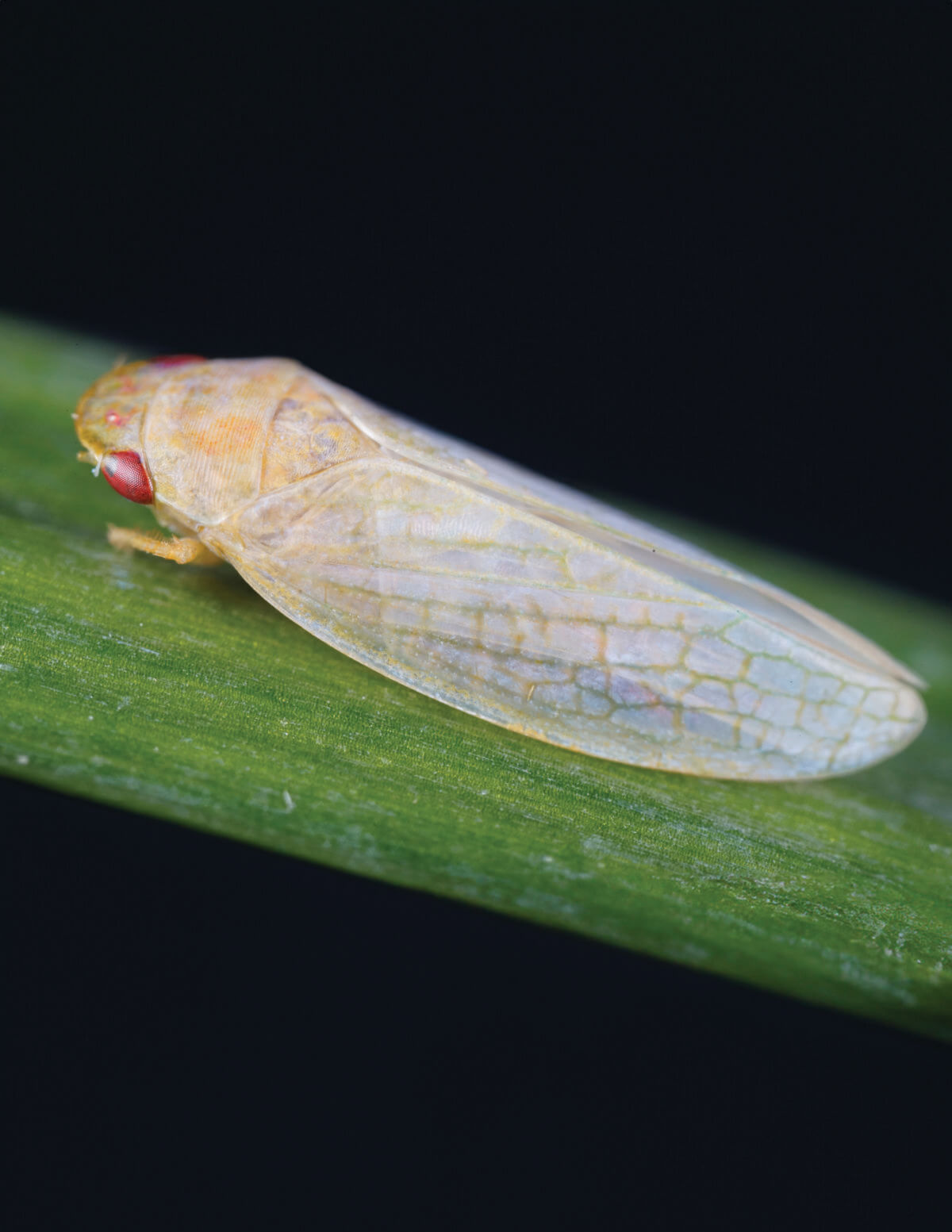
Close-up shot of a leafhopper. (© ddt - stock.adobe.com)
Leafhopper-Inspired Nanoparticles Achieve 96% Glare Reduction in Lab Tests
In A Nutshell
- Nature’s inspiration: Leafhoppers coat themselves with microscopic soccer ball-shaped particles that cut reflective glare by 80-96%, making them harder for predators to spot
- Manufacturing breakthrough: Penn State researchers created synthetic versions using microfluidics, producing 100,000+ particles per second, faster than traditional nanofabrication
- Precise control: By tweaking polymer chemistry, scientists can dial in exact particle shapes and hole patterns to match five different natural designs
- Future applications: Could lead to better anti-glare coatings, energy device surfaces, military camouflage, and optical materials, but these need further testing
Leafhoppers, insects smaller than your thumbnail, have been mastering the art of staying hidden for millions of years. They coat themselves with microscopic particles that work like nature’s own invisibility cloak, making them harder to spot by cutting down the telltale glints that would otherwise give them away to predators.
Now, researchers at Pennsylvania State University have figured out how to manufacture these biological anti-glare devices in their lab. The breakthrough could lead to everything from better light-handling surfaces for energy tech to improved military camouflage.
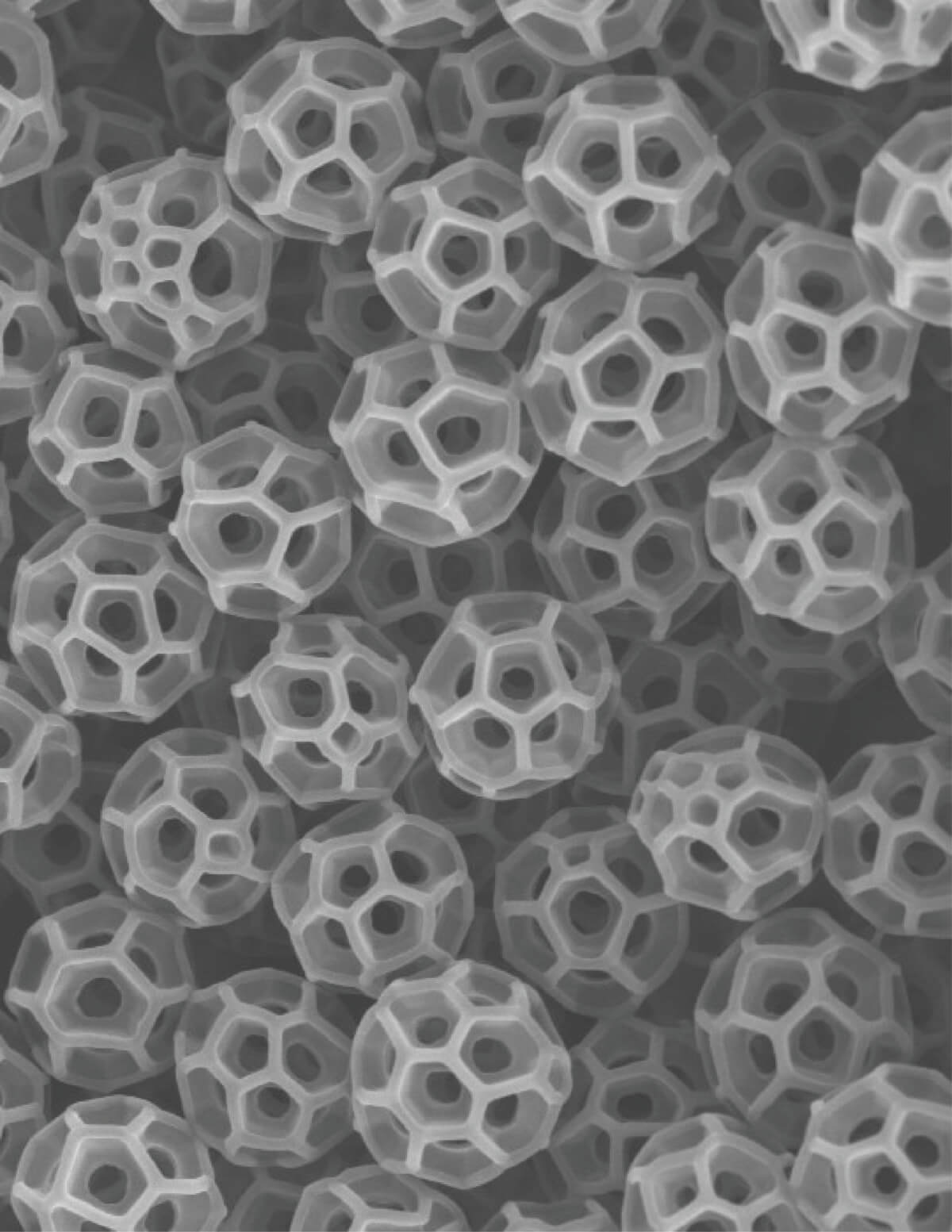
The secret weapon is a collection of hollow, soccer ball-shaped particles called brochosomes. Each one ranges from hundreds of nanometers to a couple micrometers across and contains precisely arranged holes that scatter light in ways that dramatically reduce reflective glints.
Nature’s Four-Stage Assembly Line
Leafhoppers manufacture these “invisibility” particles inside specialized organs through a process that puts human factories to shame. The insects start by creating protein clusters near cellular structures, then develop them into surface-bumped packages wrapped in tiny cellular membranes. These evolve into fully formed hollow spheres as their cores dissolve away.
The finished brochosomes range from 250 nanometers to 2.5 micrometers across. Their surfaces sport pentagon and hexagon patterns reminiscent of soccer balls, with holes measuring 50 nanometers to 1 micrometer in diameter.
Mechanical engineering professor Tak-Sing Wong and graduate student Jinsol Choi developed their artificial version based on a key insight: molecules with both water-loving and water-avoiding parts can self-assemble into these patterns. In the lab, they tune that balance using block copolymers.
Microfluidics Meets Molecular Engineering
The team’s breakthrough, published in ACS Nano, came from mimicking nature’s process using entirely artificial materials. Their microfluidic system creates tiny droplets containing dissolved polymers suspended in surfactant-treated water. As the solvent evaporates, surface tension forces guide the polymers into the same soccer ball structures found on real leafhoppers.
By adjusting the molecular weight and water-attraction properties of their synthetic polymers, the researchers can dial in specific particle shapes and pore patterns. Lower surface tension produces the pentagon and hexagon holes that match natural brochosomes. Higher surface tension creates circular pores instead.
Through systematic testing of 11 different polymer recipes, the team mapped exactly which molecular ingredients produce which brochosome designs. Success requires polymers with 10 to 23 percent water-loving molecular sections and molecular weights below 235 kilograms per mole, parameters that closely match the proteins found in actual leafhopper brochosomes.
Manufacturing Speed That Defies Belief
The system’s production rate reaches more than 100,000 synthetic brochosomes per second—several orders of magnitude faster than traditional nanofabrication methods while maintaining precise control over size and shape.
The synthetic particles successfully replicated five distinct natural brochosome designs from different leafhopper species. Sizes ranged from 390 nanometers to 2 micrometers, with holes between 30 and 130 nanometers across. Optical tests confirmed the artificial versions matched their natural counterparts in dramatically reducing unwanted reflections across ultraviolet and visible light.
When applied to transparent surfaces, the synthetic brochosomes reduced reflective glare by 80 to 96 percent across the visible spectrum. This performance matches or beats the anti-reflective properties measured on actual leafhopper wings.
Beyond Stealth Applications
While military camouflage grabs headlines, the technology’s potential extends far beyond warfare. Some energy devices could benefit from coatings that waste less light, but that would need dedicated testing. The authors also point to biomedicine, including drug delivery, as a possible direction. That’s still a next-step idea, not something this study tested.
The manufacturing approach might also work for creating artificial versions of other biological systems, ranging from viruses to pollen grains, as the researchers noted in their paper.
Medical researchers could potentially exploit the particles’ unique geometry for various applications. The combination of controllable size, shape, and surface properties opens doors to applications not yet imagined.
From Science Fiction to Factory Floor
The successful reverse-engineering of leafhopper anti-reflective technology shows how biological manufacturing processes can inspire entirely new approaches to creating materials with properties that seemed impossible just decades ago.
By understanding how tiny insects solve complex engineering problems that challenge human ingenuity, scientists continue finding blueprints for innovations that could transform industries from energy to healthcare to defense.
The research proves that sometimes the most advanced technology comes from paying attention to solutions that evolution perfected millions of years before humans even existed. In a world where sophisticated anti-glare coatings and ultra-efficient energy devices might soon transition from science fiction to reality, the humble leafhopper deserves recognition as one of nature’s most accomplished engineers.
Paper Summary
Study Limitations
The research focused on polystyrene-block-poly(4-vinylpyridine) copolymers with toluene as the solvent system, which may limit the range of achievable structures compared to the diverse protein compositions found in natural brochosomes. The synthetic system requires specific environmental conditions including controlled humidity (20-60%) and temperature for optimal particle formation. Additionally, while the study successfully replicated five natural brochosome architectures, many different designs exist across various leafhopper species that remain to be synthesized.
Funding and Disclosures
This research was funded by the Office of Naval Research grant N00014-23-1-2173, with program managers LCDR Geoffrey Ciarlone, PhD, MSC, USN and Dr. Kristy L. Hentchel. Additional support came from the Mandy and Tim Decker Fund and the Penn State College of Engineering Diefenderfer Graduate Fellowship. The authors have filed a patent application related to this work (Application No.: PCT/US2024/054898; Filing Date: November 7, 2024).
Publication Details
Authors: Jinsol Choi (Department of Mechanical Engineering and Materials Research Institute, The Pennsylvania State University) and Tak-Sing Wong (Department of Mechanical Engineering, Materials Research Institute, and Department of Biomedical Engineering, The Pennsylvania State University)
Journal: ACS Nano
Citation: Choi, J., & Wong, T.-S. (2025). Morphogenesis and High-Throughput Nanomanufacturing of Synthetic Brochosomes Inspired by a Leafhopper. ACS Nano.
DOI: 10.1021/acsnano.5c12763
Received: July 28, 2025; Revised: November 28, 2025; Accepted: December 1, 2025


