(Credit: Antonio Guillem/Shutterstock)
NEW YORK — The first person who ever said “it’s the thought that counts” probably had just received a pair of socks or some other lousy gift. Since then, plenty of people have had to fake excitement over a disappointing present during the holidays. Now, a new survey finds over half of Americans have needed to use their “resting gift face” (RGF) during the holidays.
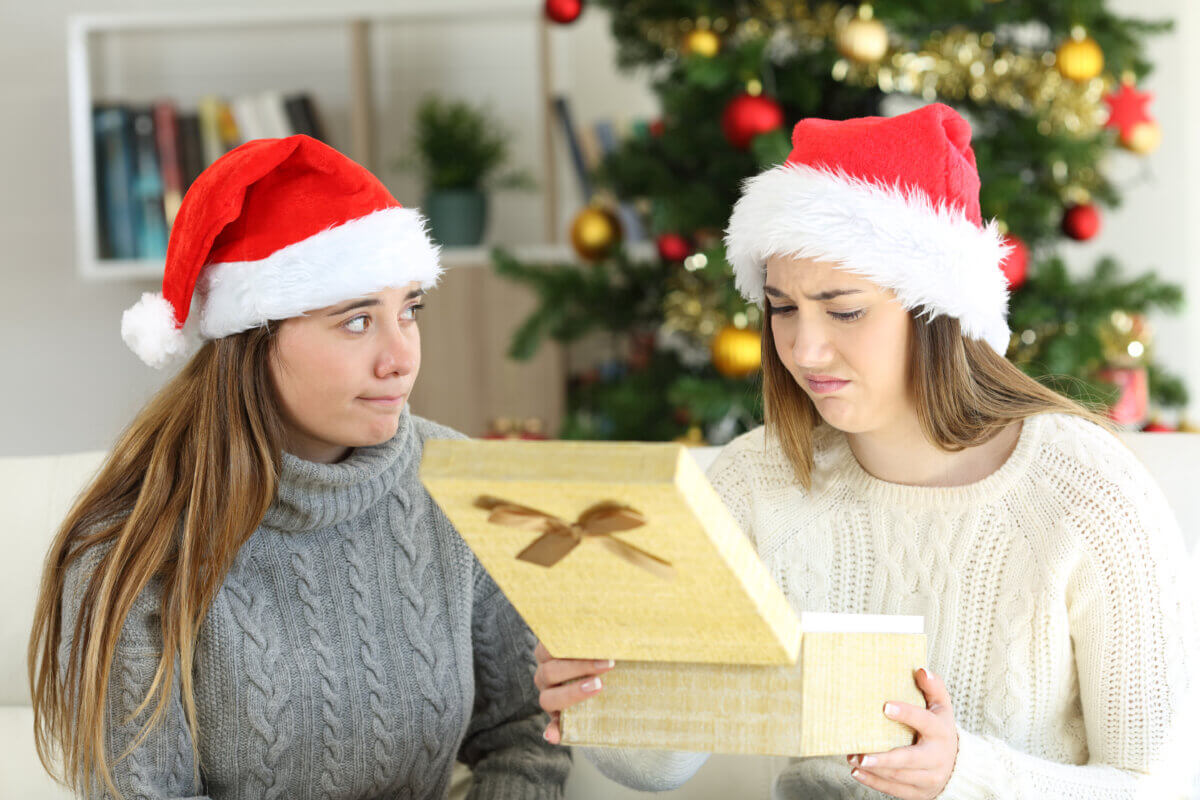
The poll of 2,000 U.S. adults who celebrate winter holidays looked at the phenomenon of “resting gift face,” which is the expression someone gives — intentionally or unintentionally — when receiving a gift that poses confusion or questions (is this a gift?) and misses the mark.
Researchers found that over the past three years, the average person has received two gifts they simply didn’t like, with the top dampeners of excitement being poor wrapping (14%), wrapping gifts in crumpled or old materials (13%), and using mismatched holiday themes (12%).
In most cases, people are likely to keep their responses cordial and polite. Americans said they’d be most likely to respond to the misguided gift-giver with a, “thank you for thinking of me” (27%), “I love it” (23%), or “I really appreciate this” (21%).
These results reflect a strong inclination to maintain positive interactions, emphasizing the importance of gratitude during gift exchanges, even when the recipients aren’t keen on the gifts in front of them.
Conducted by Talker Research on behalf of Scotch Brand, the survey also found that avoiding eye contact is the clearest sign of gift dissatisfaction (24%). This is followed by putting on a fake smile (20%), changing the tone of their voice (16%), or talking too much about how great the gift looks (16%). Fifty-six percent of respondents skillfully conceal their disappointment with a “resting gift face,” and 57% believe they’ve mastered this art.
Likewise, 53% can tell “right away” when others dislike a gift. This acute awareness may resonate with anyone who’s been in the tricky position of trying to gauge the true feelings of a gift recipient.
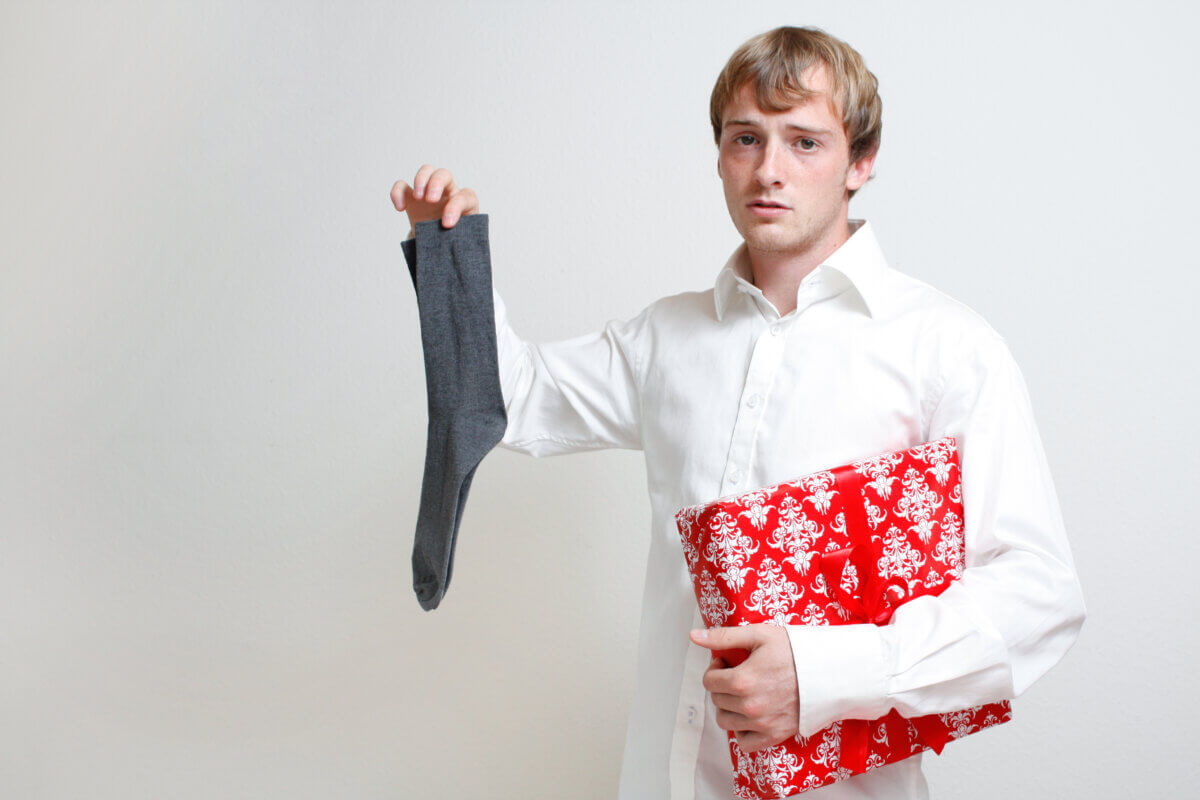
“Resting gift face” was found to come out the most often when receiving gifts from family members (34%), significant others (29%), and friends (28%). M0ore than half of respondents judge presentation closely, with 54% agreeing that it matters how a present looks when they receive it.
Perhaps unsurprisingly, those who claimed to be skilled at wrapping are more likely to be disappointed by poor wrapping quality. For instance, those who consider themselves expert or proficient wrappers feel less excited if the wrapping is incomplete, crumpled, or outdated.
According to respondents, thoughtfulness drives joy. When receiving a gift, the top things that make it feel special are when there’s thought behind the gift (42%), it recalls a memory of the gift-giver (16%) and if it has sentimental value (15%). With only 5% attributing the significance of a gift to its monetary value, emotional connections, and sentimental value dominate recipients’ joy. Generally, 40% said they feel pressured to open gifts in front of the person they received it from.
“With the anticipation of the holiday season, we know this can bring out our need to find the perfect present and meticulously wrap them perfectly with every bow and fold,” says gift-wrapping expert, Amber Kemp-Gerstel, who’s a spokesperson for Scotch Brand, in a statement.
“However, behind that intense concentration is the pure joy of giving — because nothing feels better than knowing the love you put into a gift will be felt long after the paper is torn away. With every wrap, we’re really wrapping up moments of joy.”
The survey also found when receiving gifts, the first thing people notice is the size of the gift (18%). Beyond size, the color or pattern of wrapping paper stands out to 17%, while others take notice of how neatly it’s been wrapped (14%) and if it’s been accompanied by a card or handwritten note (11%).
Four in five (81%) believe presentation matters when giving gifts to others during the holiday, and 68 percent said they get more joy out of giving gifts than receiving them. While 74% of “expert wrappers” prefer giving, only 55% of “beginner wrappers” felt the same, pointing to the added personal satisfaction that skilled wrappers associate with their gift-giving efforts.
A third claimed they were experts at gift wrapping, no matter the size or shape of the gift. Four in 10 people felt they were at least proficient, but admitted they struggle with uniquely shaped items. Overall, this shows that the majority of respondents possess a good level of wrapping skills.
Universally, nearly half agree the easiest and quickest way to prepare gifts is to put it in a gift bag. When it comes to gift boxes, 26% prefer them for giving, but only 19% find them easiest to open.
A quarter of respondents believe wrapping paper is noted as the easiest for opening (25%), but even fewer find it quick to open (21%).
“Wrapping a gift is more than just covering what’s inside. It’s a ritual, a moment to slow down and let intention shine through,” Kemp-Gerstel says. “Each fold and ribbon is a layer of excitement, building anticipation and joy. Because when you wrap with care, you’re not just giving a gift — you’re giving an experience.”
Survey methodology
Talker Research surveyed 2,000 Americans who celebrate winter holidays; the survey was commissioned by Scotch™ Brand and administered and conducted online by Talker Research between Oct. 17 and Oct. 22, 2024.


