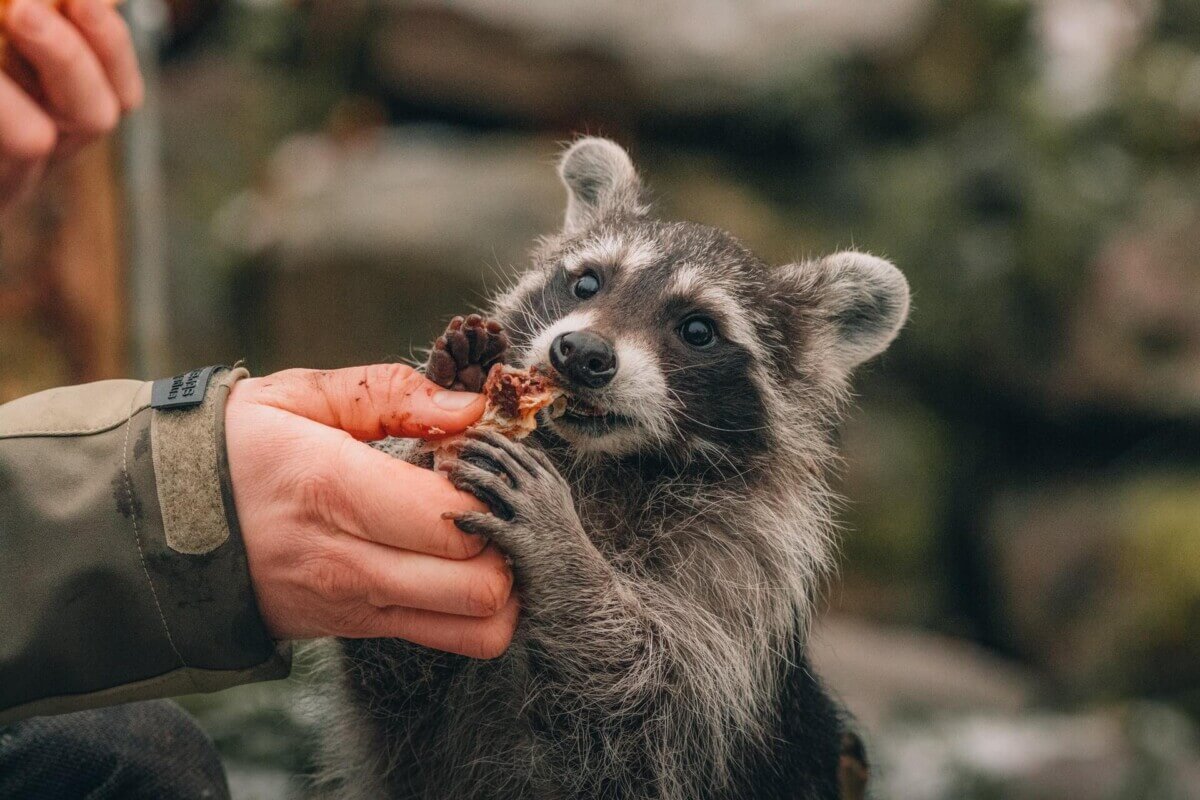
(Photo by David Selbert from Pexels)
Raccoons Don’t Just Scavenge. They Study.
In A Nutshell
- Raccoons continued solving puzzle box openings even after their food reward was gone, suggesting they explore for the sake of learning, not just eating.
- When problems were easy, raccoons tried more solutions and varied their approach. When problems were hard, they quickly committed to one reliable method.
- More curious raccoons solved more problems overall, but took longer to retrieve their food: a real trade-off between learning and efficiency.
- Researchers say this behavioral flexibility may help explain why raccoons thrive in cities, and why outsmarting them keeps getting harder.
Most animals stop working once they have eaten. Raccoons, it turns out, keep going.
A new study found that raccoons continued solving puzzles long after retrieving their food reward, spending extra time and effort opening locks, latches, and sliding panels on a specially designed puzzle box when nothing was left inside. Researchers describe this as “foraging for information,” where animals gather knowledge about possible solutions even when no reward remains. Rather than acting on instinct alone, raccoons appear to balance the effort of learning something new against the comfort of sticking with what already works, adjusting that balance depending on how hard the problem in front of them is.
Published in the scientific journal Animal Behaviour, the authors describe the experiment as a new way to study exploration vs. exploitation trade-offs during problem solving in animals. Scientists borrowed a framework economists and psychologists have long applied to human behavior, the tension between trying new options and sticking with known ones. Similar strategies have been studied in species including great apes and spotted hyenas, but this study applied the concept to a problem-solving context in a way not previously attempted. Cities, it turns out, may be producing exactly the kind of animal that can keep pace with the humans who built them.
Raccoons are already among the most successful urban mammals on the continent. A large-scale survey across 20 North American cities found they had the highest average occupancy of any mammal studied. Their success has long been chalked up to dietary flexibility and nimble paws. This research points to something deeper: a brain wired to seek out and retain new information, even when hunger is no longer the motivation.
Inside the Raccoon Intelligence Experiment
Sixteen adult raccoons were individually presented with a clear acrylic puzzle box roughly the size of a shoebox at the USDA National Wildlife Research Center in Fort Collins, Colorado. One was removed for not participating and another for damaging the equipment, leaving 14 that completed the full trials. Nine separate openings were built into the box across three difficulty levels. Easy solutions required a single motion, like pulling down a window panel or sliding a latch. Medium solutions needed two sequential steps. Hard solutions demanded three coordinated actions, including removing a padlock from a metal clasp before unlatching a door.
Each raccoon worked through the levels in order. A single food reward was placed inside per trial, and raccoons had up to 20 minutes to interact with the box.
Raccoons kept opening solutions even after eating their reward and even after they could see and feel with their paws that the box was empty. Nearly all of them solved multiple openings in a single trial across every difficulty level, far beyond what getting the food required. They were not doing it for a snack. They were doing it, researchers argue, to learn.

How Raccoon Problem-Solving Shifts With Difficulty
Whether raccoons explored broadly or fell back on a known solution depended heavily on how hard the problems were. Facing easy solutions, raccoons solved more openings per trial and switched up the order in which they tackled each one. When puzzles were hard, they quickly settled on a single preferred solution and stuck with it.
At the easy level, raccoons averaged close to 1.9 solutions per trial and showed the most varied problem-solving patterns. At the hard level, that average dropped to roughly 1.3, and sequences became far more repetitive.
What made this especially telling is that the raccoons were not failing to crack the harder solutions. Most were capable of opening all three hard panels. They often relied on a preferred solution instead. Given the time and effort a multi-step latch sequence demands, sticking with one reliable method was the more efficient approach.
Curiosity Paid Off, But at a Cost
Raccoons that spent more time poking around the puzzle box between solving sessions ended up opening more solutions overall. Curiosity was productive. But it came at a price: those same raccoons took longer to retrieve their food reward at the start of each trial.
That trade-off will feel familiar. Every time a person tries a new restaurant instead of returning to a favorite, or takes an unfamiliar road home, they are weighing the potential value of new information against the efficiency of what they already know. Raccoons appear to run a version of that same calculation, adjusting it based on circumstance. When problems are easy and cheap to solve, explore. When problems are costly, commit to what works.
Biologists call this optimal foraging, the idea that animals maximize gains while minimizing wasted energy. Raccoons were not randomly poking at things. Their behavior was consistent with making real-time adjustments about how much effort learning was worth.
Built for a World That Keeps Changing
Cities are not stable places. Trash pickup schedules change, food sources shift, and the methods people use to secure their bins grow progressively more elaborate. For a raccoon, thriving in that environment means constantly updating a mental map of what works and what does not.
Study authors raised the possibility of a “cognitive arms race” between raccoons and the humans trying to exclude them. Research on sulphur-crested cockatoos in Australia documented a nearly identical dynamic: birds learned to flip bin lids open, residents responded with increasingly elaborate deterrents, and the birds figured those out too. Such tendencies could help raccoons adapt to changing urban environments in similar ways.
Whether wild raccoons behave identically to these captive animals is still an open question. Field distractions like predators and competition could reduce how much time wild animals devote to exploration. Earlier research, however, documented wild raccoons repeatedly innovating on puzzle boxes during single visits, which suggests the drive does not disappear outside the lab findings seen here.
An animal wired to keep learning after it has already won holds a real edge. In the city, that edge compounds.
Paper Notes
Study Limitations
All raccoons were captive animals, meaning their behavior may differ from wild raccoons facing predators, social competition, and unpredictable conditions. Researchers could not fully eliminate residual food odors from the box after rewards were consumed, which may have influenced continued solution attempts. None of the raccoons solved the push-up window in the Medium difficulty set, a result the authors linked to possible interference from a visually similar pull-down window learned earlier, though this remains speculative. The study also cannot confirm that raccoons consciously weigh effort against reward; the data show behavior consistent with that pattern, but the underlying cognitive process remains open to interpretation. Sample size was limited to 14 completing raccoons, and statistical power for some analyses was moderate.
Funding and Disclosures
Funding was provided by the University of Wyoming. Hannah Griebling is supported by a Special UBC Graduate Scholarship, FRST Doctoral Fellowship (No. 6372). Housing and care of the raccoons was funded by the U.S. Department of Agriculture, Animal and Plant Health Inspection Service, Wildlife Services. Authors declared no competing interests.
Publication Details
Authors: Hannah J. Griebling (University of British Columbia), Shylo R. Johnson (USDA APHIS Wildlife Services, National Wildlife Research Center), Sarah Benson-Amram (University of British Columbia) | Title: “Raccoons optimally forage for information: exploration–exploitation trade-offs in innovation” | Journal: Animal Behaviour, Volume 234 (2026), Article 123491 | DOI: https://doi.org/10.1016/j.anbehav.2026.123491


