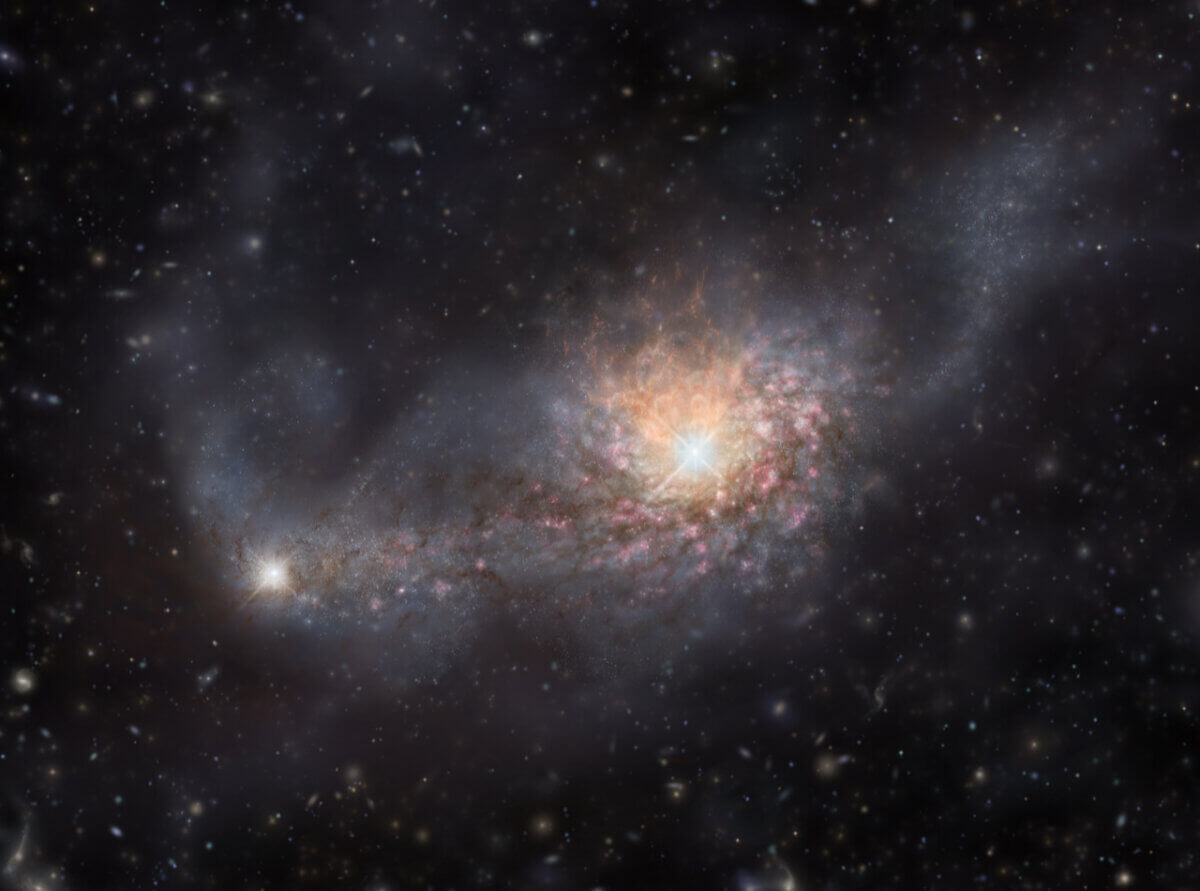
Artist’s impression of the interacting galaxies observed in this research. The gravitational interactions during the merger trigger both starburst and quasar activity. (Credit: ALMA (ESO/NAOJ/NRAO), T.Izumi et al.)
MITAKA, Japan — Astronomers have captured a rare glimpse of two ancient quasars on a collision course, set to form what scientists call a “monster galaxy.” This cosmic merger, observed by researchers led by Dr. Takuma Izumi from the National Astronomical Observatory of Japan, is occurring at a staggering distance of 12.9 billion light-years away, allowing us to peer back in time to when the universe was merely 900 million years old.
What exactly is a monster galaxy?
In astronomical terms, a monster galaxy is an extremely massive and luminous galaxy that formed in the early universe. These cosmic behemoths are characterized by their enormous size, rapid star formation rates, and the presence of supermassive black holes at their centers. Monster galaxies are thought to be the ancestors of the largest galaxies we see in the present-day universe, including giant elliptical galaxies found at the centers of galaxy clusters.
The newly discovered quasar pair represents a crucial stage in the formation of these cosmic monsters. Quasars, powered by supermassive black holes at the hearts of galaxies, are among the brightest objects in the universe. As these two quasars and their host galaxies merge, they are expected to combine their resources – stars, gas, and black holes – to form a single, extraordinarily massive galaxy.
What makes this discovery particularly exciting is that it allows astronomers to witness the birth of a monster galaxy in its infancy. Most known monster galaxies have been observed in their fully formed state, leaving scientists to speculate about their origins. This merging quasar pair provides a unique opportunity to study the formation process in action.
This discovery, made by a team led by Dr. Takuma Izumi from the National Astronomical Observatory of Japan, used the Atacama Large Millimeter/submillimeter Array (ALMA) in Chile to detect the faint emissions from cold gas and dust surrounding the quasars. Their observations revealed a massive reservoir of gas – enough to form nearly 100 billion suns – fueling both intense star formation and the growth of the central black holes. This abundance of material explains how these early quasars could grow so rapidly, addressing a long-standing puzzle in astronomy.
The study, published in The Astrophysical Journal, also uncovered signs of turbulence and outflows in the gas, indicating that the quasars are already beginning to influence their surroundings. This process, known as feedback, is crucial for understanding how monster galaxies evolve. The energy released by the quasars can heat up and expel gas from the galaxy, potentially regulating star formation and the growth of the black holes themselves.
Intriguingly, despite their cosmic significance, these quasars are relatively dim compared to other known ancient quasars. This suggests that the researchers may have caught them in an early stage of their evolution before they reached their full, dazzling brightness. As the merger progresses, the quasars are expected to become much more luminous, potentially rivaling the brightest known objects in the early universe.
Computer simulations predict that as the merger continues, the two quasars will eventually combine to form a single, super-bright quasar at the heart of a massive galaxy – the monster galaxy in its final form. This process is thought to be a key step in the formation of the most massive galaxies we see in the present-day universe.
The discovery of this merging quasar pair is like finding a baby picture of the universe’s largest galaxies. It’s a rare glimpse into cosmic childhood, showing us how the giants of the galactic world got their start. As we continue to study this system, we’re not just looking at distant objects; we’re uncovering the roots of the cosmic structures we see around us today.
Paper Summary
Methodology
The researchers used the ALMA telescope to observe the quasar pair in submillimeter wavelengths, which allowed them to detect the cold gas and dust around the quasars. They focused on a specific emission line from ionized carbon, which is a good tracer of star-forming regions. By analyzing the intensity and distribution of this emission, they could map out the gas in the system and measure its properties. They also looked at the continuum emission from dust, which provides information about the overall structure and star formation rate in the galaxies.
Key Results
The study found that the quasar pair is surrounded by a massive amount of gas, estimated at about 100 billion solar masses. This gas is forming stars at a rate of about 550 solar masses per year, which is extremely high for the early universe. The researchers also detected signs of outflows from the quasars, with gas moving at speeds of up to 600 kilometers per second. The quasars themselves are relatively dim, with each black hole estimated to be about 100 million solar masses.
Study Limitations
The main limitation of this study is the extreme distance of the object, which makes detailed observations challenging. While ALMA provides unprecedented sensitivity, the resolution is still limited, meaning some of the finer details of the interaction between the quasars may be missed. Additionally, observing a single pair of quasars, while informative, may not be representative of all quasar mergers in the early universe.
Discussion & Takeaways
This discovery provides strong evidence for the importance of mergers in the growth of supermassive black holes and the formation of massive galaxies in the early universe. It suggests that even before the universe was a billion years old, complex structures and interactions were already taking place. The presence of strong outflows indicates that quasar feedback was already playing a role in regulating galaxy growth at this early time. The relatively low luminosity of these quasars, combined with their high gas content, suggests that we’re observing an early stage in the formation of a very massive quasar.
Funding & Disclosures
The research was supported by various grants from the Japan Society for the Promotion of Science and other institutions. The ALMA observatory, which was crucial for this discovery, is a partnership of multiple international organizations, including ESO, NSF, and NINS. The researchers declared no conflicts of interest related to this study.


