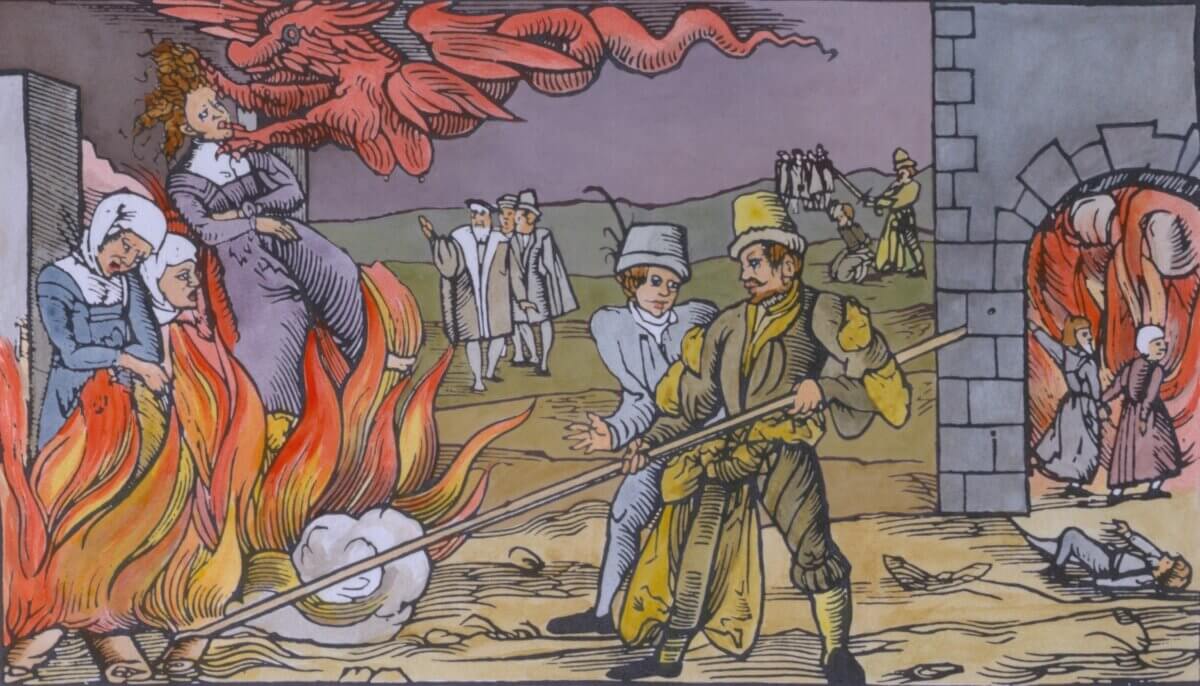
Three women executed as witches in Derneburg Germany in October 1555. Europeans began prosecuting suspected witches in the 14th century. 16th century woodcut with modern watercolor. (Photo by Everett Collection on Shutterstock)
SANTA FE, N.M. — The invention of the printing press in 1450 revolutionized how people communicated. Books and newspapers could be easily printed and sent across towns in hours, allowing people to spread ideas and knowledge. Though the printing press represented an intellectual milestone for humanity, a new study finds it is also the reason behind the mass hysteria and eventual deaths of so many “witches.”
One publication that became extremely popular across Europe in 1487 was witch-hunting manuals. The Malleus Maleficarum was a fan-favorite, with copies spread across cities and fueled the hunt for demonic witches. People read the manual describing how to spot a witch and other published news of witch trials in other towns. According to the authors, seeing what neighboring towns were doing to deal with witches influenced whether another town would adopt their own witch trials.
“Cities weren’t making these decisions in isolation,” says lead author Kerice Doten-Snitker, a Complexity Postdoctoral Fellow at the Santa Fe Institute, in a statement. “They were watching what their neighbors were doing and learning from those examples. The combination of new ideas from books and the influence of nearby trials created the perfect conditions for these persecutions to spread.”
The belief in witchcraft was not something that sprung up one day. Europeans had believed in witches for centuries, but it was only discussed amongst small circles, such as religious scholars and local inquisitors. However, printing witch-hunting manuals like Malleus Maleficarum put a greater spotlight on witches, providing a guide for finding, questioning, and prosecuting witches. In the 300 years of persecution and trials, roughly 90,000 people were accused, and nearly half of them were sentenced to death.
The new study, published in Theory and Society, built on previous research examining factors influencing the spread of witchcraft. These works emphasized economic and environmental factors, but the authors focused this time on social and trade networks and how they influenced people’s behaviors.
Researchers tracked the timing with the publication of witch-hunting manuals between 1400 and 1679 and the timing of witch trials in 553 cities. They found that with every new edition of Malleus Maleficarum, there was an increase in witch trials.
Along with printing witch manuals, the authors noticed neighboring cities also influenced whether a city would host witch trials. When one city adopted the practices in Malleus Maleficarum, others copied their behavior. This behavior is known as ideational diffusion, which is how ideas are spread through a population. It took years for people to learn and accept the new ideas surrounding witchcraft. Once they did, however, it led to unprecedented persecution for witches.
Study authors note the same principles for social change that allowed mass hysteria to happen can be seen in today’s society. “The process of adopting witch trials is not unlike how modern governments adopt new policies today,” explained Doten-Snitker. “It often starts with a change in ideas, which are reinforced through social networks. Over time, these ideas take root and change the behavior of entire societies.”
Today, witch hunts still continue in some parts of the world and still result in violent and torturous acts — even on children. According to the 2023 Annual Report of the United Nations Human Rights Council, hundreds of thousands are harmed annually in regions such as sub-Saharan Africa, India, and Papua New Guinea because of belief in witchcraft. The New York Times reported in 2023 that in India alone, more than 1,500 people were killed between 2010 and 2021 after being accused of witchcraft. Groups like End Witch Hunts and Advocacy for Alleged Witches are helping to bring more awareness to this alarming problem.
Paper Summary
Methodology
The researchers analyzed data from 553 cities in Central Europe between 1400 and 1679. They tracked the timing of witch trials, the publication of witch-hunting manuals (particularly the Malleus Maleficarum), religious conflicts, climate conditions, and trade network connections. Using statistical models, they examined how these factors correlated with the likelihood of a city conducting its first witch trial. The analysis focused on three main hypotheses: the impact of printed manuals, influence from neighboring cities’ trials, and the effect of a city’s connectedness in trade networks.
Results
The study found that cities were 29.7% more likely to hold a witch trial within 10 years of new editions of Malleus Maleficarum being printed nearby. Cities were also much more likely to conduct trials if their neighbors had recently done so. Well-connected cities at the center of trade networks were far more prone to witch hunts, with the most central cities having over 1000% higher odds of starting trials compared to isolated towns. There was little evidence linking crop failures or extreme weather to increased witch hunts in urban areas. Religious conflict had a mixed effect, increasing trials in direct battle areas but decreasing them in neighboring regions.
Limitations
The study focused only on urban areas, potentially missing patterns in rural witch hunts. It relied on historical records, which may be incomplete or biased. The analysis couldn’t directly measure how ideas spread between individuals, instead inferring ideological diffusion from city-level data. The study also couldn’t account for all possible factors influencing witch hunts, such as individual personalities of local leaders or specific local events.
Discussion and Takeaways
The research suggests that the spread of witch hunts was driven more by the diffusion of new ideas and social influence than by economic hardship or superstition alone. It highlights how new communication technologies (like printing) can accelerate the spread of dangerous ideologies. The study emphasizes the power of social influence, showing how actions of neighboring cities greatly impacted local decision-making. These findings have implications for understanding how extremist ideologies spread in modern times, particularly through interconnected social networks and media platforms.
Funding and Disclosures
The paper does not mention any specific funding sources or conflicts of interest for this study.


