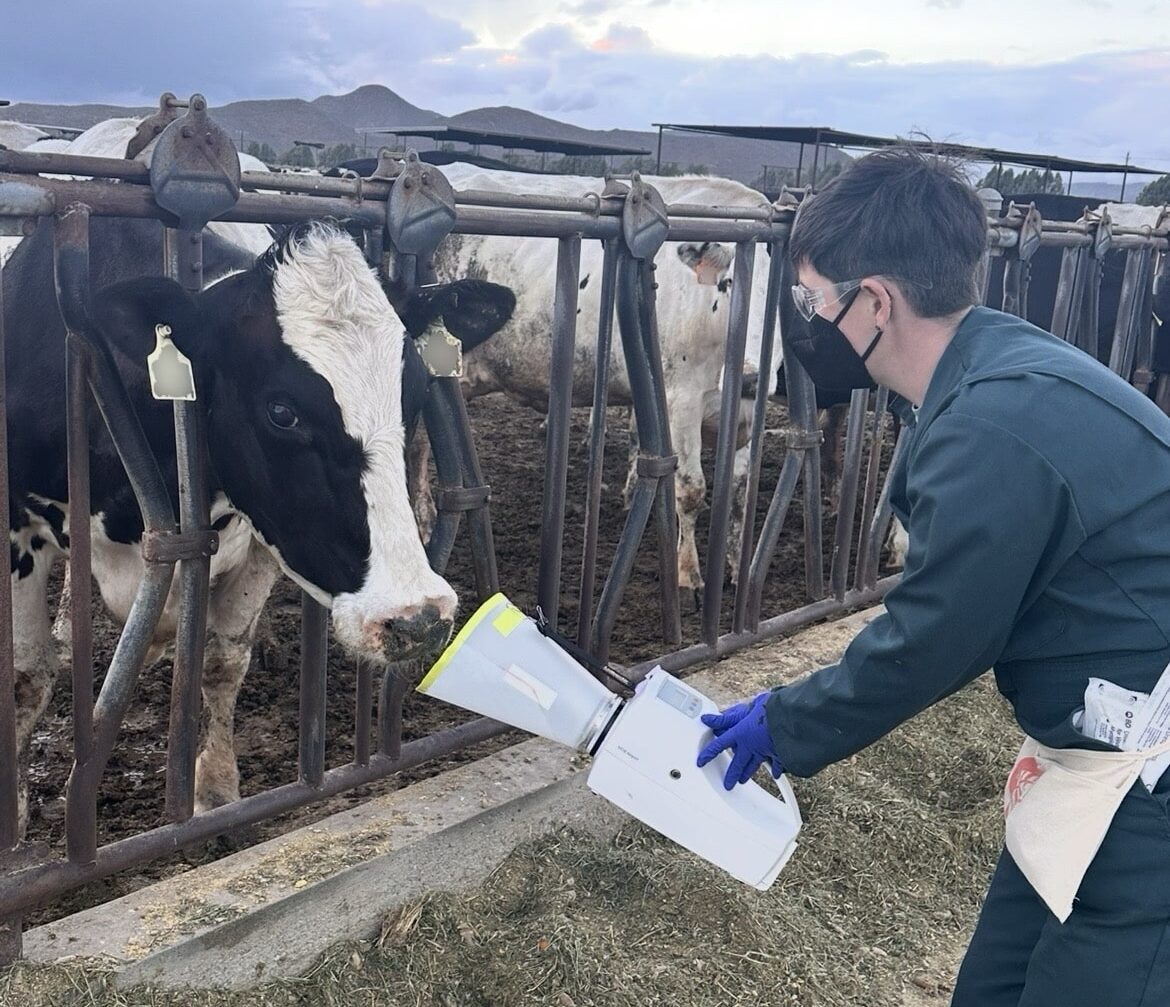
Dr. AJ Campbell (lead author) sampling the exhaled breath from cows on a dairy farm in California. (Credit: Seema Lakdawala and colleagues)
Infected Cows May Show No Signs
In A Nutshell
- Researchers found live, infectious H5N1 bird flu virus in the air of dairy farm milking rooms during active outbreaks, not just in milk or on surfaces.
- H5N1 genetic material was detected at every point in farm water systems tested, with live virus confirmed in two samples, and infected wastewater may be reaching migratory birds.
- Some cows with no visible symptoms of illness showed signs of prior H5N1 exposure, suggesting farms relying on sick-cow signals are likely missing cases.
- Evidence from individual cow tracking casts doubt on milking equipment as the sole transmission route, pointing to multiple spread pathways that current protocols may not fully address.
Researchers studying H5N1 outbreaks on California dairy farms didn’t find the virus only in milk. During active outbreaks, they found infectious virus in milking room air, the same enclosed spaces where farm workers spend long hours each day.
When H5N1 bird flu began spreading through American dairy herds in 2024, contaminated milk and milking equipment were the leading suspected routes of spread. A new study across 14 infected California dairy farms complicates that picture. Scientists found living, infectious H5N1 in the air of milking barns during active outbreaks, suggesting that contaminated milking equipment may not be the only route of spread.
Published in PLOS Biology, the findings show the virus has more ways to spread than previously characterized, including through air, wastewater, and apparently healthy cows.
How H5N1 Bird Flu Is Spreading Through the Air on Dairy Farms
Researchers from Emory University, the University of Michigan, Colorado State University, and several other institutions conducted air sampling on California dairy farms during active H5N1 outbreaks between October 2024 and April 2025. Several collection devices were tested in milking rooms and housing areas, including one worn in a backpack to mimic worker exposure. From 71 samples in the first phase, six tested positive, including samples from the breathing zones of rows of cows.
A focused second phase on three southern California farms during outbreaks in early 2025 yielded more definitive results. Of 35 air samples collected in milking rooms, 21 came back positive, and four contained virus that was still alive and capable of causing infection. Genetic traces of a virus are one thing; live, infectious particles in the air workers breathe is another matter entirely.
“Dairy parlors, which are often enclosed spaces and where aerosolization of milk occurs, pose the greatest threat from inhalation of the virus to dairy farm workers compared to the open-air housing pens,” the authors wrote. Put simply, the milking process sends fine droplets of milk into the air, and during an active outbreak, those droplets can carry the virus.

H5N1 Found in Farm Wastewater at Every Point Tested
Researchers also traced H5N1 genetic material through the water systems on these farms and found it at every wastewater point they tested. Live virus was detected in two high-concentration samples from one farm.
Milk from sick cows gets routed through on-farm water systems, eventually collecting in large holding lagoons or spread across fields. Researchers sampled water at multiple stages and found viral genetic material at every stop, from the milking room drain to the far-end lagoon. Those same lagoons attract migratory birds, which could carry the virus well beyond the farm’s fence line.
Cows Showing No Signs May Still Be Missed by Standard Farm Protocols
Perhaps the most consequential finding involves cows that looked completely healthy. On one farm using electronic monitoring to track daily milk output, scientists identified animals that had recovered from an earlier outbreak, animals that showed a temporary production drop, and animals that never showed any measurable signs of illness.
When researchers tested milk from all groups for antibodies, the immune proteins produced after an infection, every recovered cow tested positive. So did six out of ten cows that had shown no signs of illness, indicating prior exposure the farm had never detected.
On a separate farm, seven cows tested positive for H5N1 in their milk without showing mastitis, the udder inflammation that had been the primary warning sign for the virus in dairy cattle. Farms relying on visible symptoms are likely missing a substantial share of cases.

H5N1 Bird Flu Transmission Routes Point Beyond Milking Equipment
One significant thread involves how infection distributes across a cow’s four separate milk-producing sections, called quarters. Milking machines attach to all four teats in a fixed orientation, so the same cup goes to the same quarter on every cow, every time. If a contaminated machine were the main way the virus spreads, a predictable pattern would emerge across the herd. That’s not what researchers found. Which quarter tested positive varied widely from cow to cow, with no section consistently affected. Experimental studies cited in the paper also failed to spread H5N1 between cows using contaminated equipment alone, pointing to other transmission routes farms may not yet be guarding against.
Genetic analysis added a layer worth watching. Sequencing of virus recovered from air and wastewater on one farm revealed small genetic variations, including a change in the part of the virus that determines which cells it can latch onto and enter. For a flu virus to infect a human, it generally needs to bind to receptors found in the human respiratory tract rather than those more common in birds and cattle. Mutations at the position identified here have been linked in other research to improved ability to do exactly that. Whether this specific variant actually increases human infection risk remains unknown, and the authors are careful to say so. Finding it in the air of a working dairy parlor is a reason for closer surveillance, not proof that the virus has become more dangerous to people.
With an unknown number of infections potentially going unnoticed in cows that show no symptoms, and live infectious particles confirmed in working milking rooms, the data indicates current containment strategies may not be enough.
Disclaimer: This article is based on a peer-reviewed observational study and reflects the findings and limitations of that research. Results were observed during active outbreaks on a specific set of farms and may not apply universally to all dairy operations. No causal claims about transmission have been established. Readers should consult public health authorities for guidance on H5N1 risks and protective measures.
Paper Notes
Limitations
Detailed, day-by-day tracking of individual cows was conducted on only one farm with 14 animals over a short sampling window, which may not reflect broader patterns. Researchers could not trace the specific order in which cows were milked or fully track shared equipment usage across all animals. Live virus recovered from both air and wastewater samples likely underestimates the true levels present, given the inherent difficulty of capturing and preserving infectious virus during field collection. Air samples collected directly from the breath of individual cows all came back negative, though confirmed H5N1 status of those specific animals at the time of sampling was not always available.
Funding and Disclosures
This work was supported by discretionary funds from Emory University and gift funds to the Emory Center for Transmission of Airborne Pathogens, provided by the California Dairy Research Foundation and Flu Lab, a California-based organization focused on influenza prevention and treatment. Additional support came from the Michigan Infectious Diseases Genomics Center through a National Institute of Allergy and Infectious Diseases grant. A gift from the Sergey Brin Family Foundation supported a portion of the work, and an agreement from the United States Department of Agriculture’s Animal and Plant Health Inspection Service supported another portion. The authors note that the views expressed do not necessarily reflect those of APHIS. Funders had no role in study design, data collection and analysis, the decision to publish, or preparation of the manuscript. Several authors disclosed outside financial relationships: two authors receive funds from Flu Lab, NIH, and other agencies; one author receives consulting fees and research support from a pharmaceutical company; and one author is a co-inventor on vaccine-related patents and reports consulting relationships with multiple pharmaceutical companies.
Publication Details
Title: Surveillance on California dairy farms reveals multiple possible sources of H5N1 influenza virus transmission Authors: A.J. Campbell, Meredith Shephard, Abigail P. Paulos, Matthew D. Pauly, Michelle N. Vu, Chloe Stenkamp-Strahm, Kaitlyn Bushfield, Betsy Hunter-Binns, Orlando Sablon, Emily E. Bendall, William J. Fitzimmons, Kayla Brizuela, Grace E. Quirk, Nirmal Kumar, Brian McCluskey, Nishit Shetty, Linsey C. Marr, Jenna J. Guthmiller, Jefferson J.S. Santos, Scott E. Hensley, Edith S. Marshall, Kevin Abernathy, Adam S. Lauring, Blaine T. Melody, Marlene K. Wolfe, Jason Lombard, Seema S. Lakdawala Journal: PLOS Biology Published: May 5, 2026 Volume/Issue: 24(5): e3003761 DOI: https://doi.org/10.1371/journal.pbio.3003761


