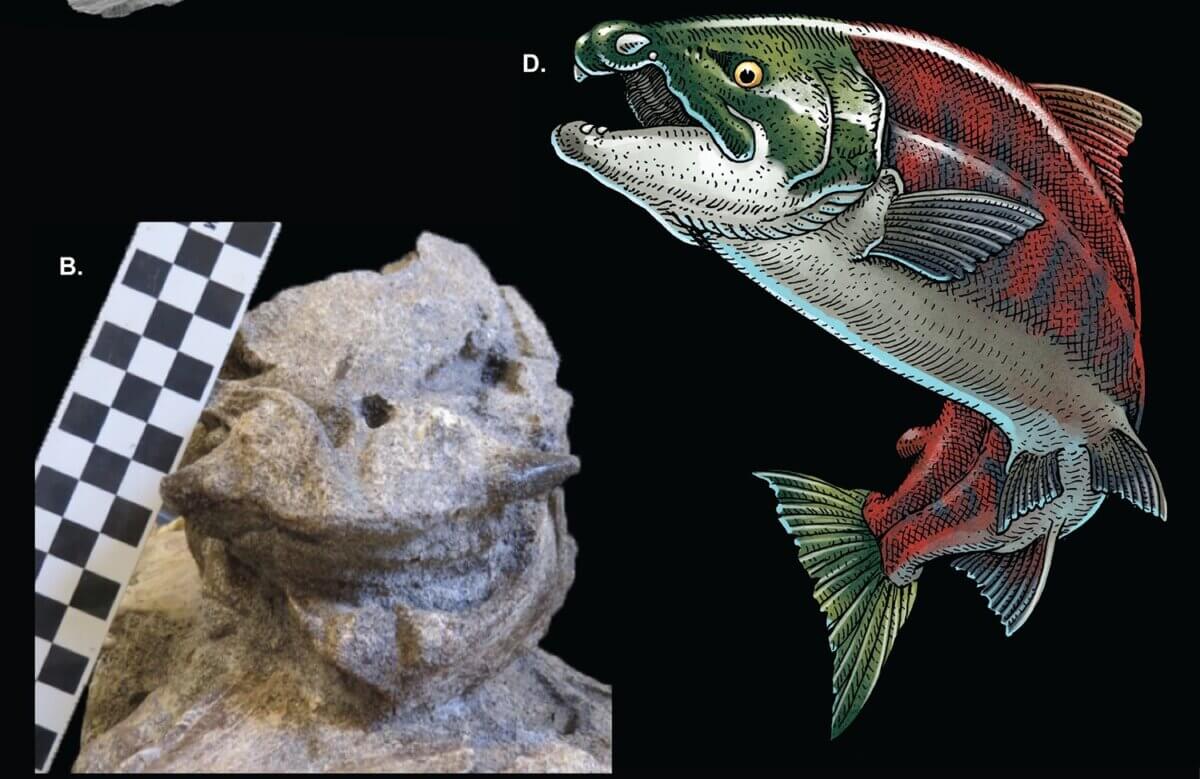
†Oncorhynchus rastrosus. (A) CT model of Holotype, UO F-26799, skull in right lateral view with a stylized drawing of the originally proposed “sabertoothed” position of the isolated premaxilla; (B) UO_A in anterior view of skull, prior to complete preparation and CT scan; (C) Artist’s rendering skull of male iconic fish with accurate spike-tooth configuration; (D) Artist’s rendering of complete female iconic fish with accurate spike-tooth configuration.
EUGENE, Ore. — In the rivers of the ancient Pacific Northwest, a colossal salmon once swam – one that dwarfed even the largest of today’s prized catches. For decades, this extinct giant has captured imaginations as the “Sabertooth Salmon,” conjuring images of a fish with fearsome downward-pointing fangs. But a study published in PLOS ONE reveals that we’ve been telling fish tales about this prehistoric marvel all along.
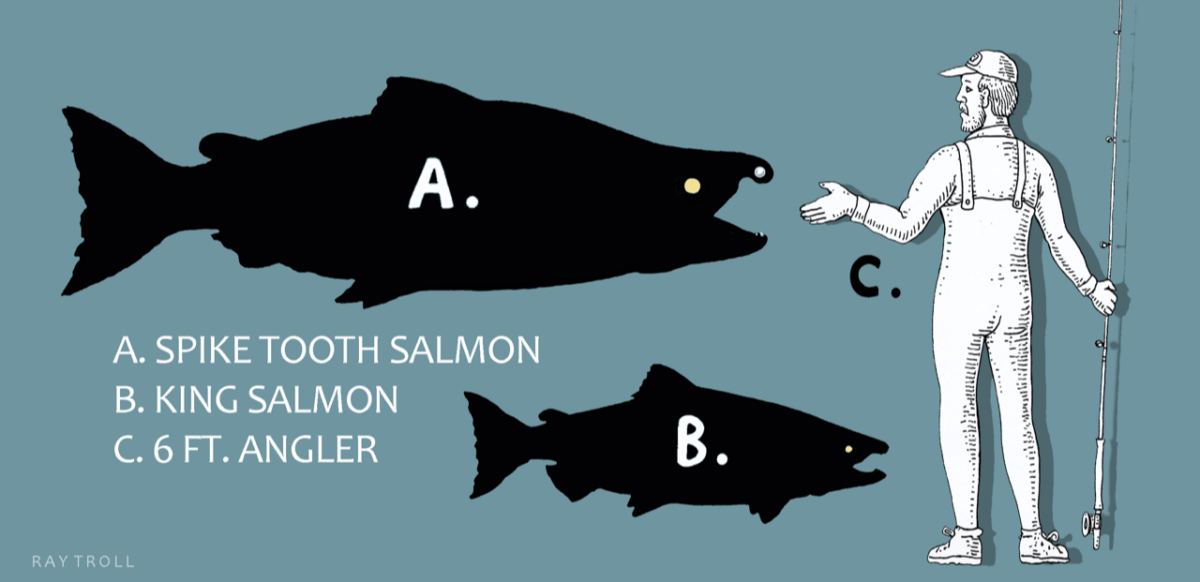
Meet Oncorhynchus rastrosus, a salmon that grew to an astonishing 2.7 meters (8.9 feet) in length – nearly three times the size of the largest modern salmon. When first described in the 1970s, paleontologists found massive, isolated teeth unlike anything seen in living salmon. Without a complete skull to work from, they logically assumed these teeth pointed backward into the mouth like fangs. This led to the creature’s popular nickname and even its original scientific name, which translates roughly to “rake-toothed smilodon-fish.”
Now, thanks to remarkably well-preserved new fossils and advanced imaging techniques, researchers have discovered that we’ve had it all wrong. Those imposing teeth weren’t downward-facing fangs at all but rather sideways-pointing spikes!
“The teeth projected laterally like tusks, not ventrally like sabers or fangs,” the study authors explain in the report.
This radical reorientation of O. rastrosus’s most distinctive feature has scientists rethinking everything about how this fish lived and why it evolved such bizarre anatomy.
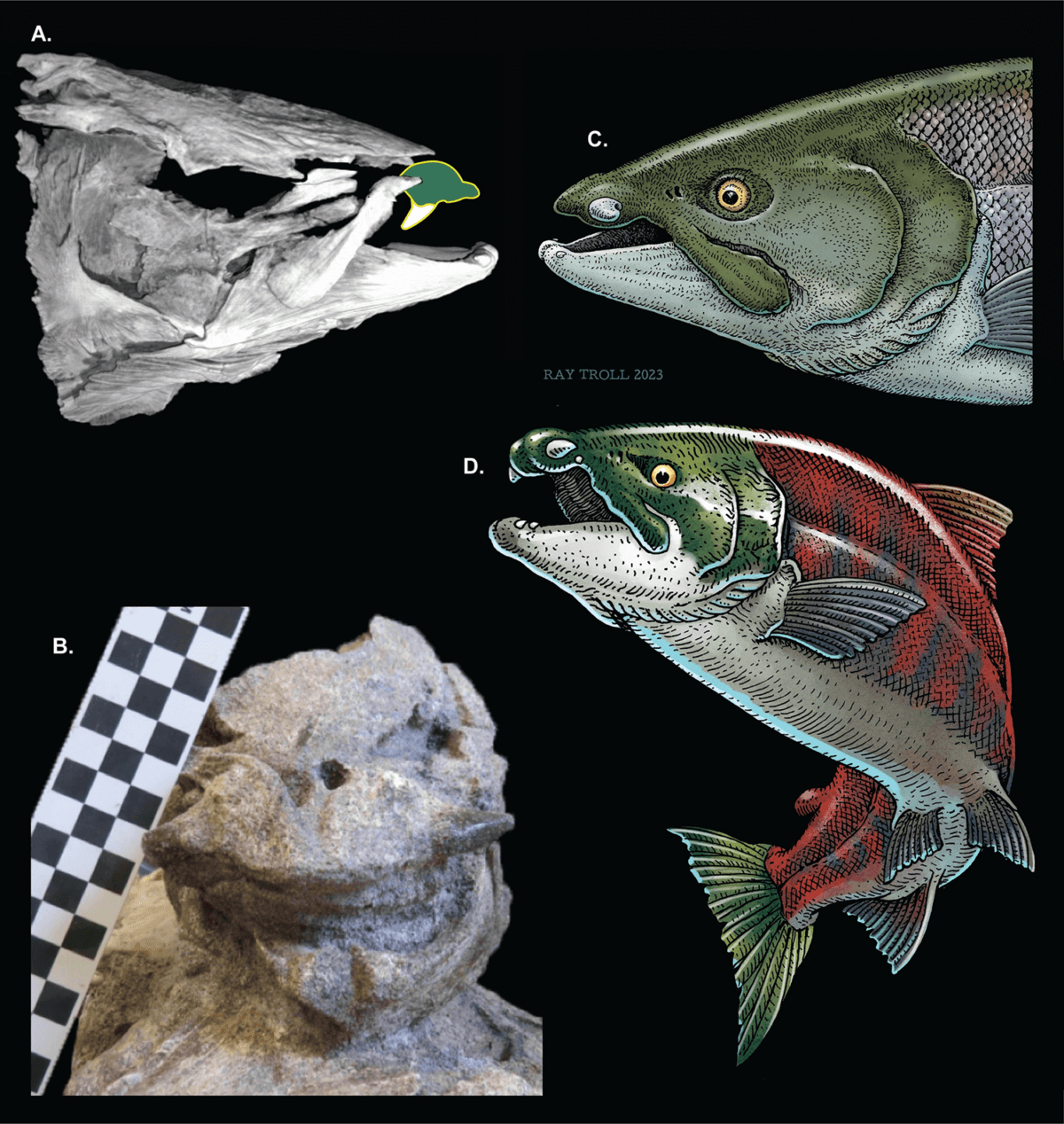
The newly analyzed fossils reveal a salmon with a broad, powerful head adorned with two massive, tusk-like teeth jutting out to the sides. Picture a salmon crossed with a warthog, and you’ll get the idea. This discovery prompted the researchers to suggest a new nickname: the “Spike-Toothed Salmon.”
“We have known for decades that these extinct salmon from Central Oregon were the largest to ever live. Discoveries like ours show they probably weren’t gentle giants,” says lead author Kerin Claeson, a professor of anatomy at Philadelphia College of Osteopathic Medicine, in a statement. “These massive spikes at the tip of their snouts would have been useful to defend against predators, compete against other salmon, and ultimately build the nests where they would incubate their eggs.”
So, why would a salmon evolve such strange headgear? The study’s authors propose several intriguing possibilities:
- Defense: Like the tusks of a warthog, the spikes may have deterred predators. Even large carnivores might think twice before trying to swallow a fish with dagger-like protrusions.
- Competition: Many animals use impressive ornaments or weapons to compete for mates. The researchers suggest the spikes may have been used in fighting, either against other spike-toothed salmon or as a defense against predators.
- Tools: Modern salmon use their tails to dig nests in riverbeds for their eggs. The researchers speculate that O. rastrosus might have used its spikes as additional digging tools to create even larger nests.
The study also sheds light on other aspects of this prehistoric giant’s life. Like modern salmon, O. rastrosus was anadromous, meaning it was born in freshwater, migrated to the ocean to grow, and then returned to rivers to spawn. Its enormous size suggests it spent significant time feeding in the productive waters of the ancient Pacific.
Intriguingly, the Spike-Toothed Salmon appears to have been a filter feeder, much like modern-day baleen whales. It had specialized structures in its gills to strain tiny organisms from the water. This combination of filter-feeding and giant size mirrors the evolution of the largest animals on Earth today – blue whales.
One surprising discovery is that both male and female O. rastrosus possessed these impressive spike-like teeth.
“We also stress that females and males alike possessed the enormous, tusk-like teeth. Therefore, the sexes were equally fearsome,” notes Brian Sidlauskas, professor and curator of fishes at Oregon State University.
This is unlike many modern species, where males often have more pronounced weapons or ornaments.
This reimagining of O. rastrosus provides a vivid new glimpse into prehistoric ecosystems. Imagine ancient Pacific Northwest rivers teeming with these massive, spike-adorned salmon during their spawning runs. Their presence would have had profound effects on the entire food web, from the prey they consumed to the predators and scavengers that fed upon them.
“I’m delighted that we have been able to put a new face on the giant spike-tooth salmon, bringing knowledge from the field in Oregon to the world,” adds Edward Davis, associate professor of earth sciences at the University of Oregon and director of Condon Collection at the UO’s Museum of Natural and Cultural History.
The Spike-Toothed Salmon serves as a reminder that the natural world is often stranger and more wonderful than we can imagine. It also highlights the importance of new discoveries and technologies in paleontology. A single well-preserved fossil can completely change our understanding of extinct creatures and ancient ecosystems.
As we face modern challenges like climate change and habitat loss, understanding the diversity and adaptations of ancient life becomes increasingly valuable. The story of O. rastrosus shows us just how dramatically species can evolve to fill ecological niches. It reminds us that the Earth has seen radical changes before and that life finds a way to adapt – sometimes in truly spectacular fashion.
Paper Summary
Methodology
The researchers examined newly discovered, well-preserved fossils of O. rastrosus, including complete skulls. They used CT (computed tomography) scanning to create detailed 3D models of the skulls and individual bones. This allowed them to see how the various parts fit together and to examine internal structures.
They compared these new specimens to previously known fossils and to the skeletons of modern salmon species. The team also conducted a phylogenetic analysis, comparing the physical characteristics of O. rastrosus to other extinct and living salmon species to determine its place on the evolutionary tree.
Key Results
The study confirmed that the large teeth of O. rastrosus pointed sideways rather than downward. Both males and females had these spike-like teeth. The researchers found subtle differences in skull shape between males and females, similar to the sexual dimorphism seen in modern salmon. The analysis also revealed that O. rastrosus was closely related to modern sockeye salmon and other specialized filter-feeding salmon from the same time period.
Study Limitations
While the new fossils provide unprecedented detail, they still represent only a handful of individuals from a species that lived millions of years ago. The soft tissues that would have surrounded the teeth are not preserved, so some aspects of how they functioned remain speculative. Additionally, behavior cannot be directly observed in extinct animals, so the proposed uses for the spiked teeth remain hypothetical.
Discussion & Takeaways
The reorientation of O. rastrosus’s distinctive teeth from downward-pointing to sideways-projecting fundamentally changes our understanding of this ancient fish. The researchers propose multiple possible functions for these unique structures, including defense, competition, and tool use.
The study also highlights the importance of filter-feeding adaptations in the evolution of extremely large body sizes in aquatic animals. The similarities between male and female O. rastrosus in having spiked teeth, unlike the more pronounced sexual dimorphism in modern salmon, raise interesting questions about their mating behavior and social structure.
Funding & Disclosures
This research was funded by the National Science Foundation. The authors declared no conflicts of interest.


