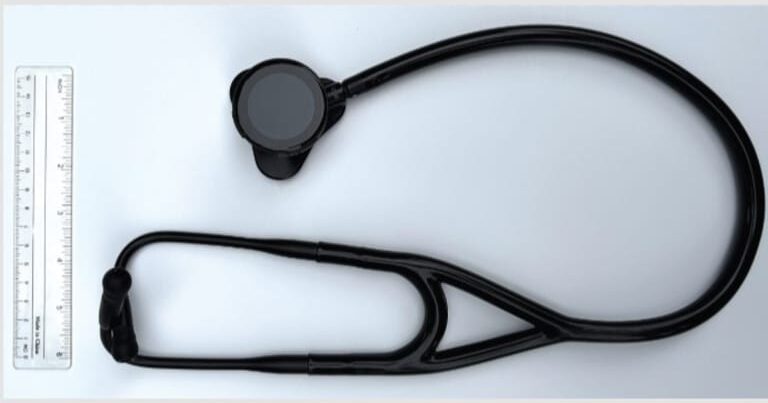
Figure 1—The AI-enabled digital stethoscope (Core 500; EKO Health Inc) used in the present prospective observational study conducted at the North Carolina State University College of Veterinary Medicine from August 1, 2025, through December 31, 2025. Cardiac auscultation was performed by a veterinary cardiologist, cardiology resident, and clinical year student on 54 dogs and 51 cats. The device interfaces with a smartphone application to perform cardiac auscultation and generate real-time AI-assisted interpretations of murmur presence and cardiac rhythm at each auscultation site; the device and application are designed for use in humans. (Credit: Journal of the American Veterinary Medical Association 2026; 10.2460/javma.26.05.0353)
In a Nutshell
- An AI-powered digital stethoscope detected only 2 of 22 heart murmurs in cats, missing nearly every one that expert cardiologists caught.
- In dogs, the AI device performed about as well as fourth-year veterinary students at detecting murmurs, but no better.
- For rhythm detection in dogs, the device classified no dog as arrhythmia-free, including none of the dogs with confirmed normal rhythms.
Artificial intelligence is being trusted to listen to pets’ hearts. But a new study found that in cats, it missed almost every heart murmur it should have caught. In both dogs and cats, its rhythm readings were so unreliable they could lead to unnecessary anxiety and avoidable referrals or costs.
Veterinary cardiologists at North Carolina State University put an AI-powered digital stethoscope to the test on 105 dogs and cats, comparing it against fourth-year veterinary students and experienced clinicians. Their results, published in the Journal of the American Veterinary Medical Association (JAVMA), should give pause to any pet owner, veterinarian, or clinic thinking about adopting the technology without question. In cats, the device detected only 2 out of 22 heart murmurs. In dogs, fewer than 1 in 4 of its atrial fibrillation calls, a type of irregular heartbeat, actually turned out to be true.
Researchers tested the Core 500, a stethoscope built and trained for human use by EKO Health Inc. That distinction matters enormously. Cats have faster heart rates and smaller chest cavities than people, and the AI behind the stethoscope was almost certainly never designed with a cat in mind.
A Human AI Stethoscope, Put to the Test on Pets
AI-powered diagnostic tools are booming in veterinary medicine. A 2024 survey of nearly 4,000 veterinary professionals found that nearly 70% use AI tools daily or weekly. But the field largely lacks the regulatory oversight and clinical testing standards that exist in human healthcare. This study set out to address that gap.
Researchers enrolled 54 dogs and 51 cats brought into the NC State veterinary teaching hospital between August 1, 2025, and December 31, 2025. Every animal had its heart listened to in four specific spots on the chest using the AI stethoscope, and those results were compared against what both a board-certified veterinary cardiologist and a cardiology resident heard. Fourth-year veterinary students also listened independently, with different students evaluating different cases, giving researchers a useful human comparison point.
Each animal also received a standard six-lead heart rhythm recording, essentially a basic electrocardiogram, and most received a heart ultrasound as well. Echocardiograms were performed in 44 of 54 dogs and 48 of 51 cats.
Dogs: The AI Stethoscope Only Matches Students
For dogs, the AI stethoscope’s murmur detection was described as “moderate.” It correctly identified murmurs in 33 of 38 dogs that actually had them, giving it a sensitivity, a measure of how often it catches true cases, of about 87%. That sounds decent until the flip side comes into view. It falsely flagged 7 of the 16 dogs that had no murmur at all, giving it a specificity, its accuracy at clearing healthy patients, of just 56%.
More telling was the comparison to veterinary students. Both performed identically overall. That might seem like a compliment to the machine, but it flips the marketing pitch on its head. Researchers had hypothesized the AI would outperform students. It did not. And while the two groups made the same number of errors overall, they made them on different patients, a sign they pick up on different signals rather than one being a reliable substitute for the other.
One finding did stand out. Louder, more severe murmurs were far more likely to be caught by the device. Dogs with high-grade murmurs had more than 15 times the odds of being detected compared to dogs with no murmur at all. Softer, low-grade murmurs were another matter. Only loud murmurs showed a clear detection advantage in the analysis, and the device’s ability to reliably catch quieter cases could not be confirmed.
Cats: A Near-Total Failure
In cats, the results were stark. Out of 51 cats examined, cardiologists found murmurs in 22. The AI stethoscope caught just 2, a detection rate of roughly 9%.
Veterinary students, by contrast, caught cat murmurs with about 64% sensitivity, far superior to the machine. Researchers said species differences may explain much of the gap. Cats have higher heart rates and smaller chests than humans, and the device and its app were designed for people, not animals. The 2 cats the device did detect happened to have the lowest heart rates in the group and the loudest murmurs, a sign the device may only register the most obvious feline cardiac sounds.
Study authors were explicit on one point: a negative result from this device, particularly in cats, should not be taken as a reason to rule out cardiac disease.

Rhythm and Rate Readings Miss Badly
Perhaps the most alarming finding involved rhythm. In dogs, the stethoscope classified no dog as arrhythmia-free. Among the 23 dogs clinicians determined had no arrhythmia, the AI correctly cleared none of them. Every one of those dogs received either an abnormal or an unclassified rhythm label rather than a clean result.
While the device did catch all 6 confirmed cases of atrial fibrillation with 100% sensitivity, it also falsely labeled 22 additional dogs with the same condition, meaning fewer than 1 in 4 of its atrial fibrillation calls in dogs were correct. A common culprit was sinus arrhythmia, a physiologically common pattern in dogs where the heart rate naturally speeds up and slows down with breathing. Roughly 69% of dogs (9 of 13) with this normal pattern were misread by the device as having atrial fibrillation.
That error has real consequences. Researchers noted the study was partly inspired by actual patient referrals to NC State from other clinics, dogs sent in for suspected atrial fibrillation based on AI stethoscope findings, only to be found in completely normal rhythm upon proper examination. Researchers noted that false alarms like these can drive unnecessary client anxiety and avoidable spending on time and further testing.
Heart rate readings were similarly off. Nearly three-quarters of dogs with normal heart rates were incorrectly classified as having an elevated rate, likely because the AI’s baseline expectations were calibrated for human heartbeats, which are typically slower than dogs’.
Researchers were careful not to write off the device entirely. Beyond its automated AI calls, the stethoscope produces readable heart sound recordings and rhythm tracings within its smartphone app. Those raw outputs, reviewed by a trained clinician rather than trusted blindly, could be genuinely useful, particularly in rural areas, mobile clinics, or practices that lack access to full cardiac diagnostics. Study authors encouraged clinicians to treat those tracings as the primary reference point rather than deferring to the AI interpretation alone.
Sound amplification features could also help practitioners with hearing difficulties, though this has not been formally studied. In settings where no trained clinician is available, even a moderate murmur detection rate in dogs could prompt a follow-up referral that might otherwise not happen. But study authors are unambiguous about where the limits are. This device should not be used as a standalone diagnostic tool, and its AI readings should not drive clinical decisions without backup from a trained clinician and additional testing.
Across 105 animals in a prospective study design, meaning animals were enrolled going forward rather than records reviewed after the fact, the conclusion is clear. This human-designed AI stethoscope is not ready to serve as a standalone cardiac screening tool in veterinary medicine, especially in cats, and especially for heart rhythm. The authors frame the broader technology as promising but still needing clinical validation before routine use. It may have a supporting role, but it still needs a human expert to check its work.
Paper Notes
Study Limitations
Researchers identified several important limitations. Clinician consensus between the cardiologist and cardiology resident was used as the gold standard, which may introduce some bias, particularly for softer murmurs where even experienced examiners may disagree. Multiple different veterinary students served as the third examiner, each evaluating a different number of patients (ranging from 1 to 11), which limits how reliably their performance can be measured or compared. Because cardiac murmurs can vary with heart rate and examination technique, different findings between examiners may reflect true moment-to-moment changes in the animal rather than examiner error. Auscultation took place in standard clinical environments without noise control, meaning it is unclear whether poor AI performance in some cases reflects a flaw in the algorithm itself or simply background noise from ventilation systems and staff activity. The manufacturer’s manual does not specify noise thresholds for reliable operation. Finally, the logistic regression models were limited by the relatively modest sample size, and the absence of significant findings for variables beyond murmur grade should be interpreted with caution.
Funding and Disclosures
Authors reported no funding for the study and stated they had nothing to disclose. One author, Dr. DeFrancesco, disclosed that she provided feedback and received a different stethoscope system for the EKO-Vet+ and Canine-Beat Boehringer-Ingelheim project, described as separate from and independent of the current study. All other authors declared no conflicts of interest. Authors also stated that no AI-assisted technologies were used in writing the manuscript.
Publication Details
Paper Title: “An artificial intelligence–enabled digital stethoscope demonstrates moderate murmur detection in dogs but not cats and unreliable arrhythmia classification in both species”
Authors: Jake H. Johnson, DVM; Joshua A. Stern, DVM, PhD, DACVIM; Teresa C. DeFrancesco, DVM, DACVIM, DACVECC; Kursten V. Pierce, DVM, DACVIM
Institution: College of Veterinary Medicine, North Carolina State University, Raleigh, NC
Journal: Journal of the American Veterinary Medical Association (JAVMA)
Published Online: August 5, 2026


