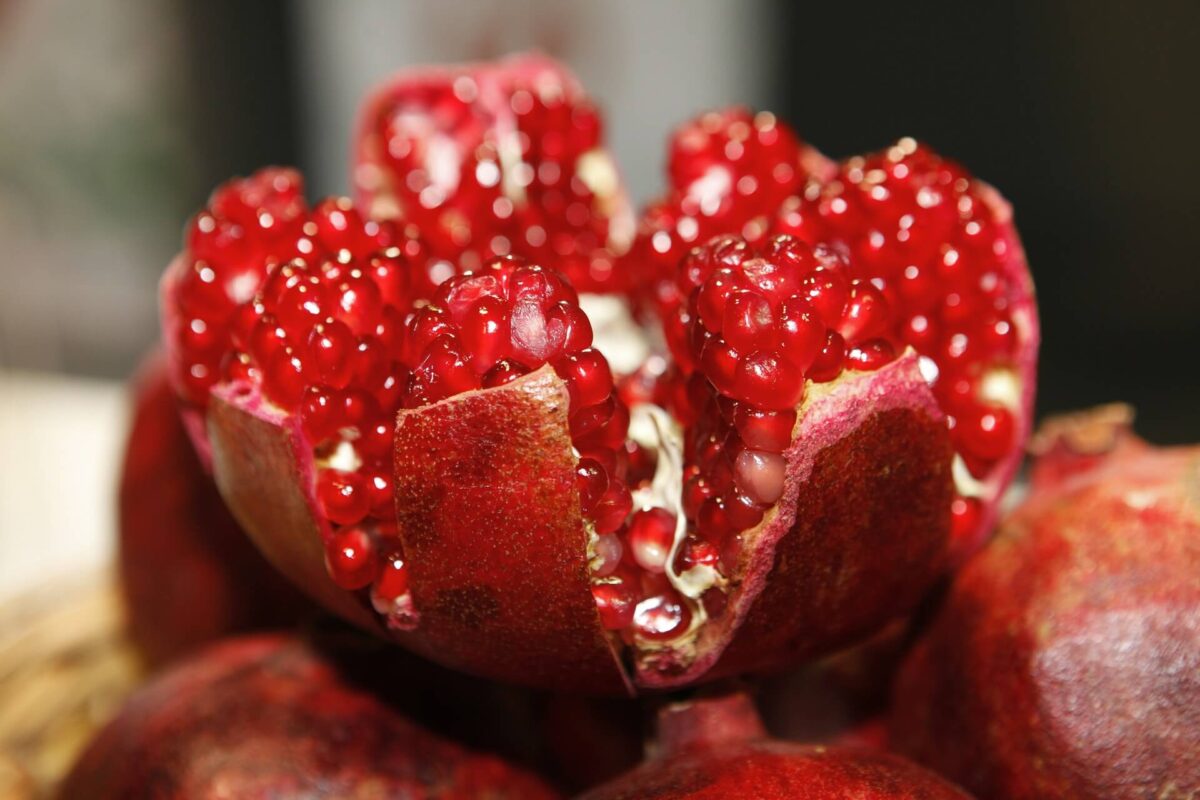
(Credit: Pixabay from Pexels)
Scientists Discover How Pomegranate Triggers the Gut’s Own Repair System
In A Nutshell
- Researchers have mapped a precise chain of molecular events by which Urolithin A, a compound the gut makes from pomegranate-related foods, strengthens the intestinal lining and reduces inflammation in mouse models and lab-treated cells from IBD patients.
- Urolithin A works by activating a specific receptor in gut lining cells, which triggers a protective signaling sequence involving two key immune molecules, IL-18 and IL-22, without broadly suppressing the immune system.
- When researchers removed any single step in that chain during mouse experiments, the protective effect disappeared entirely, confirming that each link is essential.
- No pomegranate foods or Urolithin A supplements have been shown to treat IBD in people; human clinical trials will be needed to determine whether this pathway can be targeted therapeutically.
Crohn’s disease and ulcerative colitis both involve a gut lining that has lost its ability to keep bacteria contained, leaving the body’s immune system in a state of chronic overdrive. Scientists may have found a way to fix that. They’ve identified a specific chain of molecular events triggered by a compound the body makes from pomegranate-related foods that appears to strengthen that wall and calm the chaos, a discovery that could point researchers toward a new treatment strategy for inflammatory bowel disease.
Urolithin A is a substance the gut produces when it breaks down ellagitannins, plant compounds found in pomegranates and certain other foods. That does not mean pomegranates or Urolithin A supplements have been shown to treat IBD in people. Researchers had previously shown that Urolithin A can protect against gut inflammation, but the exact biological steps it follows to do that remained a mystery. A new study published in Nature Communications has mapped that path in detail, revealing a precise chain reaction that reinforces the gut’s lining and turns down the inflammatory alarm.
What sets this discovery apart is its specificity. Urolithin A doesn’t broadly suppress inflammation. Instead, it activates a specific protein in the cells lining the gut, a molecular switch called the aryl hydrocarbon receptor, which then triggers a cascade of protective signals that reinforces the gut’s defenses, at least in experimental models and lab-prepared cells from intestinal biopsies from people with IBD.
Pomegranate Compound Urolithin A Triggers a Step-by-Step Gut Repair Sequence
Specifically, Urolithin A activates the aryl hydrocarbon receptor in the cells that form the lining of the intestine. Once that switch is flipped, it activates another protein called NLRP6, which acts like a sensor inside the cell. Activating NLRP6 leads to the controlled release of a signaling molecule called interleukin-18, or IL-18, a chemical messenger that helps keep the gut environment stable.
Critically, the researchers found that Urolithin A triggered the release of IL-18 but not a closely related, more inflammatory molecule called IL-1β. That distinction matters because IL-18 at the right level is protective, while too much of it, or releasing the wrong molecules, can actually make gut inflammation worse. Urolithin A appears to hit a kind of sweet spot, promoting just enough IL-18 to start a healing cascade without tipping into damage.
That IL-18 signal then travels to another group of immune cells in the gut lining, which respond by producing a second messenger called interleukin-22, or IL-22. IL-22 is a well-established repair signal: it stimulates the cells responsible for producing the gut’s protective mucus layer and ramps up production of proteins that help keep harmful bacteria in check.

Urolithin A’s Protective Effects Vanish When Key Links in the Chain Are Removed
Researchers then set out to confirm that each step of this chain was truly necessary. Mice engineered to lack the aryl hydrocarbon receptor in their gut lining cells showed no protective benefit from Urolithin A at all, while mice that lacked it only in immune cells were still protected, a result that pinpointed the gut lining as the critical site of action. Mice in the study were exposed to a chemical that induces colitis, a standard approach in IBD research. Similar knockout experiments then removed NLRP6, then IL-18, then IL-22 from the equation. In each case, removing a single piece of the chain broke the protective effect, confirming that every step is essential.
Scientists also prepared single-cell suspensions from intestinal biopsies collected from patients with IBD, taken from both inflamed and non-inflamed areas. When these cell preparations were exposed to Urolithin A in the lab for 24 hours, the compound triggered increased IL-18 in intestinal lining cells and increased IL-22 from immune cells, mirroring the mouse model results. Blocking the aryl hydrocarbon receptor using a chemical inhibitor eliminated that IL-22 response, supporting the receptor’s role in human cells as well. Notably, other known activators of the same receptor did not produce the same IL-18 response, suggesting Urolithin A engages it in a more targeted way.
Why This Pathway Could Matter for Future IBD Treatments
IBD has no cure, and the people who live with it often face years of trial-and-error with medications that work by broadly suppressing the immune system, an approach that can help but also leaves patients vulnerable to infections and other complications. Targeting a specific protective pathway in gut lining cells, without broadly dampening immunity, represents a different treatment strategy altogether.
Levels of the aryl hydrocarbon receptor and its natural activating molecules are already lower than normal in the intestines of IBD patients, suggesting these individuals may be starting at a disadvantage when it comes to maintaining a healthy gut barrier. Urolithin A, the researchers suggest, may offer a way to reactivate that protective pathway.
All of this was conducted on cell preparations in a laboratory setting, not in living patients, and the jump from lab dish to clinical treatment is a long one. Still, the fact that key signals observed in mice also appeared in cells from IBD patient biopsies is a meaningful sign that the biology may translate, and researchers consider this pathway a promising target worth pursuing in human trials.
Disclaimer: This article is based on peer-reviewed research. The findings described involve preclinical animal models and laboratory experiments on cells from human biopsies. Results have not been confirmed in human clinical trials. This content is intended for informational purposes only and should not be interpreted as medical advice. Consult a qualified healthcare provider regarding any medical condition or treatment.
Paper Notes
Limitations
Human tissue experiments in this study were conducted on single-cell suspensions from intestinal biopsies treated in a laboratory setting, not in clinical trials involving live patients. While the mouse models used are well-established for studying inflammatory bowel disease, they do not fully replicate the complexity of human IBD. Questions remain about how Urolithin A specifically activates NLRP6 but not NLRP3 in intestinal lining cells, and the precise molecular details of that selectivity have not yet been fully determined. Future studies using cell-specific IL-18 knockout models are needed to more precisely separate the roles of gut lining cells versus immune cells in producing IL-18 during different stages of inflammation and recovery.
Funding and Disclosures
Lead corresponding author Venkatakrishna Rao Jala is a co-founder of Artus Therapeutics. All other authors declare no competing interests. Funding was provided by NIH/NIGMS (P20GM125504-01), NIH/NIEHS (P30ES030283), NIH/NCI (CA191683), NIH/NIAAA (R21AA030638), NIH/NIDDK (R01DK135603), and The Jewish Heritage Fund for Excellence Research Enhancement Grant, among other sources affiliated with the University of Louisville Department of Microbiology and Immunology and UofL Brown Cancer Center.
Publication Details
Paper Title: Urolithin A activates aryl hydrocarbon receptor-NLRP6-mediated pathways in intestinal epithelial cells to modulate mucosal immunity and strengthen gut barrier integrity | Authors: Sweta Ghosh, Zachary M. Vanwinkle, Sobha Rani Bodduluri, Subir Kumar Juin, Mahendar Kadari, Ankita Singh, Gerald W. Dryden, Matthew B. Lawrenz, Thirumala-Devi Kanneganti, Shesh N. Rai, Misty Good, Pawan Kumar, Bodduluri Haribabu, and Venkatakrishna Rao Jala | Institutional Affiliations: University of Louisville (Department of Microbiology and Immunology, UofL-Brown Cancer Center, Center for Microbiomics, Inflammation and Pathogenicity; Department of Medicine); Stony Brook University (Department of Microbiology and Immunology); St. Jude Children’s Research Hospital (Department of Immunology); University of Cincinnati College of Medicine (Biostatistics and Informatics Shared Resource); University of North Carolina at Chapel Hill (Division of Neonatal-Perinatal Medicine, Department of Pediatrics) | Journal: Nature Communications | DOI: https://doi.org/10.1038/s41467-026-73760-3 | Received: November 11, 2025 | Accepted: May 15, 2026 | Published Online: June 23, 2026 | Article Number: 5411


