
Planet Volumes For Unsplash+
Lowering the Cost of Living Won’t Change Minds Already Made Up About Kids, Study Finds
In A Nutshell
- A nationwide survey of 20,118 adults found that personal traits like being single and older were tied to being childfree about 11 times more strongly than a state’s population size.
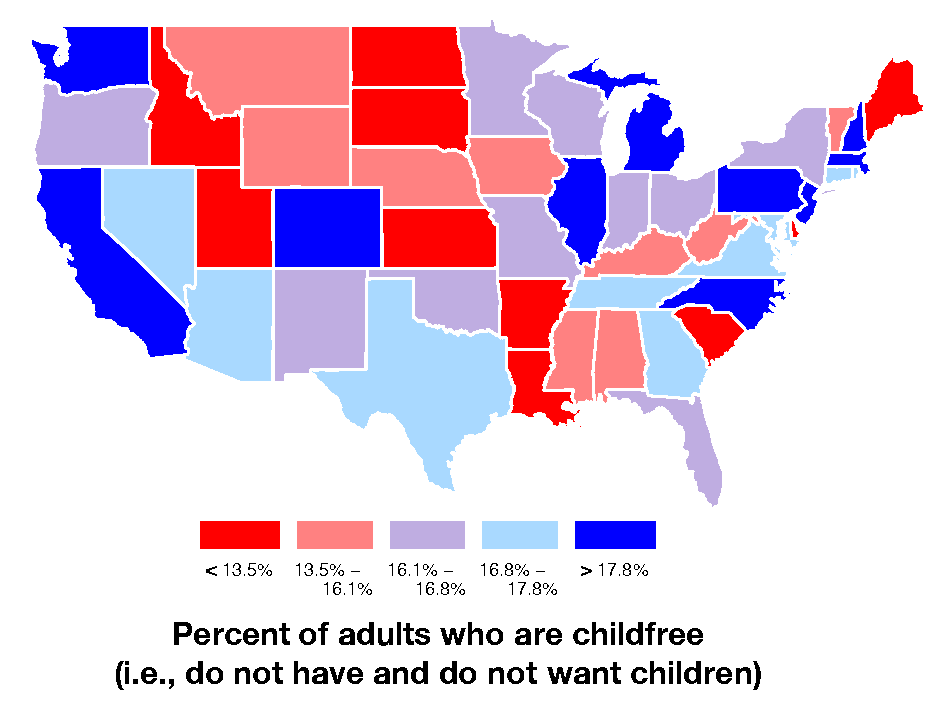
- Childfree adults are not clustered in any single region of the country, though some low-prevalence states are concentrated in the Mountain West and Great Plains.
- A state’s cost of living and population size showed a modest link to childfree rates, while more education spending was tied to somewhat lower rates.
- Researchers say policies aimed at cutting the cost of raising a family are unlikely to change the minds of people who have already decided against having kids.
Roughly 1 in 3 American adults without kids say they don’t want any, ever. Researchers call this group “childfree,” separating them from people who don’t have kids yet but plan to, or who wanted kids but couldn’t have them. A new study published in PLOS One asked whether the state someone lives in has much to do with that choice. The answer is mostly no.
Researchers at Michigan State University set out to map the childfree population across all 50 states. They wanted to know whether childfree adults were clustering in certain regions of the country, and whether things like a state’s cost of living pushed people toward that choice. What they found upended a tidy assumption: personal traits, like whether someone is single or how old they are, mattered far more than anything about the state they call home. Marital status alone was tied to being childfree about 11 times more strongly than a state’s population size was.
For policymakers hoping to reverse falling birth rates by adjusting state-level incentives, that’s a sobering finding.
Childfree Means No Kids and No Desire for Them, Not Just Not Yet
There are also non-parents who haven’t had kids yet and plan to, plus those still undecided. For this study, only people who fit the childfree definition count: adults who answered no to having children, no to wanting children in the future, and no to wishing they could have them.
Among people ages 15 to 44 who don’t have kids, the share who identify as childfree rose from 13.8% in 2002 to 29.4% in 2023.
No Evidence of Regional Clustering, Despite Some Low-End Overlap
To map where childfree people actually live, the research team drew on survey data collected in fall 2024 through the Civic Health and Institutions Project, a multi-university effort that surveys adults across all 50 states. After removing incomplete responses, the final sample included 20,118 adults spread across every state.
Respondents answered a series of questions about whether they had kids, planned to, or wished they could. Researchers weighted the responses so each state’s sample reflected its actual population by age, race, gender, and education.
California topped the list at 22%, while Louisiana came in lowest at 9.4%. South Dakota was close behind at 10.0%. Michigan and New Hampshire also ranked among the highest, at 19.9% and 19.4% respectively. Despite that spread, a statistical analysis found no evidence that childfree adults were clustering into specific regions. Some lower-prevalence states were concentrated in the Mountain West and Great Plains, but high-prevalence states were scattered around the country, from New England to the Midwest to the West Coast.
State Factors Play a Role, But a Small One
Researchers then asked whether features of each state lined up with more childfree residents. At first glance, three things seemed to matter: a bigger population, a higher cost of living, and stronger legal protections for abortion access.
But once the researchers accounted for who was actually answering the survey, that picture narrowed. Living in a bigger, pricier state was still tied to a modestly higher chance of being childfree. States that spent more per student on public education saw somewhat lower rates. Abortion access, once a promising lead, stopped mattering once individual traits were factored in.
Being single carried the strongest tie to being childfree, followed by age, being male, leaning politically liberal, and being white. Education level and whether someone lived in a city or a rural area made no real difference either way.
To put the difference in concrete terms, the researchers modeled two hypothetical people while holding state characteristics constant at national averages. A 30-year-old conservative partnered non-white woman had roughly a 3% chance of being childfree. A 50-year-old liberal single white man had closer to a 44% chance, a gap of more than 40 percentage points tied to differences in those individual traits.
State context moved the needle far less. For a different hypothetical woman, a politically moderate, single 30-year-old, comparing the cheapest, least populated, most education-friendly state against the priciest, most populated, least education-friendly one shifted her odds by about 13 percentage points, a real but much smaller effect than what individual traits produced above.
Cheaper Living Costs Won’t Change Minds Already Made Up
Government efforts to encourage more childbearing are gaining attention in several states. Some proposals focus on cutting the cost of raising a family or offering financial incentives for having children. This study’s results suggest those approaches are unlikely to change the minds of people who have already decided they don’t want children.
As the authors put it, “State policies designed to achieve population growth and encourage people to have children by, for example, reducing the cost of living or improving public education, are unlikely to have an effect on people who do not want children.” Whether a person lives in California or Louisiana, the decision not to have kids traces back to who they are, not their zip code.
Paper Notes
Limitations
This study has several limitations the authors openly acknowledge. First, the data only capture a snapshot in time, so it isn’t possible to track whether childfree individuals change their minds or whether the population shifts in different regions over the years. Second, the geographic detail is limited to the state level, meaning local clustering within cities or counties might exist but would be invisible in this analysis. Third, the study focuses on a limited set of state-level factors and doesn’t explore other potential influences, such as the political party of a state’s governor or the fraction of a state’s residents who identify with a particular political party. Finally, while the survey was weighted to reflect key population characteristics, it may not be perfectly representative on every dimension.
Funding and Disclosures
According to the paper, the authors received no specific funding for this work. The data used in the study come from the Civic Health and Institutions Project, and the funders and principal investigators of that project bear no responsibility for the analyses or conclusions reported in this paper. Michigan State University’s Institutional Review Board determined that analysis of these publicly available, anonymous data does not constitute human subjects research. No competing interests were declared.
Publication Details
Authors: Zachary P. Neal and Jennifer Watling Neal, Psychology Department, Michigan State University, East Lansing, Michigan. | Paper Title: “The spatial distribution of the U.S. childfree population: Does state context matter?” | Journal: PLOS One | Published: August 12, 2026 | DOI: https://doi.org/10.1371/journal.pone.0352872 | Data and code availability: Open Science Framework, https://osf.io/qexm3


