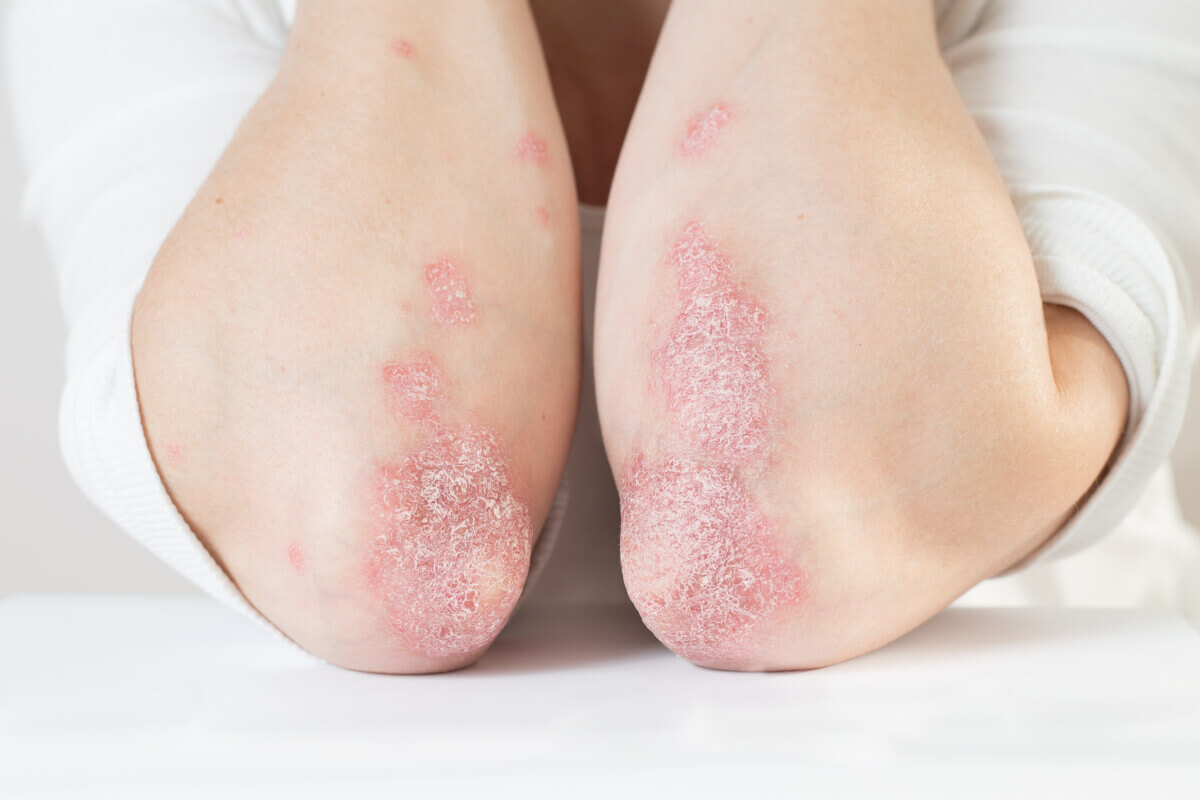
(Credit: © SNAB - stock.adobe.com)
In a Nutshell
- A natural body chemical called pantethine normally keeps immune cells called dendritic cells from becoming overactive, but an enzyme called Vanin breaks it down, allowing cholesterol to build up and trigger inflammation.
- Mice with psoriasis-like skin disease improved when researchers blocked Vanin or gave them extra pantethine, and the same calming effect showed up in immune cells taken from human psoriasis and lupus patients.
- In a small human trial, psoriasis patients who took pantethine capsules alongside their regular topical treatment improved more than patients who used the topical treatment alone.
A supplement already sold over the counter for cholesterol control just showed up as an unexpected psoriasis fighter. In a small clinical trial, psoriasis patients who added the compound, called pantethine, to their regular topical treatment improved more than patients who used the cream alone, researchers reported.
Dendritic cells are central to the finding. These immune cells act like the body’s security guards, patrolling for threats and calling in backup for an attack. In psoriasis, those guards become trigger-happy, attacking healthy skin and driving the rapid cell growth and inflammation that cause scaly, itchy patches.
Scientists found the culprit behind the overreaction, reported in the Journal of Experimental Medicine: an enzyme called Vanin that breaks down pantethine inside immune cells. Destroying pantethine lets cholesterol pile up on the cell’s surface, and that buildup is what switches dendritic cells into attack mode. When researchers blocked Vanin or topped up pantethine levels in mice and in cells from human psoriasis and lupus patients, the overactive immune response quieted down.
How Pantethine Calms the Psoriasis Immune Response
Researchers started by sifting through genetic data from patients with different autoimmune disorders, looking for patterns in which genes were switched on in their immune cells. Across several studies and patient groups, including people with lupus and psoriasis, the Vanin gene family kept showing up as unusually active in dendritic cells. That pattern held whether scientists looked at blood samples, skin biopsies, or immune cells grown in a lab dish and deliberately provoked with bacterial signals.
To see whether Vanins were causing the problem rather than just appearing alongside it, the team bred mice lacking a Vanin enzyme called Vnn3 and compared them with normal mice. Both groups were exposed to a cream that triggers psoriasis-like skin inflammation, a common method scientists use to study the disease in animals. Mice missing Vnn3 developed noticeably milder skin lesions, thinner inflamed patches, and lower levels of inflammatory chemicals in their skin. Their dendritic cells also failed to fully switch on, meaning they couldn’t effectively call in other immune cells for an attack.
Next, the team tested whether simply adding back pantethine could produce the same calming effect without touching the enzyme. They treated dendritic cells from mice, and later from human donors, with pantethine and watched activation levels drop. Treated cells became noticeably worse at displaying the molecular “wanted posters” that trigger immune attacks, and worse at provoking other immune cells into action. The researchers also tried a drug called RR6, which blocks Vanin directly, and saw similar results: calmer immune cells, less cholesterol buildup, and milder psoriasis symptoms in mice.
Cholesterol is what ties the whole process together. Pantethine normally helps limit how much cholesterol a cell produces. When Vanin destroys pantethine, cholesterol piles up on the cell’s outer wall, forming a dense cluster that acts almost like a megaphone for inflammatory signals. Restoring pantethine, either by adding it directly or blocking the enzyme that destroys it, reduced that cholesterol pileup and quieted the immune response. When researchers artificially added cholesterol back into pantethine-treated cells, the calming effect vanished, which pointed to cholesterol buildup as a main driver of the overactive immune response.
Finally, the team moved from mice to people. They tested dendritic cells taken from psoriasis and lupus patients and found that both pantethine and the RR6 drug reduced activation in those human cells as well. From there, the team ran a clinical trial with 24 psoriasis patients split into two groups. One group received a standard topical treatment combining two prescription medications, calcipotriol and betamethasone. The other group received the same topical treatment plus oral pantethine capsules taken twice a day. After 12 weeks, patients taking pantethine alongside their cream showed greater improvement in their psoriasis severity scores than those using the cream alone. Patients who also had unhealthy cholesterol levels at the start of the trial responded far better to pantethine than similar patients who received only the topical treatment. Those with normal lipid levels saw little difference between the two approaches, a pattern that fits the researchers’ view that pantethine works partly by affecting cholesterol. No treatment-related side effects were reported.

Why Pantethine Could Matter for Psoriasis Patients
Psoriasis affects far more than appearance. It’s a chronic inflammatory disease that can bring pain, emotional strain, and a higher risk of other health problems. Current treatments range from topical creams to expensive biologic drugs, but not everyone responds well, and some options come with steep costs or side effects. A compound sold over the counter for years to manage cholesterol, now showing promise against an autoimmune skin disease, is an unusually accessible option.
A clear chain of cause and effect runs through the work: an enzyme destroys a protective compound, that destruction triggers a cholesterol buildup, and the buildup pushes immune cells into overdrive. Each link in that chain was tested separately, by blocking the enzyme, restoring the compound, and manipulating cholesterol directly, and each step produced the expected result. Seeing that same pattern hold up across mouse studies, human cells, and now a clinical trial gives the Vanin-pantethine link real staying power, not just lab curiosity.
Cao and colleagues are upfront that this was a small trial at a single medical center, designed to test whether the idea works at all rather than to prove definitively that the same mechanism plays out in people exactly as it does in mice. Still, for a disease that affects millions and often requires lifelong management, discovering that a cheap, familiar supplement might add real benefit to existing treatment is worth watching, especially for patients who are also dealing with high cholesterol alongside their skin symptoms.
Disclaimer: This research combined mouse experiments, lab-grown human cells, and a small, single-center proof-of-concept trial in 24 psoriasis patients. The findings are early and not confirmation that pantethine is an effective psoriasis treatment. Pantethine is sold as a cholesterol supplement, not an approved psoriasis therapy, and larger trials are needed. Anyone considering it should talk with a doctor before adding a supplement to their treatment.
Paper Notes
Limitations
This trial ran at a single medical center with a small group of psoriasis patients, 24 of whom completed the 12-week analysis. Researchers frame it as a proof-of-concept study rather than a definitive, large-scale confirmation. The authors note that clinical benefits may involve contributions from cell types beyond dendritic cells, and that evidence for the Vanin-pantethine axis in autoimmune diseases beyond psoriasis remains largely associative and requires further validation in disease-specific models. They also point out that other cholesterol-lowering drugs, such as statins, have shown inconsistent effects on dendritic cell function in past studies, an indication that the relationship between cholesterol-modulating drugs and immune cells can shift depending on context.
Funding and Disclosures
The National Natural Science Foundation of China and the Research Foundation of the Nanhu Laboratory supported this work. The authors declared no competing interests.
Publication Details
Paper Title: “Vanin-pantethine metabolic axis shapes dendritic cell function and affects inflammatory disorder progression”
Authors: Ai-Ping Cao, Jun-Cheng Li, Rui Wang, and colleagues, affiliated with institutions including Nanhu Laboratory’s State Key Laboratory of Biomedical Analysis, Huazhong University of Science and Technology, Fudan University, and the Chinese PLA General Hospital
Journal: Journal of Experimental Medicine, 2026, Vol. 223, No. 11, e20252558.
DOI: 10.1084/jem.20252558


