
Getty Images For Unsplash+
HIV Patients on Ozempic Were Aging Up to 4.9 Fewer Biological Years Per Year, Trial Analysis Finds
In A Nutshell
- A new analysis of a randomized clinical trial found that semaglutide, the active ingredient in Ozempic and Wegovy, was linked to measurably slower biological aging in adults with HIV.
- Participants on semaglutide showed up to 4.9 fewer biological years of aging per calendar year compared to those on placebo, across multiple epigenetic clocks.
- Blood-based aging markers tied to the brain, heart, liver, kidneys, and inflammation all trended in a positive direction in the semaglutide group.
- Researchers caution the findings are exploratory, the sample was small, and further trials are needed before conclusions extend to the broader population.
Millions of people already take semaglutide to lose weight or protect their hearts. A new clinical trial analysis suggests the drug may also be capable of slowing the rate at which the body biologically ages.
Blood samples taken from adults with HIV during a 32-week randomized, controlled trial showed measurably slower rates of biological aging in those who received the drug compared to those who got a placebo, and the effect held up across multiple independent tests. Published in Nature Communications, the analysis marks the first randomized trial evidence that semaglutide, the active ingredient in Ozempic and Wegovy, can measurably affect biological aging markers.
Biological age and chronological age are not the same thing. A person can be 50 years old by the calendar but have a body that functions more like a 60-year-old, or a 40-year-old. Scientists can now measure this gap using tools called epigenetic clocks, which read chemical changes on DNA that accumulate over time in patterns tied to health and disease risk. People with HIV tend to age faster biologically, even when their infection is well-managed, making them a practical population for testing whether a drug can push back against that accelerated aging process.
Semaglutide Trial Enrolled HIV Patients With Excess Abdominal Fat
This was not a study designed from scratch to test aging. It was a deeper look inside an already completed trial. The original study was a phase 2 randomized, double-blind, placebo-controlled trial designed to test whether semaglutide could reduce excess body fat in people with HIV-associated lipohypertrophy, a condition where abnormal fat accumulates around the abdomen and internal organs. Neither the participants nor the researchers knew who was receiving the real drug or the saline placebo.
A total of 108 adults were enrolled, 54 to semaglutide and 54 to placebo. Participants had to be at least 18, have a confirmed HIV diagnosis, be on stable HIV medication for at least 12 weeks, and have a body mass index of 25 or higher. People with diabetes or active heart disease were excluded. Semaglutide was injected once weekly, starting at a low dose and stepping up over eight weeks before continuing at full dose through week 32.
Of the 108 participants, 84 had blood samples available at both the start and end of the study, 45 in the semaglutide group and 39 in placebo. The average age was 49, and about 42 percent were women. Fifty-eight percent were Black, 38 percent were White, and 11 percent were Hispanic.
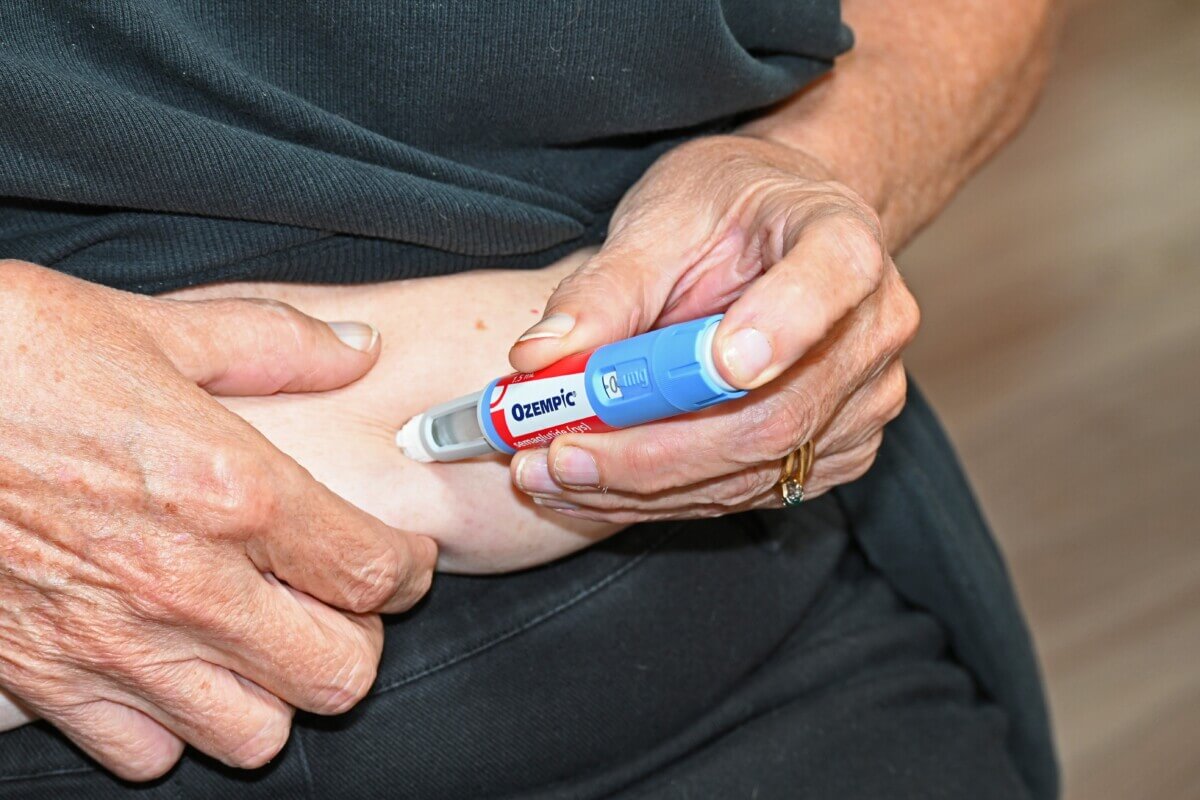
Semaglutide Users Were Aging up to 4.9 Fewer Biological Years Per Year
Researchers ran the blood samples through 17 different epigenetic clocks, essentially different scientific instruments for reading how fast a person’s biology appears to be aging. Across the more advanced clocks, semaglutide produced consistent, statistically significant reductions in biological aging rates compared to placebo. One measure called PhenoAge, which predicts risk of death and disease, showed the largest effect: participants on semaglutide were aging nearly 4.9 fewer biological years per calendar year compared to those on placebo. Another well-regarded measure called DunedinPACE showed that participants on semaglutide were aging approximately 9 percent more slowly than those on placebo.
Blood-Based Clocks Pointed to Changes Across Several Body Systems
Perhaps the most expansive part of the analysis involved 11 organ-specific aging clocks measurable from a single blood sample. These tools use patterns in blood to estimate aging signals linked to different body systems, including the brain, heart, liver, kidneys, and lungs. Semaglutide was associated with meaningful reductions in biological aging across seven of these system-specific measures, with the largest effects in clocks tracking inflammation, brain aging, and metabolic aging. Four other system clocks trended in the same direction but did not reach statistical significance, possibly because the sample was small. The researchers tested whether shifts in immune-cell types might explain the findings and found no significant differences between groups, though they note subtle effects cannot be fully ruled out.
Researchers Say Larger Trials Are Needed Before Broader Conclusions
This was an exploratory analysis added onto a trial with different primary goals, and that distinction matters. The sample was relatively small, the follow-up was only 32 weeks, and the population was specific: middle-aged adults with HIV and excess abdominal fat, without diabetes or heart disease. Whether these results would hold in HIV-negative people, in older adults, or over longer treatment periods remains an open question.
Epigenetic clocks are statistical predictors, not definitive proof that cells are biologically younger or that a person will live longer, and blood-based measurements cannot confirm what is actually happening inside specific organs. The paper is currently an unedited Article in Press, meaning it may still undergo final editing before final publication. Purpose-built trials in larger and more diverse populations are the necessary next step before semaglutide can seriously be considered a tool for slowing human aging more broadly.
Disclaimer: This article is based on a post hoc exploratory analysis published as an unedited Article. The findings have not been replicated in larger or more diverse populations and should not be interpreted as proof that semaglutide extends lifespan or slows aging in the general population.
Paper Notes
Limitations
This study was a post hoc exploratory analysis, meaning the epigenetic aging outcomes were not pre-specified in the original trial design. The sample size of 84 participants is modest, and the follow-up period was limited to 32 weeks. The cohort was specific to adults with HIV and lipohypertrophy, which limits the ability to generalize findings to the general population or to people without HIV. Epigenetic clocks were measured in blood cells, not directly in organ tissues, meaning they are indirect indicators of organ-level aging rather than definitive measures. The study did not fully account for individual variation in prior HIV medication history, which may have influenced baseline biological age or responsiveness to treatment. The authors also note that epigenetic clocks are statistical predictors of aging-related outcomes, not mechanistic proof of altered lifespan, and that small methylation differences at the individual DNA site level have uncertain biological significance. Serial samples beyond the 32-week endpoint were not collected, so longer-term trajectories could not be assessed.
Funding and Disclosures
The study used datasets from a biobank supported by project grant R01DK121619, approved by the University Hospitals Cleveland Medical Center Committee. Additional support came from the Clinical and Translational Science Collaborative of Northern Ohio (UM1TR004528), the James B. Pendleton Charitable Trust, and the San Diego Center for AIDS Research (P30 AI036214). Participants received the study drug free of charge and were financially compensated for time and travel. Two co-authors, Varun Dwaraka and Ryan Smith, are employees of TruDiagnostic, a company involved in DNA methylation analysis. Lead author Michael J. Corley serves as a scientific advisor for TruDiagnostic. Co-author Grace McComsey serves as a research consultant for Merck, GlaxoSmithKline/ViiV, and Gilead. The paper is published as Open Access under a Creative Commons Attribution 4.0 International License.
Publication Details
Authors: Michael J. Corley, Varun B. Dwaraka, Alina PS Pang, Danielle Labbato, Ryan Smith, Allison Ross Eckard, and Grace A. McComsey. Corley is affiliated with the University of California San Diego, Department of Medicine, Division of Geriatrics, Gerontology and Palliative Care. Dwaraka and Smith are affiliated with TruDiagnostic, Lexington, Kentucky. Labbato and McComsey are affiliated with University Hospitals Cleveland Medical Center, Cleveland, Ohio. Eckard is affiliated with the Medical University of South Carolina, Charleston. McComsey is also affiliated with Case Western Reserve University, Cleveland, Ohio. | Journal: Nature Communications | Paper Title: ‘Semaglutide slows epigenetic aging in a randomized trial of HIV-associated lipohypertrophy’ | DOI: https://doi.org/10.1038/s41467-026-72861-3 | Status: Article in Press (unedited version; final publication pending further editing) | Received: July 22, 2025 | Accepted: April 24, 2026


