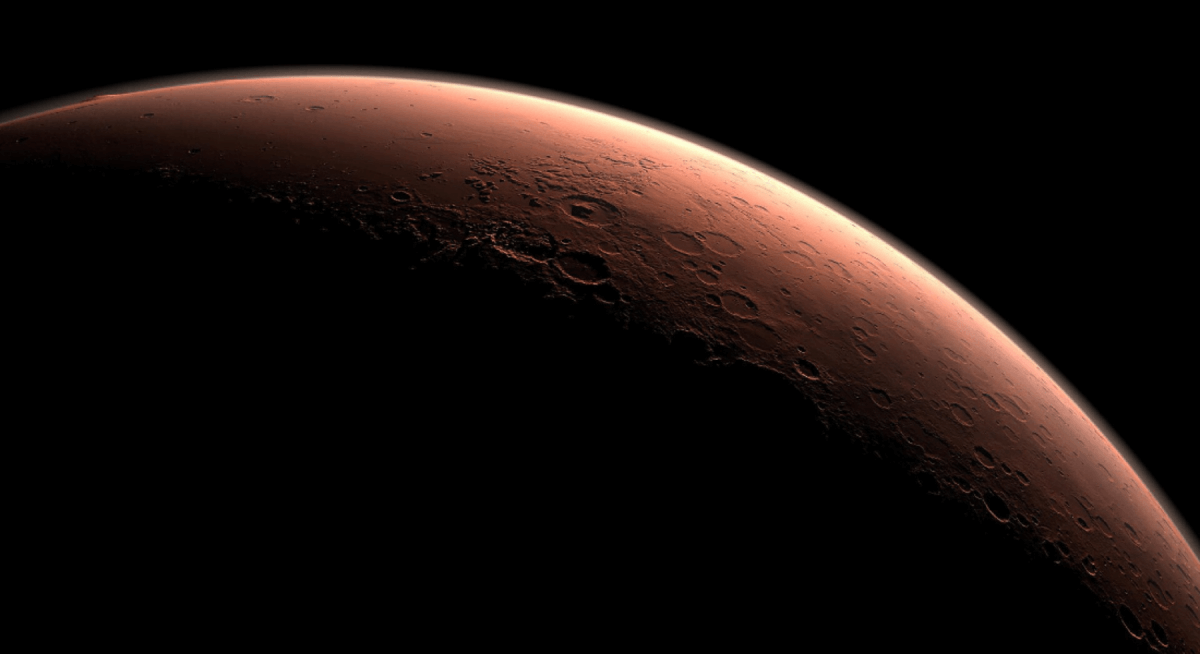
Daybreak at the Gale Crater on Mars where organic material was found Photo: NASA/JPL-Caltech/MSSS
COPENHAGEN — Two samples from Mars together deliver the “smoking gun” in a new study showing the origin of Martian organic material. The study presents solid evidence for a prediction made over a decade ago by University of Copenhagen researchers that could be key to understanding how organic molecules, the foundation of life, were first formed here on Earth.
In a meteor crater on the red planet, a solitary robot is moving about. Right now, it is probably collecting soil samples with a drill and a robotic arm, as it has quite a habit of doing. NASA’s Curiosity rover has been active on Mars as the extended arm of science for nearly 12 years, and it continues to make discoveries that surprise and challenge scientists’ understanding of both Mars and our own world here on Earth.
Most recently, the discovery of sedimentary organic material with particular properties has had many researchers scratching their heads. The properties of these carbon-based materials, in particular the ratio of its carbon isotopes, surprised researchers.
Facts: Organic material
The sample found on Mars contains deposits of so-called organic material.
To laymen, this may sound more exciting than it is. Organic material in a chemical context does not necessarily mean something living, as one might normally think. The term covers molecules that contain carbon and at least one other element and can easily exist without life. These molecules are rather the building blocks of life.
Organic materials with such properties, if found on Earth, would typically be a sign of microorganisms, but they can also be the result of non-biological, chemical processes. The find obviously had researchers scrambling for a clear answer, but nothing seemed to fit.
However, for the research collaboration behind a study published in Nature Geoscience, there has been little hair scratching and much enthusiasm.
In fact, the discovery on Mars provided the missing piece that made everything fall into place for this group of researchers from the University of Copenhagen and the Tokyo Institute of Technology.
As co-author and chemistry professor Matthew Johnson puts it, it is “the smoking gun” needed to confirm a decade old theory of his about so-called photolysis in Mars’ atmosphere.
With the Curiosity sample, the new research is able to prove with reasonable certainty that the Sun broke down CO2 in the Martian atmosphere billions of years ago – as the old theory predicted. And that the resulting carbon monoxide gradually reacted with other chemicals in the atmosphere synthesizing complex molecules – and thus providing Mars with organic materials.
“Such carbon-based complex molecules are the prerequisite of life, the building blocks of life one might say. So, this it is a bit like the old debate about which came first, the chicken or the egg. We show that the organic material found on Mars has been formed through atmospheric photochemical reactions – without life that is. This is the ‘egg’, a prerequisite of life. It still remains to be shown whether or not this organic material resulted in life on the Red Planet.” said Johnson and continued:
“Additionally because Earth, Mars and Venus had very similar CO2 rich atmospheres long ago when this photolysis took place, it can also prove important for our understanding of how life began on Earth,” said Professor Matthew Johnson from Department of Chemistry at University of Copenhagen.
Facts: What is Photolysis
Photolysis means that the Sun’s UV rays provide molecules with energy to perform a chemical transformation. According to the research this happened in the Martian atmosphere, where 20% of CO2 molecules there were split into oxygen and carbon monoxide.
In earlier research, Johnson and colleagues showed that carbon dioxide containing the carbon-12 isotope is photolyzed more quickly than the heavier isotope carbon-13. Over time, CO is produced that is depleted in 13C, and 13C builds up in the remaining CO2. This results in so-called isotopic enrichment in CO2 and depletion in CO, like mirror images of each other or the two halves of a broken plate.
It is the fractionation ratio in carbon, which serves as evidence of photolysis in the two samples from Mars.
Two pieces separated by 50 Million Kilometers – one puzzle solved
Twelve years ago, Johnson and two colleagues used simulations based on quantum mechanics to determine what happens when a CO2-rich atmosphere is exposed to the UV light of the Sun, in a process known as photolysis.
Basically, on Mars, around 20% of the CO2 is split into oxygen and carbon monoxide. But carbon has two stable isotopes: carbon-12 and carbon-13. Usually, they are present in a ratio of one carbon-13 for every 99 carbon-12. However, photolysis works faster for the lighter carbon-12, so the carbon monoxide produced by photolysis has less carbon-13 (is depleted), and the leftover CO2 has more (is enriched).
Because of this, Johnson and his colleagues were able to make very precise predictions of the ratio of carbon isotopes after photolysis. And this gave them two distinctive fingerprints to look for. One of these was identified in a different Martian sample, years ago.
“We actually have a piece of Mars here on Earth, which was knocked off that planet by a meteorite, and then became one itself, when it landed here on Earth. This meteorite, called Allan Hills 84001 for the place in Antarctica where it was found, contains carbonate minerals that form from CO2 in the atmosphere. The smoking gun here is that the ratio of carbon isotopes in it exactly matches our predictions in the quantum chemical simulations, but there was a missing piece in the puzzle. We were missing the other product of this chemical process to confirm the theory, and that’s what we’ve now obtained,” says Matthew Johnson.
Facts: Isotopes Have Different Weights
Isotopes are variants of the same element that have different weights because the nucleus contains more or fewer neutrons.
Carbon has two stable isotopes – Normally, about 99% of carbon has 6 protons and 6 neutrons in its nucleus (12C). About 1% has 6 protons and 7 neutrons instead (13C). The ratio can serve as a chemical fingerprint, revealing what reactions the carbon has undergone.
Photolysis favors carbon-12, and a high concentration of the isotope can therefore indicate this process.
The carbon in the Allan Hills meteorite is enriched in carbon-13, which makes it the mirror image of the depletion in carbon-13 that has now been measured in the organic material found by Curiosity on Mars.
The new study has thus linked data from two samples, which researchers believe have the same origin in Mars’ childhood but were found more than 50 million kilometers apart.
“There is no other way to explain both the carbon-13 depletion in the organic material and the enrichment in the Martian meteorite, both relative to the composition of volcanic CO2 emitted on Mars, which has a constant composition, similar as for Earth’s volcanos, and serves as a baseline,” said Johnson
Hope to find the same evidence on Earth
Because the organic material contains this isotopic “fingerprint” of where it came from, researchers are able to trace the source of the carbon in the organic material to the carbon monoxide formed by photolysis in the atmosphere. But this also reveals a lot about what happened to it in between.
“This shows that carbon monoxide is the starting point for the synthesis of organic molecules in these kinds of atmospheres. So we have an important conclusion about the origin of life’s building blocks. Although so far only on Mars,” said Matthew Johnson.
Facts: The oxygen painted Mars red
Photolysis of a CO2 molecule yields carbon monoxide (CO) and an oxygen atom (O). On Mars, only carbon monoxide remains, which is transformed into the organic material found by the Curiosity rover.
But where the oxygen has gone is also no secret. The oxygen combines into O2, which interacts with iron on Mars’ surface. The Red Planet is rust red due to oxidized iron.
Researchers hope to find the same isotopic evidence on Earth, but this has yet to happen, and it could be a much bigger challenge because our geological development has changed the surface significantly compared to Mars, Johnson explains.
“It is reasonable to assume that the photolysis of CO2 was also a prerequisite for the emergence of life here on Earth, in all its complexity. But we have not yet found this “smoking gun” material here on Earth to prove that the process took place. Perhaps because Earth’s surface is much more alive, geologically and literally, and therefore constantly changing. But it is a big step that we have now found it on Mars, from a time when the two planets were very similar,” says Matthew Johnson.
Press release and media provided by the University of Copenhagen – Faculty of Science
The paper, “Synthesis of 13C-depleted organic matter from CO in a reducing early Martian atmosphere,” was published in Nature Geoscience on May 9, 2024.
The following researchers have contributed to the new study:
From the Department of Chemistry at the University of Copenhagen:
Matthew S. Johnson and Johan A. Schmidt
From the Tokyo Institute of Technology:
Yuichiro Ueno, Xiaofeng Zang, Alexis Gilbert, Hiroyuki Kurokawa and Tomohiro Usui
From the University of Tokyo and the Royal Belgian Institute of Space Aeronomy:
Shohei Aoki


