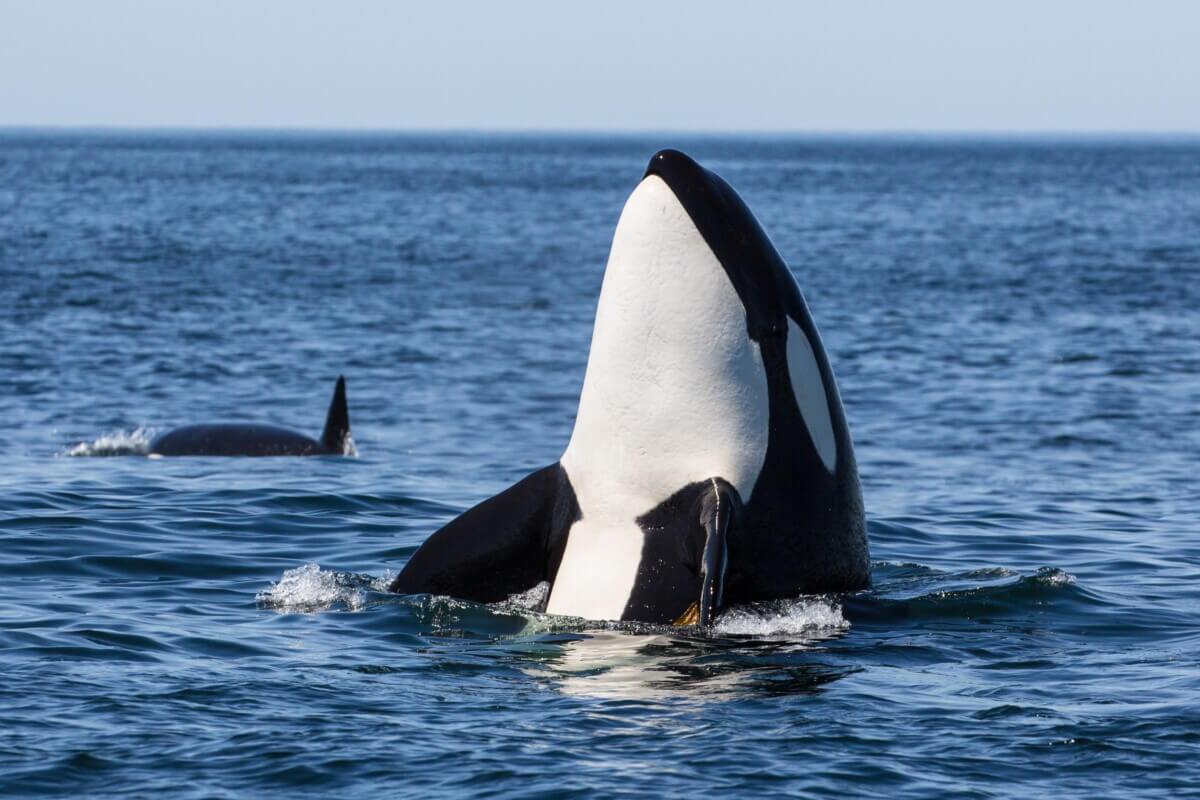
(Photo by Tory Kallman on Shutterstock)
This Orca Hunting Move Had Never Been Filmed in Detail, Until Now
In A Nutshell
- Orcas in the Gulf of California were filmed using a coordinated ramming maneuver, holding a sunfish steady while a second orca slammed into it at high speed and broke apart its flesh.
- Researchers call the pattern “ram-to-fragment,” and say this level of detail in the behavior has not previously been described.
- A juvenile or calf fed on the resulting fragments in both events, hinting the maneuver may help younger orcas access food they could not easily get on their own.
- The sunfish were already dead before ramming began, suggesting the behavior processes a carcass rather than delivers a killing blow.
Researchers have captured rare footage of orcas in the Gulf of California executing a high-speed ramming maneuver forceful enough to cause substantial tissue fragmentation in a sharp-tail sunfish, sending chunks of flesh into the surrounding water. In the first event, a juvenile fed on the scattered fragments while the adults ate from the larger remains. In the second, a calf extracted tissue from the main carcass instead. The study, published in the journal Frontiers in Ethology, says this ram-to-fragment pattern has not previously been described in detail.
Sunfish are the world’s largest bony fish, and orcas are known to hunt them, but what these researchers witnessed was not a straightforward kill. Teamwork is what makes the behavior memorable. Whether it reflects intentional parental feeding, social play, or some mix of both remains unclear, but researchers say it points to cooperative precision that, in their cautious view, goes beyond what had previously been documented.
Both Attacks Followed the Same Precise Pattern
Both events were captured on video, giving researchers the ability to reconstruct each interaction step by step. The first was recorded on July 29, 2024, near San Jose del Cabo, Mexico, among a group that included three adult females, a male, and a juvenile. An adult female held a sunfish by its clavus, the distinctive rounded tail structure unique to sunfish, while the adult male accelerated toward it belly-up at high speed. She released the sunfish just before impact, and the collision sent tissue fragments spreading through the water. Because filming began after the prey had already been killed and opened, researchers could not reconstruct the full hunting sequence. A juvenile, estimated at roughly half to three-quarters the adult female’s length, swam through the fragments and began eating them, while the adults fed on the larger remaining portions.
A second event, recorded September 7, 2025, near Isla Cerralvo, followed a similar pattern with three adult females and a calf. One adult steadied the sunfish while another rammed it in an upright position, then flipped belly-up after impact. A third adult joined to feed on the split-open carcass, and the calf extracted tissue from that primary carcass as well. Earlier that same day, the group had been seen preying on a shortfin mako shark. The first group of orcas had a similarly varied menu: before the sunfish encounter, they had already killed and eaten a spine-tail devil ray. Researchers say this kind of dietary range fits what is already known about orcas in the Gulf of California, where some pods hunt sharks and rays while others focus on fish, rather than sticking to one kind of prey the way some orca populations elsewhere in the world do.
A Water-Rich Collagen Layer Makes Sunfish Vulnerable
Sharp-tail sunfish have a thick outer layer made largely of a gel-like collagen material that is nearly 90% water, an unusual composition that may explain their vulnerability to this kind of impact. Researchers note that pronounced fragmentation like this has not been reported for other sunfish species, suggesting something specific about the sharp-tail’s structure.
Sunfish spend much of their time near the ocean’s surface, resting and warming up in the sun after diving into colder depths below, a habit that puts them within easy reach of hunting orcas. Despite a long-held assumption that sunfish are sluggish, recent research shows they are capable swimmers with strong evasive responses. In these incidents, though, the sunfish were already dead and had their organs removed before ramming began, suggesting that the maneuver was used to process a carcass rather than deliver a killing blow.
Adults May Be Fragmenting Prey to Help Younger Orcas Feed
Researchers are also interested in what this says about how orcas learn together. Orcas engage in behaviors that appear to involve learning, play, and the passing of knowledge within family groups, and adults breaking prey into manageable pieces could reflect a form of parental investment, though researchers frame this as one possible interpretation among several rather than a confirmed finding.
Researchers raise a more speculative side point, too. Sunfish carry distinct microbial communities in their outer tissues, and scattering that tissue into the water column may influence the surrounding environment by redistributing nutrients and microbial material. Researchers present this as a hypothesis worth exploring, not an established effect.
Wildlife tourism and consumer camera technology made both recordings possible; one came from an authorized tour operation, the other from footage a third party uploaded. Researchers caution that more sightings do not necessarily mean orcas are doing this more often. It may simply mean more people are watching.
Sunfish are the most frequently observed fish prey for orcas in the Gulf of California, and these two events add real detail to that picture. Orcas here have also been recorded working together to hunt whale sharks and herd rays, so the sunfish ramming fits a broader pattern of teamwork rather than standing alone as an isolated oddity. What researchers captured is evidence of coordinated behavior that may be learned socially, in which adults may be shaping feeding opportunities for younger orcas, though confirming that will require more observation.
Paper Notes
Limitations
This study is based on two opportunistic observations rather than a controlled or systematic study, which limits how broadly its conclusions can be applied. Sample size is inherently small given the nature of opportunistic wildlife documentation. Researchers could not confirm whether the same individual orcas appeared in both events, since high-resolution identification photographs were not collected across both encounters. Because both events were already underway or partially complete when filming began, the full sequence of each predation event could not be reconstructed. Researchers also note it remains difficult to determine whether more documented events reflect a true rise in this behavior or simply greater observation effort from more people with cameras on the water.
Funding and Disclosures
Authors declared that no financial support was received for this research or its publication. One author declared membership on the editorial board of Frontiers at the time of submission, stated to have had no impact on the peer review process or final publication decision. Authors declared no commercial or financial conflicts of interest and stated that generative AI was not used in the creation of the manuscript.
Publication Details
Authors: Kathryn A. Ayres, Austin J. Gallagher, Christine V. Avena, Carlos M. Duarte, and Jesús Erick Higuera Rivas | Affiliations: Beneath The Waves, Boston, MA, United States; Marine Science Program, Biological and Environmental Science and Engineering Division (BESE), King Abdullah University of Science and Technology (KAUST), Thuwal, Saudi Arabia; Conexiones Terramar A.C., La Paz, Baja California Sur, Mexico; Protección y Conservación Pelágica A.C., Ciudad de México, Mexico | Journal: Frontiers in Ethology, Volume 5, 2026 | Paper Title: Fragmentation of sharp-tail sunfish (Masturus lanceolatus) caused by high-impact ramming behavior in orcas (Orcinus orca) | DOI: 10.3389/fetho.2026.1835536 | Published: July 23, 2026


