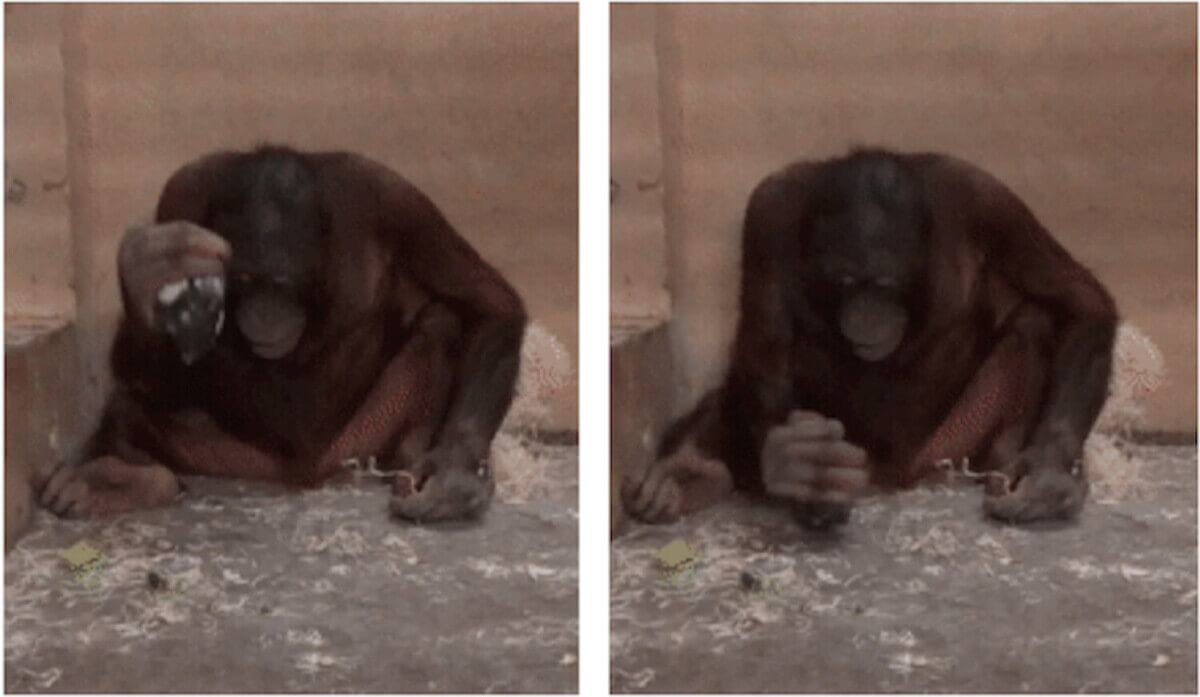
Loui (the juvenile male orangutan) using the core as an active element to vertically strike on the concrete floor of the testing room during the Flake Trading condition of Experiment 2. (Credit: Motes-Rodrigo et al., 2022, PLOS ONE, CC-BY 4.0 (https://creativecommons.org/licenses/by/4.0/))
TÜBINGEN, Germany — Untrained orangutans instinctively use hammers to strike and sharp stones to cut, reveals a new study. The largest tree-living great apes engage in behavior that show how close humans are to our genetic cousins, according to German researchers.
Without prompt, orangutans can strike rocks together, break off sharp pieces and use those flints to cut. The fascinating behavior was observed in two captive male orangutans in Norway’s Kristiansand Zoo. Neither had previously been trained or exposed to demonstration.
Scientists believe their findings show that the emergence of stone tool use could have began some 13 million years ago in our last common ancestor with orangutans.
For the study, the authors provided the orangutans with a concrete hammer, a prepared stone core, and two baited puzzle boxes requiring them to cut through a rope or a silicon skin in order to access a food reward. Both orangutans spontaneously hit the hammer against the walls and floor of their enclosure, but neither directed strikes towards the stone core.
In a second experiment, the orangutans were also given a human-made sharp flint flake, which one orangutan used to cut the silicon skin, solving the puzzle. This is the first demonstration of cutting behavior in untrained orangutans.
Researchers then decided to see if showing the apes the desired behavior would lead them to accomplishing the feat faster. The team demonstrated for three female orangutans at Twycross Zoo in the United Kingdom how to strike a core to create a flint flake. After just one time, a female went on to to use the hammer to hit the core, directing the blows towards the edge.
“Our study is the first to report that untrained orangutans can spontaneously use sharp stones as cutting tools,” the authors explain in a statement. “We also found that they readily engage in lithic percussion and that this activity occasionally leads to the detachment of sharp stone pieces.”
The study is published in the journal PLOS One.
Report by South West News Service writer Joe Morgan.


