
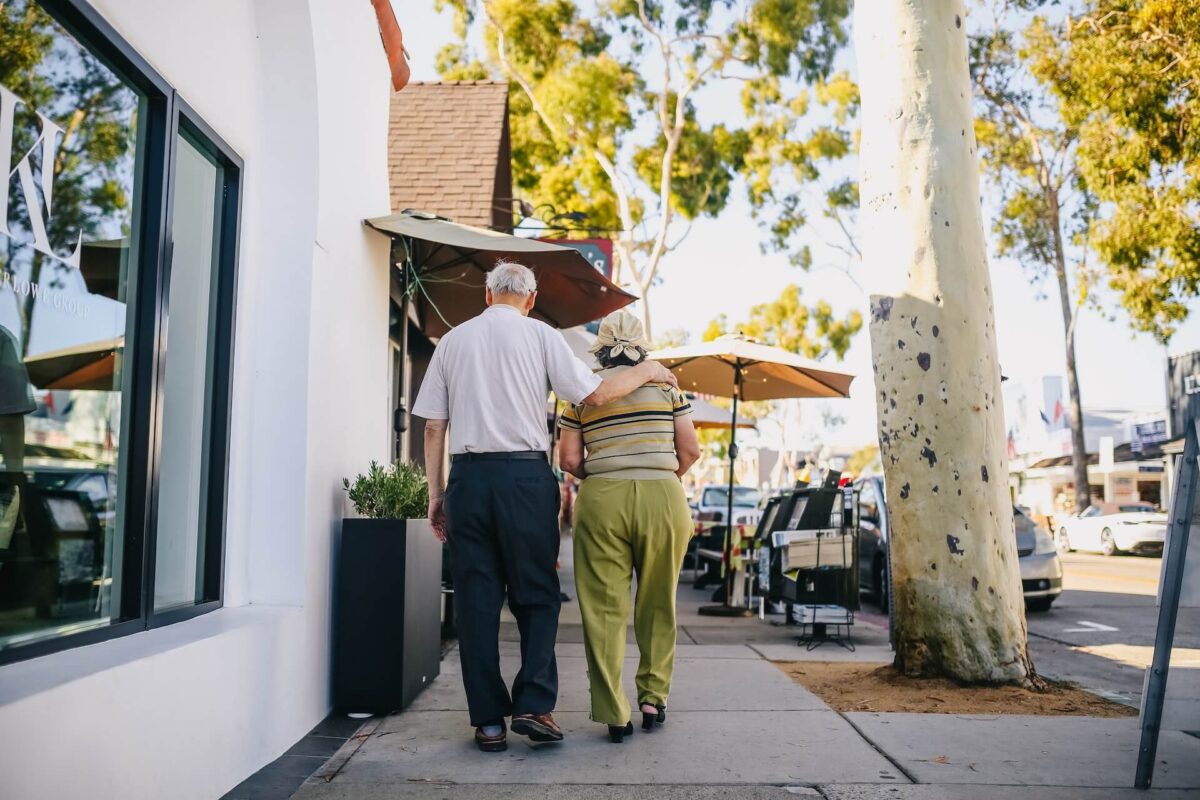
Moments of shared happiness, relaxation help lower stress among older couples. (© NDABCREATIVITY - stock.adobe.com)
In A Nutshell
- Partners only experienced positive emotions at the same time during 38% of the moments they spent together
- When both people felt happier, more relaxed, or more interested than their usual, their stress hormone levels dropped measurably in both partners
- The effect lasted beyond the moment itself: shared good moods at one check-in predicted lower stress hormones hours later at the next measurement
- Individual happiness matters for health, but sharing positive emotions with your partner adds something extra that shows up in the body’s stress response
Spend decades with someone under the same roof, and you’d think emotional synchrony would be constant. But researchers discovered something surprising when they tracked 321 older couples through their daily routines. Partners only felt genuinely good at the exact same moments about 38% of the time they were together.
That might sound low, but there’s a twist that changes everything. During those scattered moments when both people felt happier, more relaxed, or more interested than usual, something measurable happened in their bodies. Their levels of the stress hormone cortisol dropped noticeably. And the effect didn’t just vanish when the moment passed.
Scientists from universities in Canada, the United States, and Germany combined data from three separate studies to answer a deceptively simple question: Does sharing positive emotions with a partner affect biology differently than feeling good alone? They collected both emotional reports and saliva samples from participants aged 56 to 89, up to seven times daily for a week. After controlling for individual happiness levels, time since waking, recent food and caffeine intake, physical activity, medication use, age, sex, assay version, and other behaviors that influence cortisol, the pattern held. Shared positive moments corresponded to lower stress hormone levels in both partners.
The research, published in the Journal of Personality and Social Psychology, provides biological evidence, measured via cortisol, that shared positive moments are associated with lower stress-hormone levels in daily life, not just in theory or in laboratory settings.
What Happens When Two People Feel Good at Once
Most research on positive emotions and health examines individuals in isolation. Feel more joy, live longer. Experience more happiness, enjoy better heart health. But Barbara Fredrickson’s positivity resonance theory proposes something different: that positive emotions shared between two people through direct interaction carry benefits beyond solo happiness.
Previous laboratory studies documented this phenomenon during structured conversations. Middle-aged and older married partners reported simultaneous positive emotions during 29% of disagreement discussions, 58% of neutral conversations, and 74% of positive interactions. But laboratories aren’t real life. Relationships unfold in kitchens and living rooms, during errand runs and quiet evenings.
This study captured what happens naturally. Researchers recruited community-dwelling older adults from Vancouver (including nearly 40% who identified as East Asian and completed the study in Mandarin) and various parts of Germany. Participants carried tablets that prompted them throughout the day. At each check-in, they rated their current happiness, interest, and relaxation on a scale from 0 to 100. They also provided saliva samples and noted whether their partner was nearby. More than 90% of prompted assessments were completed.
Researchers defined coexperienced positive emotions as moments when both partners were physically together and both reported feelings above their own personal average. Someone who generally feels cheerful still counts as experiencing elevated happiness when they feel especially cheerful. Someone who tends toward a calmer range counts when they exceed their typical level.
Out of all the times couples were together, both partners simultaneously reported above-average positive emotions at 38% of measurements. Broken down: both partners felt happier than usual at 41% of occasions, more interested at 37%, and more relaxed at 43%.
How Shared Happiness Affects Stress Hormones
Cortisol follows a predictable rhythm in healthy people. Levels spike shortly after waking, then gradually decline. Acute stress triggers temporary increases. Chronic elevation or flattened patterns signal trouble and link to cardiovascular disease, inflammation, and early mortality.
To isolate shared emotion effects, statistical models accounted for each person’s individual positive emotions and overall average mood. Models also controlled for time since waking (both linear and quadratic patterns), recent food or caffeine intake, physical activity, shower or teeth brushing, alcohol consumption, medication use, nicotine use, age, sex, and which cortisol test version was used across study sites.
After adjusting for these factors, moments of coexperienced positive emotions corresponded to 1.03 nmol/L lower cortisol. Individual happiness mattered too, but shared positive emotions added something extra. When researchers analyzed each emotion separately, they found that coexperienced happiness and relaxation both linked to lower cortisol. Coexperienced interest did not show this link in this dataset.
Standard analyses showed the concurrent link: when couples felt good together, cortisol at that same check-in was lower. But which came first? Maybe lower cortisol makes people more likely to feel happy.
To probe direction, researchers examined lagged effects. Coexperienced positive emotions at one time point predicted lower cortisol at the subsequent assessment. However, cortisol levels did not predict whether couples would coexperience positive emotions at the following assessment. This temporal pattern suggests that synchronized emotional experiences may influence stress biology rather than simply reflecting it. While observational data can’t prove causation, the lagged findings hint that positive moments between partners might have effects extending beyond the immediate experience.
Researchers also tested whether the relationship between coexperienced positive emotions and cortisol varied by age within this older sample, by sex, or by relationship satisfaction. None of these factors changed the pattern. Men and women showed similar associations. Couples in their late 80s responded like those in their early 60s.
Why This Matters for Aging
Older adulthood might be an especially important period for this type of emotional connection. Older adults prioritize close relationships over distant acquaintances. They spend more time with partners as work and childcare responsibilities decline. Emotion regulation improves with age, and older people report experiencing positive emotions more frequently than younger adults.
Previous research on perceived positivity resonance, assessed through end-of-day reports, found that adults estimated spending about 66% of their social interaction time feeling in sync with others. That figure is higher than the 38% found here, but the methods differ. The earlier work asked people to reflect at day’s end on all social interactions with everyone. This research captured momentary emotions between romantic partners at scattered points throughout the day, eliminating recall bias.
Real-life measurement also means missing many interactions. Partners might share a joyful moment at 10:30 a.m., but if the next check-in comes at 1 p.m., that moment goes unrecorded. The 38% figure represents a lower-bound estimate.
Happy, Healthy Relationships
This study focused exclusively on long-term romantic partners. Whether shared positive emotions with adult children, friends, or siblings produce similar biological effects remains unknown. Participants were generally healthy, highly educated, and in satisfying relationships. Couples dealing with serious health conditions, cognitive impairment, or relationship distress may show different patterns.
Researchers also couldn’t determine whether partners were actively engaging with each other or simply occupying the same room during measured moments. The study also lacked measures of nonverbal synchrony such as coordinated smiling or gestures.
Questions remain about longer-term health outcomes. Does accumulating many small moments of lower cortisol across days, months, and years translate into healthier aging? Previous research from some of these same couples found that laboratory-measured positivity resonance predicted better health and longer survival over decades. Whether the everyday version produces similar long-term benefits needs more study.
Older couples don’t sync up emotionally as often as you might expect. Partners living together for decades still experience elevated positive feelings simultaneously only about two-fifths of the time they’re in the same space. Yet when those moments happen, stress biology responds in both people. At a time when loneliness and social isolation pose growing public health concerns, this research adds biological evidence to an intuitive truth: connection matters for the body, not just the mind.
Paper Summary
Methodology
Researchers harmonized data from three intensive measurement studies conducted in Vancouver, Canada and various sites in Germany between 2012 and 2018. All three studies recruited community-dwelling older adults in long-term cohabiting relationships. Participants included 321 couples (642 individuals) aged 56 to 89 years old, with an average age of 72. Most were retired, and the sample included about 37% East Asian participants in the Canadian substudy and participants from both East and West Germany in the German substudies.
Each couple received password-protected tablets that prompted them to complete short electronic surveys 5 to 7 times daily for seven consecutive days. At each prompt, participants rated their current positive emotions (happy, interested, relaxed) on a scale from 0 to 100, provided saliva samples for cortisol measurement using Salivettes, noted whether their partner was present, and reported recent behaviors that might affect cortisol (eating, caffeine intake, physical activity, medication use, smoking, alcohol consumption). Participants completed the first survey immediately upon waking, with subsequent surveys occurring at 2- to 5-hour intervals throughout the day. Adherence was high, with 91% completion in the Canadian study and 98% in the German studies.
Researchers defined coexperienced positive emotions as occasions when both partners were physically together and both reported positive emotions above their own personal average for the study week. Saliva samples were stored frozen and later analyzed for cortisol using chemiluminescence immunoassay at Dresden LabService GmbH in Germany. Statistical analyses used multilevel modeling with three levels: measurement occasions nested within persons nested within couples. Models controlled for diurnal cortisol rhythm, time-varying behaviors affecting cortisol, age, sex, assay version, and individual positive emotion levels to isolate the effect of coexperienced positive emotions.
Results
Couples coexperienced positive emotions at 38% of measurement occasions when both partners were physically together. Broken down by specific emotions, both partners reported above-average happiness at 41% of joint occasions, above-average interest at 37% of occasions, and above-average relaxation at 43% of occasions.
After controlling for individual positive emotions, diurnal cortisol patterns, behaviors affecting cortisol, and demographic factors, coexperienced positive emotions were associated with 1.03 nmol/L lower cortisol levels at the same measurement occasion. This represented a half-percentage reduction in within-person variance in log-transformed cortisol. Sensitivity analyses showed that coexperienced happiness and relaxation (but not interest) significantly predicted lower cortisol.
Lagged analyses examining temporal ordering found that coexperienced positive emotions at one assessment predicted lower cortisol at the subsequent assessment hours later. However, cortisol levels did not predict whether couples would coexperience positive emotions at the following assessment, suggesting directionality from emotions to cortisol rather than the reverse.
Moderation analyses found no differences in the association between coexperienced positive emotions and cortisol based on age, sex, or relationship satisfaction within this sample.
Limitations
Several factors limit the study’s scope. First, the research focused exclusively on older romantic partners living together, so results may not apply to other types of relationships such as friendships, adult children, or more distant family connections. Second, the sample consisted of relatively healthy, highly educated individuals in long-term, mostly mixed-sex, satisfying relationships. Couples experiencing serious health problems, cognitive decline, relationship distress, or those who are single, separated, divorced, or widowed were not represented.
Third, while the sample included cultural diversity (Canadian participants of East Asian descent, German participants from both former East and West Germany), researchers did not analyze cultural differences in detail due to lack of key contextual variables such as immigration status or generational background. Fourth, measurement occasions were fixed rather than event-triggered, so many naturally occurring shared positive moments likely went uncaptured between scheduled assessments.
Fifth, researchers could not determine whether partners were actively interacting during moments they were physically together or simply occupying the same space. The study also lacked measures of nonverbal synchrony such as coordinated gestures, facial expressions, or movements that constitute other aspects of positivity resonance. Finally, while lagged analyses provided some evidence for temporal ordering, the observational design cannot establish causation. Long-term health outcomes were not assessed in this analysis, so whether momentary patterns of shared emotions and cortisol accumulate to affect health over years remains unknown.
Funding and Disclosures
This work was supported by the Canadian Institutes of Health Research (Study 1: Grant MOP-123501 to Christiane A. Hoppmann, Maureen C. Ashe, Denis Gerstorf, and Steve Heine), the German Research Foundation (Studies 2 and 3: Grant GE 1896/6-1 to Denis Gerstorf), and the National Institute on Aging (Grant R01AG043533 to Claudia M. Haase). Additional support came from the Canada Research Chairs Program to Christiane A. Hoppmann, Theresa Pauly, and Maureen C. Ashe, as well as a Dorothy Ann and Clarence L. Ver Steeg Distinguished Research Fellowship Award to Claudia M. Haase. The authors declared no conflicts of interest.
Publication Details
Yoneda, T., Lewis, N. A., Pauly, T., Kolodziejczak-Krupp, K., Drewelies, J., Ram, N., Ashe, M. C., Madden, K. M., Gerstorf, D., Haase, C. M., & Hoppmann, C. A. (2025). “Better together: Coexperienced positive emotions and cortisol secretion in the daily lives of older couples,” published in Journal of Personality and Social Psychology: Personality Processes and Individual Differences. Advance online publication.


