(Credit: Nature)
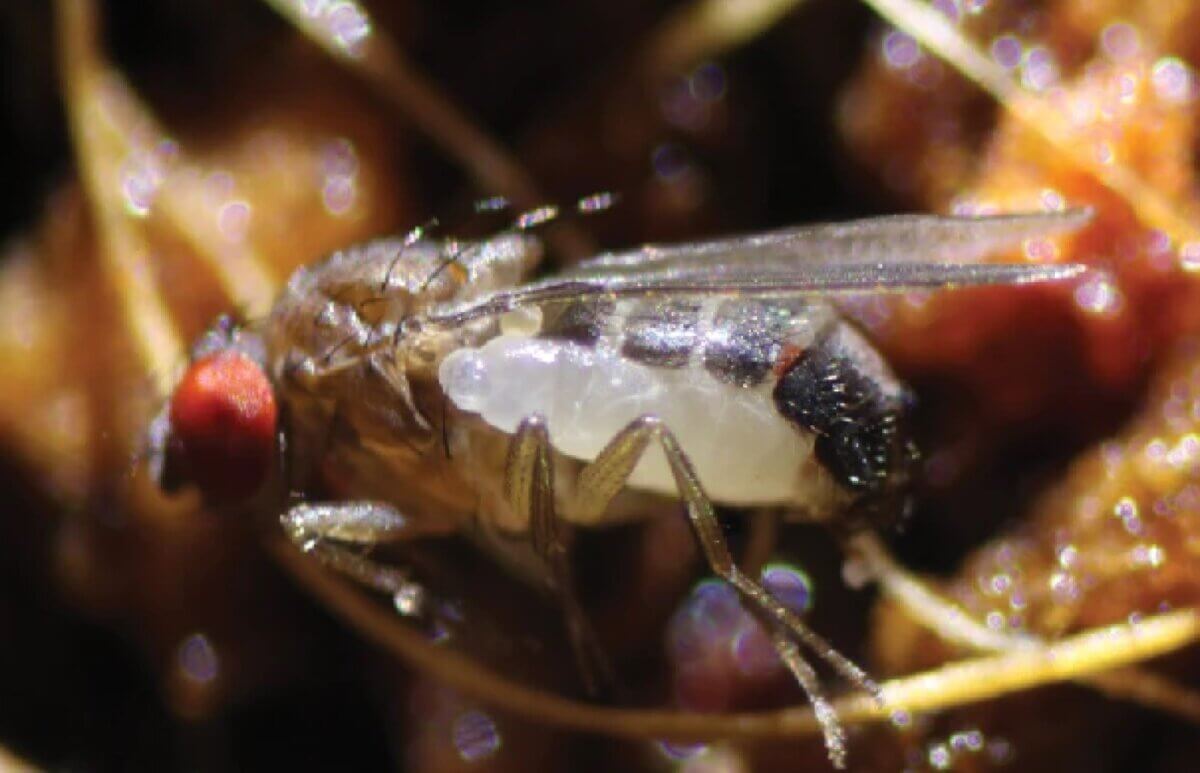
MISSISSIPPI STATE, Miss. — In a horrific discovery that seems straight out of the science-fiction movie “Alien,” researchers have found a new species of wasp that erupts from the bodies of adult flies. This groundbreaking find, published in the prestigious journal Nature, is sending shockwaves through the scientific community and opened up exciting new avenues for research.
The story begins in the most unlikely of places – a backyard in Starkville, Mississippi. Logan Moore, a Ph.D. student working with Associate Professor Matthew Ballinger at Mississippi State University, was collecting fruit flies for a research project when he noticed something unusual. Some of the adult flies were infected with parasites, a phenomenon that had never been documented before.
“All known parasitoid wasps of flies attack and develop inside immature life stages,” Ballinger explains in a university release. “Despite 200 years of research on parasitoid wasps of Drosophila and other flies, we have never come across a species that attacks the adult stage, until now.”
For those unfamiliar with the term, parasitoid wasps are a group of insects that lay their eggs inside or on other insects. The wasp larvae then feed on their host, eventually killing it as they develop. It’s a gruesome process, but one that plays a crucial role in many ecosystems.
A ‘Spectacular’ Discovery
Ballinger describes this new wasp species as a “spectacular example of undescribed biology hidden in plain sight.” It’s not every day that scientists discover a completely new biological process, especially one involving an organism as well-studied as the fruit fly.
The fruit fly in question, Drosophila melanogaster, is one of the most researched animals in all of biology. Scientists have been studying these tiny insects for over a century, using them to understand everything from genetics to neurobiology. The fact that this new wasp species targets adult fruit flies makes it even more remarkable.
After the initial discovery, Ballinger’s team set out to learn more about this new species. They combined field collections with public data to show that the wasp isn’t just a local oddity – it’s found across the Eastern United States.
To formally describe and name the new species, Ballinger’s team collaborated with Scott Shaw, an entomologist and parasitoid wasp expert from the University of Wyoming. While the official scientific name hasn’t been revealed in the press release, it’s sure to be a topic of interest for entomologists worldwide.
While the “Alien”-like life cycle of this wasp is undoubtedly fascinating, its discovery could have far-reaching implications for scientific research.
“Studying how parasites and pathogens influence Drosophila biology and behavior has helped researchers learn more about fundamental biological processes like immunity and reproduction,” Ballinger emphasizes.
In other words, this new wasp species could provide insights into how organisms defend themselves against parasites and how parasites, in turn, overcome these defenses. This could have applications in fields ranging from medicine to agriculture.
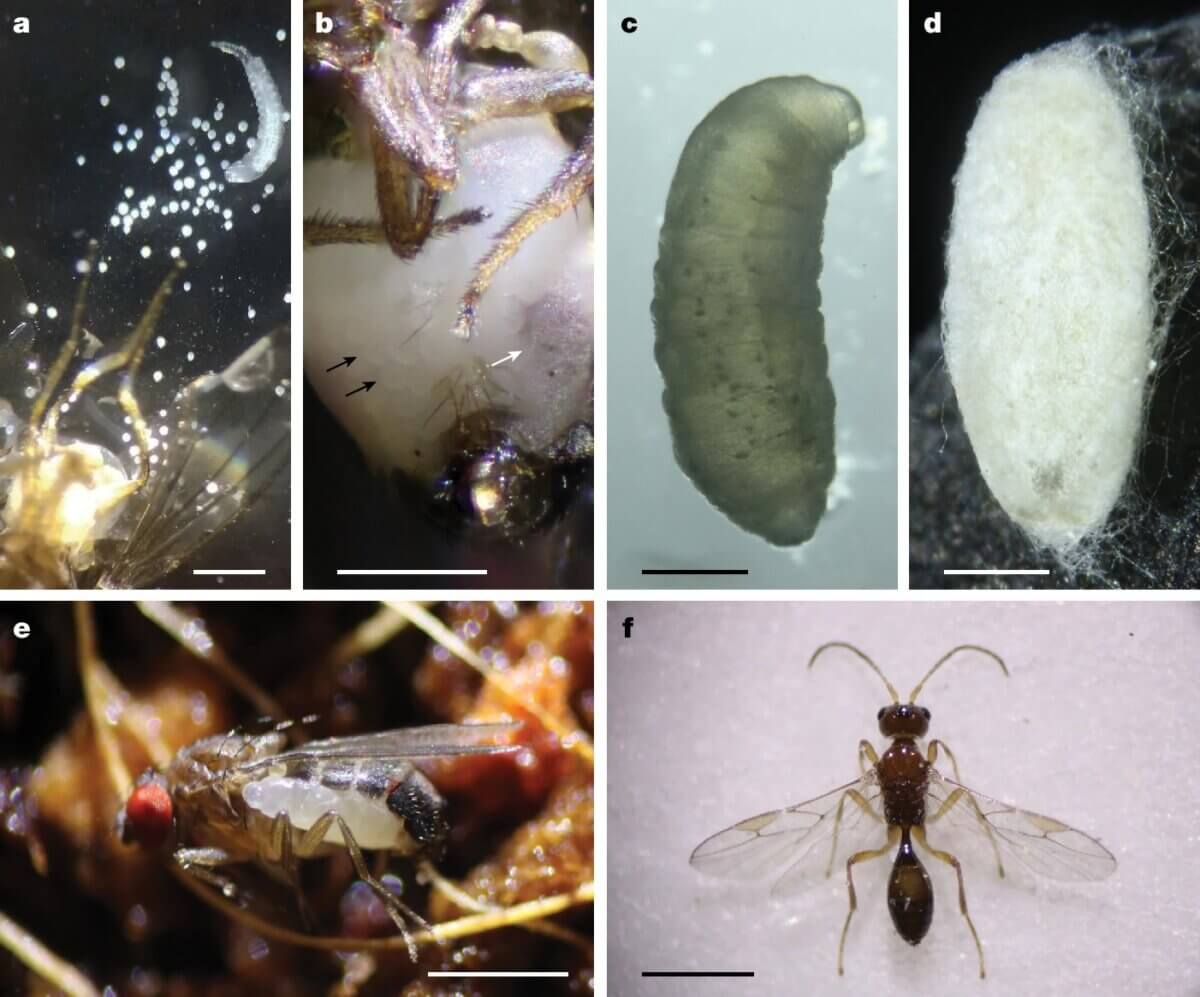
Ballinger and his team aren’t content to rest on their laurels. They’ve documented the wasp’s complete life cycle and provided instructions for other researchers to raise adult wasps in the laboratory.
“We’re excited to learn more about the new species, and we hope other researchers will begin their own projects to better understand its infection biology, ecology and evolution in the coming years,” Ballinger concludes.
This research is part of a larger project led by Ballinger, funded by an $805,682 five-year CAREER grant. The main focus of this project is to study Spiroplasma, a beneficial bacterium that protects fruit flies against parasitic infections.
Paper Summary
Methodology
The researchers conducted a detailed study of a newly discovered species of wasp, Syntretus perlmani, which infects adult fruit flies (Drosophila). To carry out the research, they collected wild fruit flies using baits like bananas, watermelon, and mushrooms. Once collected, the flies were examined for any signs of infection. This included looking at the flies’ abdomens to see if they had the wasp’s larval stage inside.
When larvae were detected, the infected flies were kept in containers until the wasps developed and emerged. The scientists also took genetic samples to confirm the identity of the new wasp species, using DNA sequencing to compare this species to other known wasps. They also performed tests in the lab to see if the wasps could infect different types of flies.
Key Results
The study found a new type of wasp that can lay its eggs inside adult fruit flies, which had never been discovered before. The wasp’s eggs grow into larvae inside the fly, and after about 18 days, the larvae burst out, killing the fly. The researchers found that about 1 in 100 male fruit flies in the wild were infected by this wasp.
They also figured out how to raise the wasps in the lab and confirmed that they could infect a few different types of flies, not just one kind. This discovery is important because it opens up new ways to study how parasites and hosts interact in nature.
Study Limitations
First, the infection rate of the wasps in female flies was very low, making it difficult to study how the wasps affect both male and female flies. Second, though the researchers were able to identify the new wasp species, they were unable to track how widespread it is outside the areas they studied, meaning there could be more unknown regions where this wasp is found. Additionally, the success rate of raising the wasps in the lab was low, indicating that further work is needed to improve the methods used to study this species in controlled environments.
Discussion & Takeaways
This discovery has major implications for understanding how wasps and their hosts evolve together. The researchers point out that studying this new wasp can help scientists learn more about the immune systems of flies and how they defend themselves against parasites. Since Drosophila melanogaster is used in many biological experiments, this new wasp could lead to important new studies on host-parasite relationships, helping scientists understand similar processes in other animals. Additionally, the ability of the wasp to infect more than one type of fly suggests it may have a broad impact on fly populations in nature, which could affect ecosystems.
Funding & Disclosures
This research was conducted by scientists from Mississippi State University and the University of Wyoming. The study was supported by funding from various research grants aimed at studying insect biodiversity and host-parasite relationships. No conflicts of interest were declared by the researchers, and all work was carried out under ethical guidelines for the study of live organisms.


