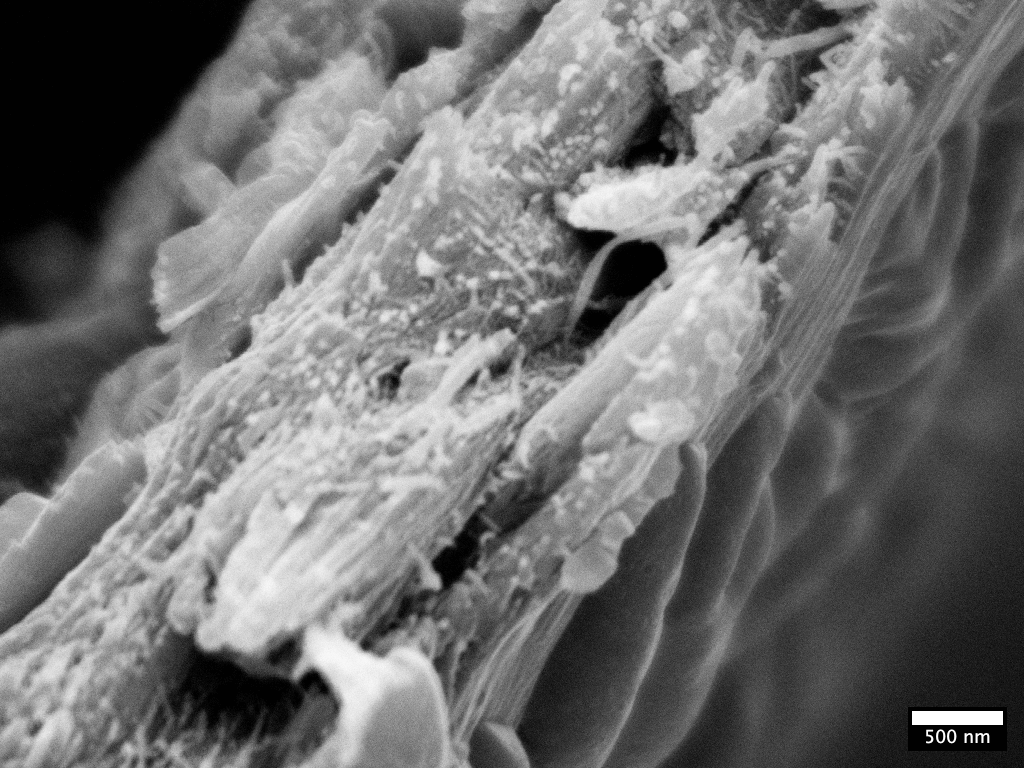
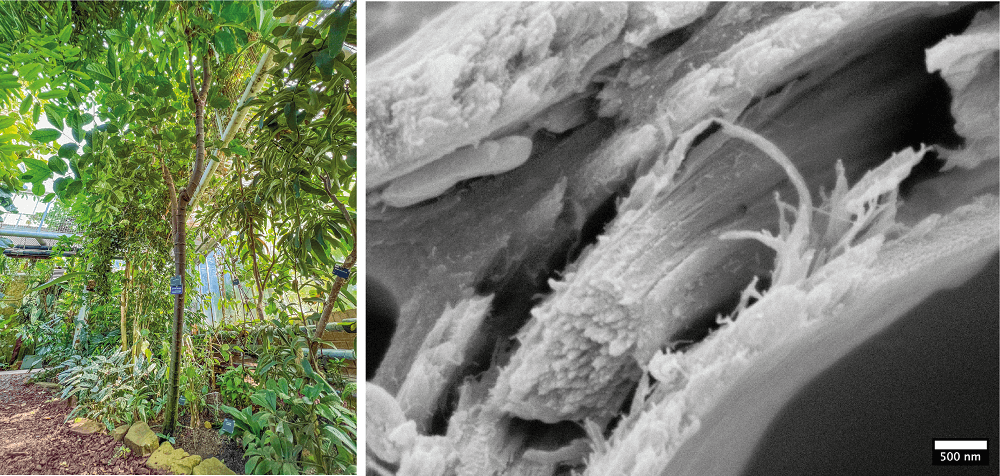
Liriodendron tulipifera wood ultrastructure observed under a cryo-SEM reveals enlarge macrofibril structures. (Credit: Jan J Lyczakowski and Raymond Wightman)
KRAKOW, Poland — In a fascinating study that reads like a botanical detective story, researchers have uncovered a secret long hidden within the wood of some of the world’s most beloved trees. Scientists from Jagiellonian University in Poland and the University of Cambridge in England have discovered an entirely new type of wood in tulip trees, a finding that could reshape our understanding of plant evolution and perhaps greatly aid our efforts to combat climate change.
The study, published in New Phytologist, set out to explore the microscopic structure of wood across various tree species. But what they found in the tulip tree (Liriodendron tulipifera) and its close relative, the Chinese tulip tree (Liriodendron chinense), was truly unexpected – a wood structure that defies traditional categories.
The key to this discovery lies in tiny structures called macrofibrils – long fibers aligned in layers within the secondary cell wall of wood. In tulip trees, these macrofibrils are much larger than those found in their hardwood relatives. This unique structure, which the researchers have dubbed “midwood” or “accumulator-wood,” may explain the tulip tree’s remarkable ability to capture and store carbon.
“We show Liriodendrons have an intermediate macrofibril structure that is significantly different from the structure of either softwood or hardwood,” explains lead author Dr. Jan Łyczakowski, from Jagiellonian University, in a statement. This discovery challenges the long-held binary classification of wood as either softwood (from gymnosperms like pines) or hardwood (from angiosperms like oaks).
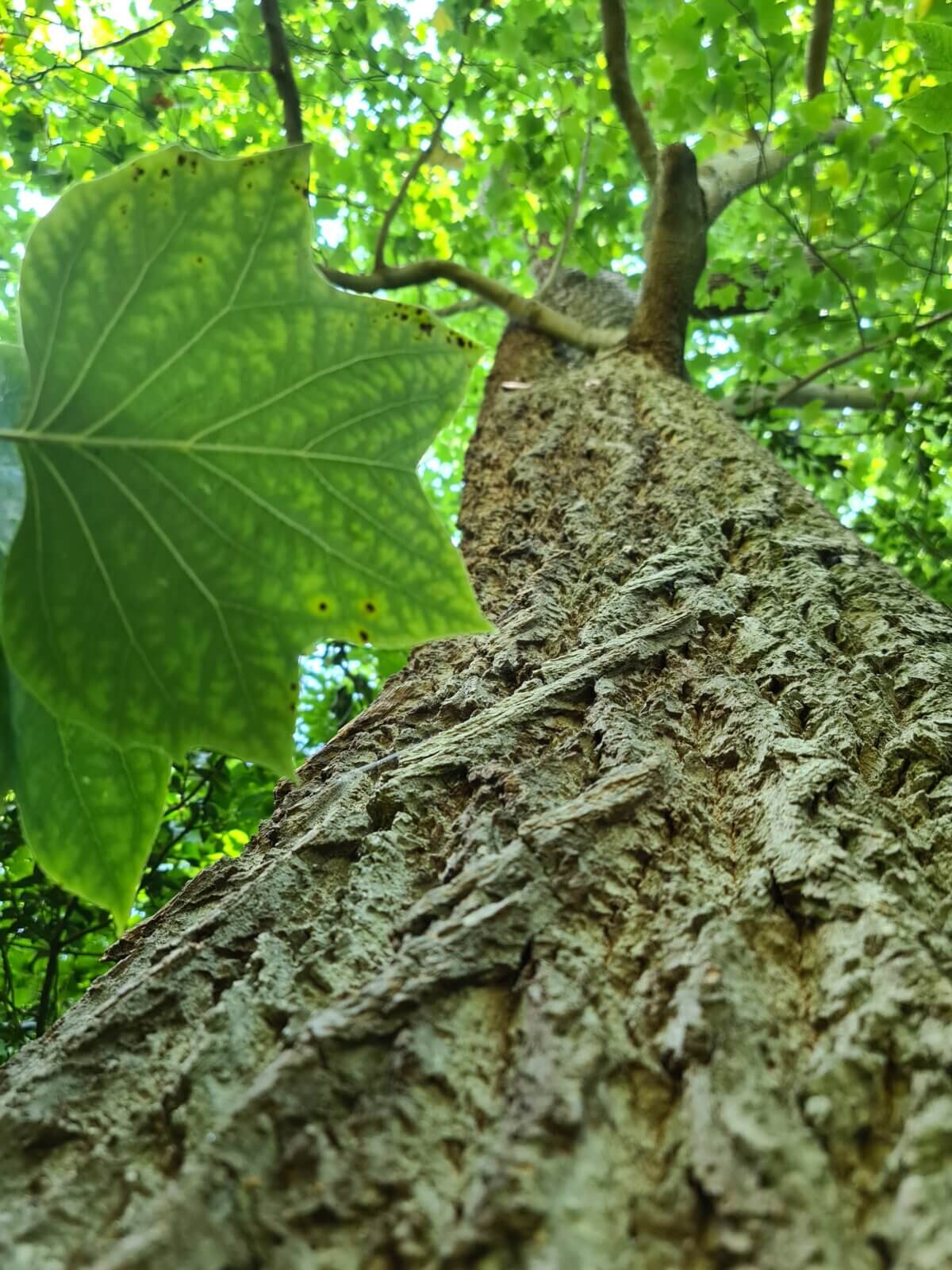
The timing of this adaptation is particularly intriguing. Tulip trees diverged from their magnolia relatives around 30-50 million years ago, coinciding with a dramatic decrease in atmospheric CO2 levels. Dr. Łyczakowski suggests that this enlarged macrofibril structure could be an evolutionary response to more efficiently capture carbon in a changing environment.
This discovery opens up exciting possibilities for climate change mitigation. Tulip Trees are already known for their rapid growth and efficient carbon sequestration. Now, with a better understanding of their unique wood structure, there’s potential to leverage these trees in large-scale carbon capture initiatives.
“Tulip trees may end up being useful for carbon capture plantations,” Dr. Łyczakowski notes. “Some east Asian countries are already using Liriodendron plantations to efficiently lock in carbon, and we now think this might be related to its novel wood structure.”
The study’s findings extend beyond tulip trees. In their survey of 33 tree species from the Cambridge University Botanic Garden, the researchers also found that certain gymnosperms in the Gnetophytes family have independently evolved a hardwood-like structure typically seen only in angiosperms. This convergent evolution adds another layer of complexity to our understanding of plant adaptation.
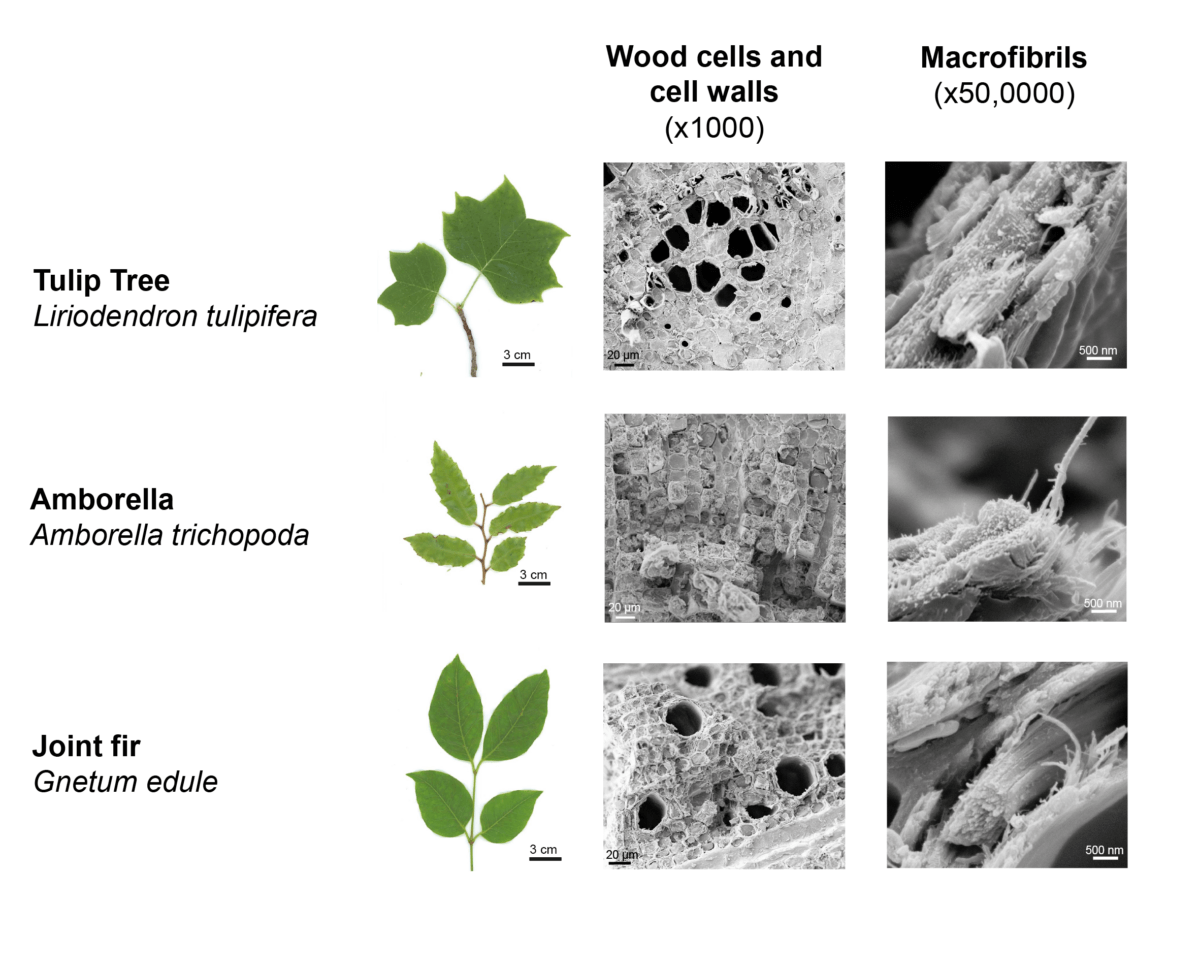
“We analyzed some of the world’s most iconic trees like the giant sequoia, Wollemi pine and so-called ‘living fossils’ such as Amborella trichopoda, which is the sole surviving species of a family of plants that was the earliest still existing group to evolve separately from all other flowering plants,” says Dr. Raymond Wightman, Microscopy Core Facility Manager at the Sainsbury Laboratory Cambridge University.
This research not only advances our understanding of plant evolution but also highlights the crucial role of wood ultrastructure in carbon sequestration. As we grapple with the challenges of climate change, insights like these could prove invaluable in developing more effective strategies for carbon capture and storage.
The discovery of this new type of wood in tulip trees serves as a reminder that even in well-studied areas of biology, there are still surprises waiting to be uncovered. It also underscores the importance of preserving diverse plant collections, like those found in botanic gardens, which continue to yield new scientific insights centuries after their establishment.
Paper Summary
Methodology
The researchers used a technique called cryogenic scanning electron microscopy (cryo-SEM) to examine fresh wood samples from 33 different tree species. This method involves rapidly freezing small samples of plant tissue and then using a powerful microscope to observe their structure at very high magnifications. The samples were collected from the Cambridge University Botanic Garden, allowing the researchers to study a diverse range of species representing different evolutionary lineages.
Results
The study revealed that Tulip Trees (Liriodendron species) have a unique wood structure with larger macrofibrils compared to other hardwood species. This structure, termed “midwood” or “accumulator-wood,” doesn’t fit into the traditional categories of softwood or hardwood. The researchers also found that some gymnosperms in the Gnetophytes family have independently evolved hardwood-like structures similar to those seen in flowering plants.
Limitations
While the study provides valuable insights, it was limited to the species available in the Cambridge University Botanic Garden. The sample size for each species was relatively small, often limited to one individual plant. Additionally, the research focused on woody plants, which may not represent the full diversity of plant cell wall structures across all plant types.
Discussion and Takeaways
The discovery of a new type of wood in tulip trees suggests that plant evolution is more complex than previously thought. The unique structure of tulip tree wood, combined with its efficient carbon sequestration abilities, could have significant implications for climate change mitigation strategies. The convergent evolution observed in Gnetophytes further underscores the adaptability of plants and the diverse ways they can evolve similar traits. These findings open up new avenues for research in plant biology, forestry, and climate science.
Funding and Disclosures
The study was supported by grants from the National Science Centre Poland. The Microscopy Core Facility at the Sainsbury Laboratory, University of Cambridge, which was used in the study, is supported by the Gatsby Charitable Foundation. The research was conducted in collaboration with the Cambridge University Botanic Garden. The authors declared no competing interests.


