
(© alonesdj - stock.adobe.com)
BRIGHTON, United Kingdom — Moving to Mars is now closer to reality, thanks to a significant breakthrough enabling the creation of energy on the Red Planet. British scientists are utilizing a material, previously deemed worthless, to achieve what they call the “most important goal” in this endeavor.
Once considered a waste product by NASA, a group of researchers have discovered a method for generating clean energy and sustainable technology from anhydrite — a common mineral byproduct of aluminum production.
“We are optimistic of the feasibility of this process on Mars, as it requires only naturally occurring materials – everything we used could, in theory, be replicated on the red planet. Arguably this is the most important goal in making the Martian colony sustainable from the outset,” says Dr. Conor Boland, a Lecturer in Materials Physics at the University of Sussex.
For their groundbreaking work, the team employed a technique similar to NASA’s method for extracting water from Martian substances. During this process, they produced anhydrite. However, it has proven to be exceedingly valuable.
The researchers transformed this byproduct into nanobelts, resembling tagliatelle-shaped materials. These nanobelts show great promise in providing clean energy and sustainable electronics. The process is remarkably sustainable, allowing for the continuous collection and recycling of water at every stage.
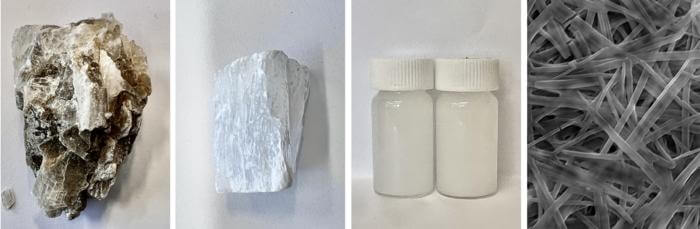
“This study shows that the potential is quite literally out of this world for nanomaterials. Our study builds off recent research performed by NASA and takes what was considered waste, essentially lumps of rock, and turns it into transformative nanomaterials for a range of applications from creating clean hydrogen fuel to developing an electronic device similar to a transistor, to creating an additive to textiles to increase their robustness,” Dr. Boland explains in a media release.
“This opens avenues for sustainable technology – and building – on Mars but also highlights the broader potential for eco-friendly breakthroughs here on Earth.”
Nanomaterials are exceptionally small, with dimensions thousands of times thinner than a single human hair. Although producing electronics on a full scale is currently impractical on Mars, due to the absence of clean rooms and sterile conditions, this discovery could significantly impact sustainable energy production on the red planet in the future. Meanwhile, it also offers the potential for clean and sustainable energy production here on Earth.
The findings are published in the journal Advanced Functional Materials.
You might also be interested in:
- Martian meals: Food could be grown on Mars to sustain a human colony
- Can stars really live on Mars? Deep underground labs may hold the key
- Is living on Mars impossible? Space travel alters genes, weakens astronauts’ immune system
South West News Service writer Isobel Williams contributed to this report.


