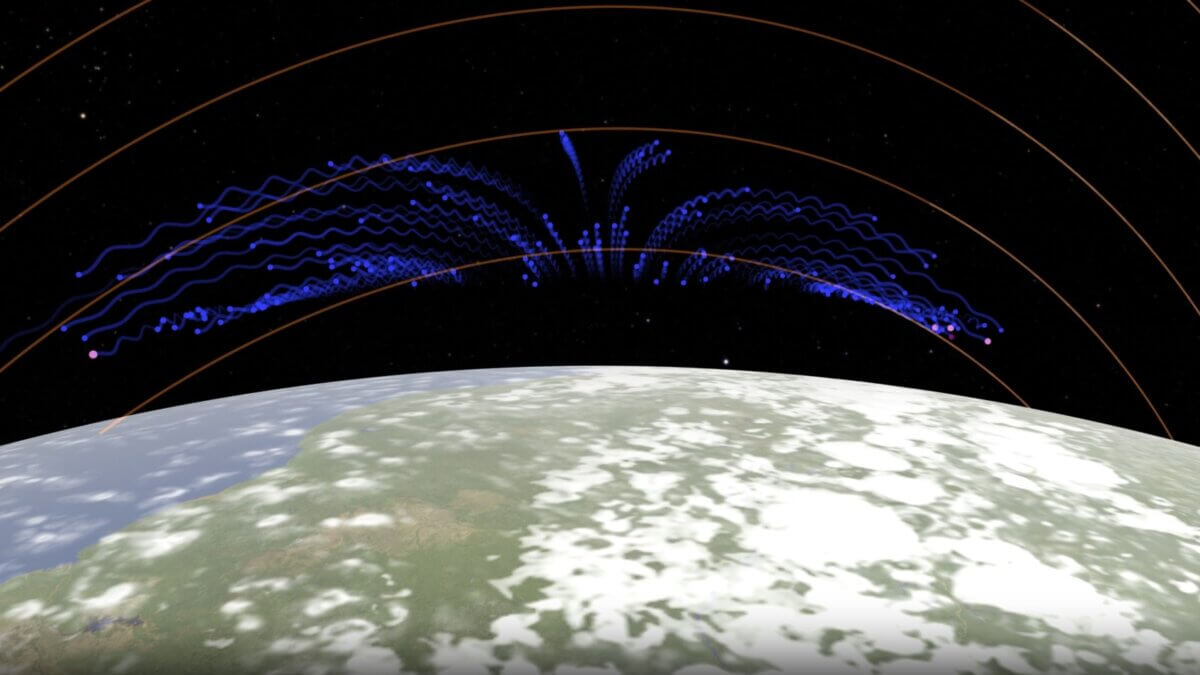
NASA’s Global-scale Observations of the Limb and Disk (GOLD) mission has revealed unexpected C- and X-shaped formations in an electrified layer of gas high above our heads called the ionosphere. (Credit: NASA)
Who knew Earth’s upper atmosphere was like alphabet soup?
NASA’s Global-scale Observations of the Limb and Disk (GOLD) mission has revealed unexpected C- and X-shaped formations in an electrified layer of gas high above our heads called the ionosphere.
While these alphabetical shapes have been observed before, GOLD sees them more clearly than other instruments have and is now finding them where and when scientists didn’t expect. Their surprise appearances prove that we have more to learn about the ionosphere and its effects on communication and navigation signals that pass through it.
Earth’s Dynamic Interface to Space
Extending some 50 to 400 miles overhead, the ionosphere becomes electrically charged during the daytime when sunlight strikes our planet and its energy knocks electrons off atoms and molecules. This creates a soup of charged particles, known as plasma, that allows radio signals to travel over long distances.
Near Earth’s magnetic equator, charged particles are funneled upward and outward along magnetic field lines, creating two dense bands of particles north and south of the equator that scientists call crests. As night falls and the Sun’s energy fades, low-density pockets in the plasma, called bubbles, can form in the ionosphere. Because of their varying density, the crests and bubbles can interfere with radio and GPS signals.
While previous observations provided brief glimpses of crests and bubbles in the ionosphere, GOLD monitors these features over extended periods of time. That’s thanks to its geostationary orbit, which circles our planet at the same rate Earth rotates, allowing GOLD to hover over the Western Hemisphere.
Unexpected X-Shaped Crests from Quiet Conditions
The ionosphere is sensitive to disturbances from both space and terrestrial weather. GOLD has previously revealed that after a solar storm or huge volcanic eruption, the crests in the ionosphere can merge to form an X shape. But now, GOLD has seen an X shape form on multiple occasions when there were no such disturbances — what scientists refer to as “quiet time.”
“Earlier reports of merging were only during geomagnetically disturbed conditions — it is an unexpected feature during geomagnetic quiet conditions,” said Fazlul Laskar, of the University of Colorado’s Laboratory for Atmospheric and Space Physics (LASP), who is the lead author of a paper about this discovery published in April 2024 by the Journal of Geophysical Research: Space Physics.
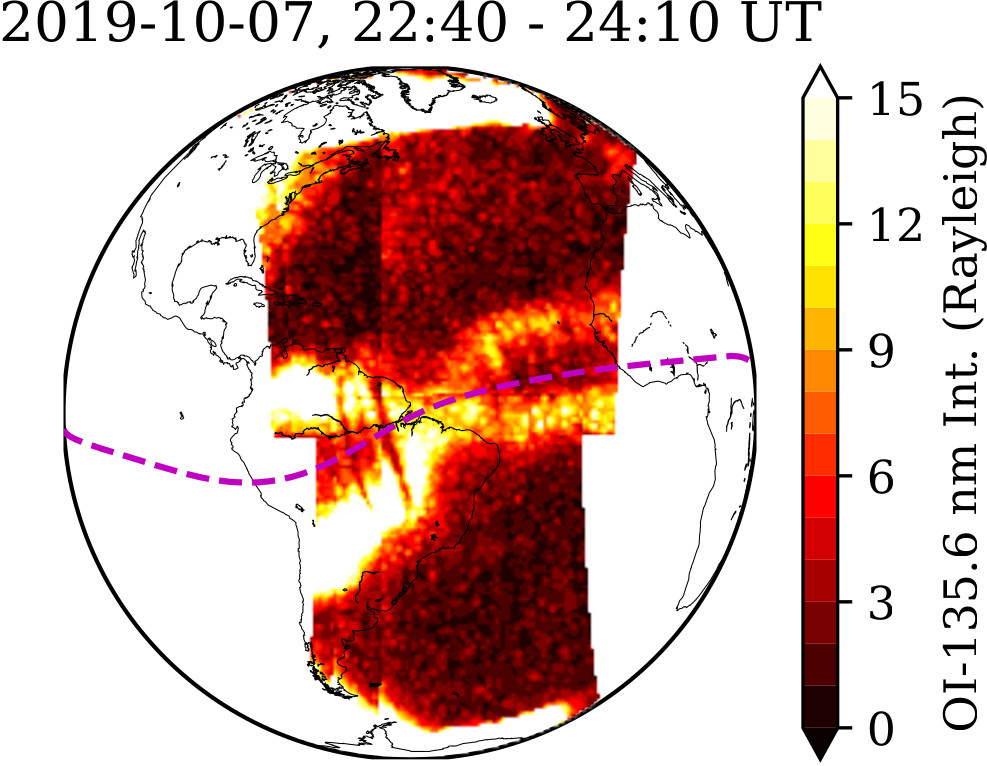
These unexpected appearances tell scientists that something else must be involved in forming these X shapes. Computer models suggest that the X could develop when changes in the lower atmosphere pull plasma downward.
“The X is odd because it implies that there are far more localized driving factors,” said Jeffrey Klenzing, a scientist at NASA’s Goddard Space Flight Center in Greenbelt, Maryland, who studies the ionosphere. “This is expected during the extreme events, but seeing it during ‘quiet time’ suggests that the lower atmosphere activity is significantly driving the ionospheric structure.”
C-Shaped Bubbles Point to Strong Turbulence
GOLD has also found surprising C-shaped plasma bubbles that point to other puzzling dynamics influencing the ionosphere.
Most plasma bubbles appear long and straight, forming along magnetic field lines. But some bubbles are curved into C shapes and reverse-C shapes, which scientists think are shaped by terrestrial winds. Computer models suggest a C-shape forms if winds increase with altitude at the magnetic equator and a reverse-C forms if the winds decrease with altitude.
“It’s a little like a tree growing in a windy area,” explains Klenzing. “If the winds are typically to the east, the tree starts to tilt and grow in that direction.”
In a paper published in November 2023 in the Journal of Geophysical Research: Space Physics, LASP scientist Deepak Karan and colleagues report that GOLD has observed C-shaped and reverse-C-shaped plasma bubbles appearing surprisingly close together — as close as about 400 miles apart (roughly the distance between Baltimore and Boston).
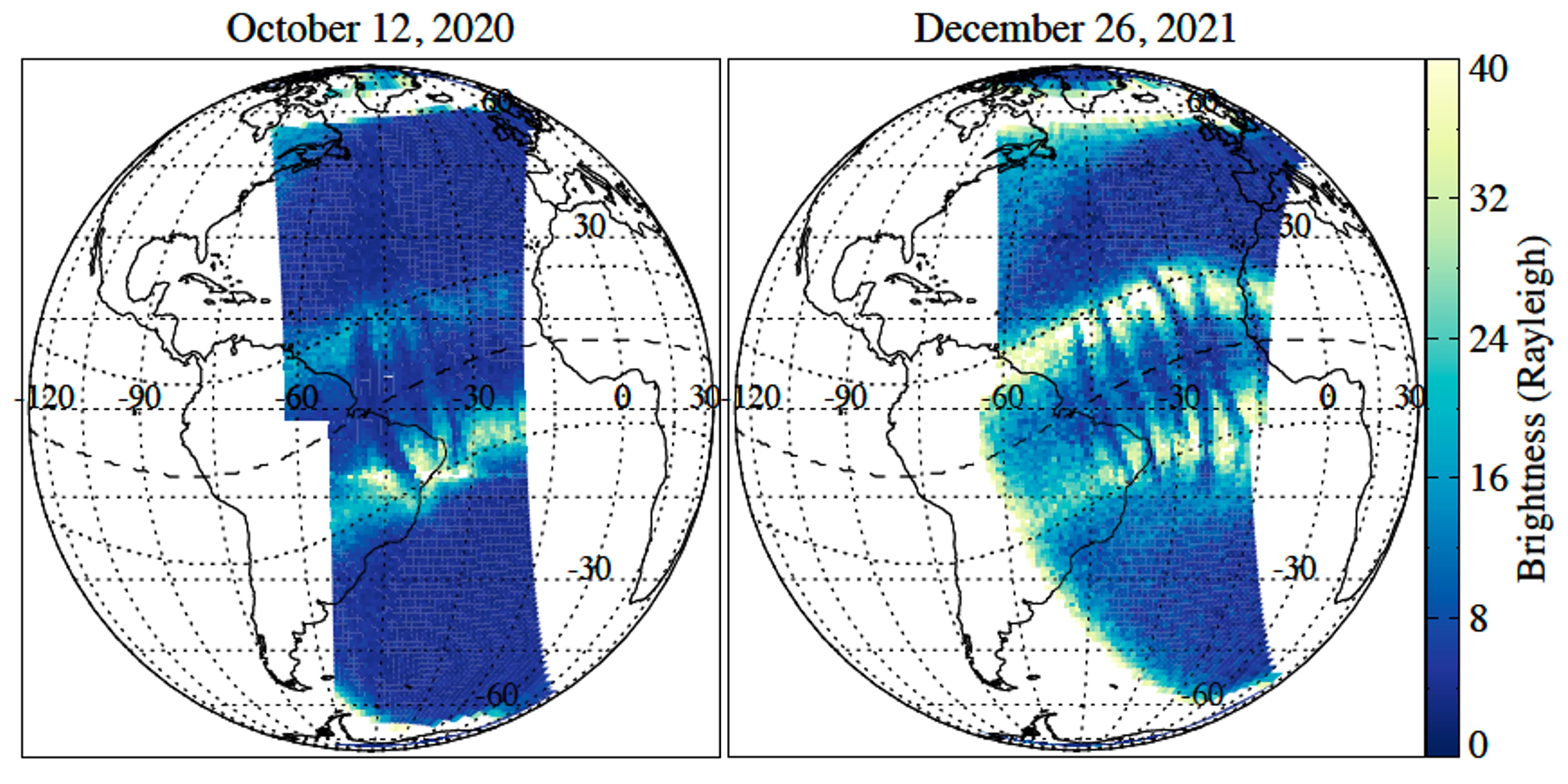
“Within that close proximity, these two opposite-shaped plasma bubbles had never been thought of, never been imaged,” said Karan. To have wind patterns change course in such a small area, Karan thinks some sort of strong turbulence — like a vortex, wind shear, or tornado-like activity — is likely at play in the atmosphere.
“The fact that we have very different shapes of bubbles this close together tells us that the dynamics of the atmosphere is more complex than we expected,” Klenzing said.
These close pairings appear to be rare, with only two instances recorded by GOLD so far. Yet because these features can disrupt critical communication and navigation technology, “It’s really important to find out why this is happening,” Karan said. “If a vortex or a very strong shear in the plasma has happened, this will completely distort the plasma over that region. Signals will be lost completely with a strong disturbance like this.”
Scientists hope GOLD’s continued observations, combined with those from other heliophysics missions, can help unlock these mysteries of the ionosphere and their effects on our lives.
By Vanessa Thomas
NASA’s Goddard Space Flight Center, Greenbelt, Md.
Press release provided by NASA
The paper, “The X-Pattern Merging of the Equatorial Ionization Anomaly Crests During Geomagnetic Quiet Time,” was published in the Journal of Geophysical Research: Space Physics on April 7, 2024.


