
Artist’s impression of the Skateholm burial island. In the foreground is a boy whose grave contained a deer hair and possibly a fragment of a woodpecker feather (Credit: Tom Björklund)
Stone Age Burials Likely Included Waterfowl Skins and Owl Feathers, And Scientists Almost Missed It
In A Nutshell
- Microscopic analysis of 40-year-old soil samples from 35 Stone Age graves in Sweden revealed invisible evidence of feathers, animal furs, and plant fibers used in burial clothing and wrappings.
- Several graves previously recorded as empty actually contained strong evidence of elaborate soft organic materials, including possible feathered headgear and fur-lined footwear.
- The most elaborate burial, a young male seated upright with red deer antlers and tooth beads, may have included a ritual headdress combining owl feathers, weasel fur, and hare skin.
- The survival of fiber evidence in decades-old museum soil samples suggests archived collections worldwide may hold undiscovered records of ancient clothing and burial practice.
Seven thousand years ago, on the edge of a shallow Baltic Sea lagoon in what is now southern Sweden, hunter-gatherers may have prepared their dead with far more care than anyone realized. Bodies were possibly wrapped in animal pelts. Headgear may have been assembled from owl feathers and weasel fur. Waterfowl skins could have been fashioned into garments. None of it survived in a form anyone could see. For decades, many of those graves were recorded as bare, their occupants presumed to have been buried with nothing.
New research has changed that picture. By examining microscopic fiber fragments recovered from 40-year-old soil samples, scientists detected feathers from ducks and geese; hairs from wild cats, weasels, pine martens, and hares; and plant fibers from materials likely used for rope, wrapping, or bark containers. Graves previously recorded as empty turned out to be nothing of the sort.
Published in the journal Archaeological and Anthropological Sciences, the study is the first large-scale survey of microscopic soft organic materials across 35 burials at one of Europe’s best-studied Stone Age cemetery complexes. Its findings rewrite the burial record for a site long thought to be well understood, and raise a pointed question: how many other ancient graves around the world are hiding the same invisible evidence?
How Researchers Decoded 7,000-Year-Old Stone Age Burial Soil
Soil samples had been archived at Lund University since excavations at the Skateholm I and II cemeteries in southern Sweden during the 1980s, collected from areas of dark discoloration within graves. The cemeteries date to roughly 5,200 to 4,800 BCE, when the area was a coastal lagoon rich in fish and game, and together form the largest Late Mesolithic burial complex in Scandinavia. No one had ever analyzed the stored samples for clothing or fiber evidence. Researchers finally did, rinsing them with water, filtering the residue through fine-mesh sieves, and examining the results under high-powered microscopes. Each fragment was compared against modern reference collections of regional mammal hairs and bird feathers.
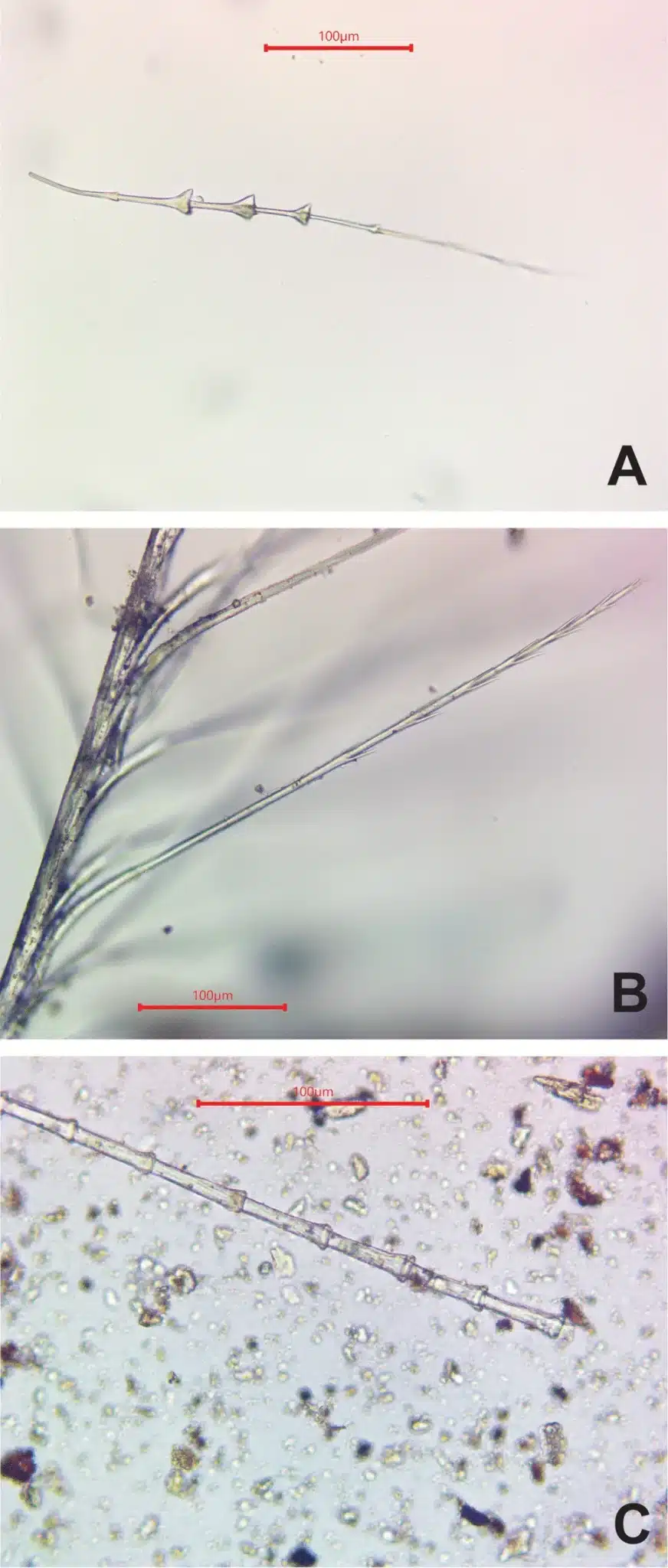
Across 79 samples from 35 of the site’s 87 graves, the team recovered 82 feather fragments, 95 mammalian hairs, and plant fibers from at least 14 burials. The site’s acidic soil, with pH levels averaging around 5.2, actually helped. Hair and feather fibers survived while bone surfaces eroded and plant material largely vanished. The tiniest structural elements of a feather, structures smaller than a millimeter called barbules, were still identifiable after seven millennia in the ground.
Waterfowl Feathers and Animal Fur in Mesolithic Burials
Feather fragments from water birds, primarily ducks and geese, were the most commonly identified bird remains, turning up in nine graves. A single owl barbule appeared in grave XV, and a possible woodpecker feather fragment was recovered in grave 41. Many other feather fragments could not be identified beyond broad categories. Where those fragments were found on the bodies mattered as much as what they were. In Skateholm I, more than half of all bird feather fragments appeared near the skull and neck, even though samples from those areas accounted for only about a quarter of the total. Researchers interpreted this as evidence of feathered headgear, hood decorations, or short capes across the shoulders.
Feathers found near torsos and limbs pointed to something more practical. Ethnographic records from Arctic communities, including Inuit traditions documented in Greenland and Canada, show that waterbird skins have long been prized for insulation and durability. Juvenile eider duck skins were specifically favored for children’s clothing because of their softness. Waterfowl down has also been used historically as pillow stuffing, and researchers suggested the same material may have cushioned the dead from direct contact with the soil.
Animal hairs rounded out the picture. Wild cat and weasel family species, including what may have been pine marten and otter, were the most commonly identified, though many hairs were too degraded to be assigned beyond family or order level. Most predator hairs concentrated near the head, consistent with hoods or headdresses made from fur. In one burial, white hairs from a weasel or stoat in its winter coat appeared near a woman’s feet, suggesting footwear assembled from animals chosen partly for the visual contrast of their light-colored winter pelts against darker fur.
The Stone Age Burial That Held Everything Invisible
Grave 58 became one of the study’s most telling cases. Its occupant, a woman estimated to be over 60 years old, was recorded during excavation as having no grave goods. Placed in a crouched position on her right side, she was initially written off as one of the site’s plainest burials. Fiber analysis said otherwise. Bird feather fragments clustered near her neck, wild cat and weasel family hairs at her back and feet, and plant fibers near her hands suggested rope or bark wrapping bound around her body. As the researchers noted, “the interred had been dressed in furs and feathers and/or pelts which might also have been used for wrapping or furnishing the grave pit.”
The most elaborate burial belonged to a young adult male in grave XV at Skateholm II, seated upright and surrounded by three large beams of red deer antlers. A row of 22 red deer tooth beads ran across the top of his skull from ear to ear. Soil samples from the grave recovered an unusual concentration of materials near his head: hairs from mountain hare, weasel family animals, and a possible bat, alongside an owl feather barbule and other unidentified bird fragments. Taken together with the tooth bead arrangement, researchers suggested these elements may have formed an elaborate headdress.
Ethnographic records from Siberia describe ritual costumes made from similar combinations of feathers and small animal furs, offering one possible parallel for what this individual’s burial assemblage may represent. Plant fibers from the inner layer of tree bark, recovered from the man’s back and leg areas, further suggested a soft bark container or binding rope placed alongside him.

Why Museum Soil Samples Could Rewrite Prehistoric Burial History
Perhaps the most consequential finding has nothing to do with any individual grave. Those soil samples sat in museum storage at room temperature for roughly 40 years before this analysis. They still yielded recoverable evidence. Soil collections archived in institutions around the world may hold untapped records of ancient clothing, burial ritual, and human-animal relationships that researchers have never thought to examine.
Several graves at Skateholm that contained no visible animal teeth, stone tools, or bone artifacts still produced strong fiber evidence. Before this study, those burials would have been described as unadorned. The invisible wardrobe those communities placed with their dead, the waterfowl-skin garment, the feathered headdress, the weasel-fur boots, was apparently as deliberate and meaningful as any carved pendant. It just required a microscope, and four decades of archived dirt, to finally see it.
Paper Notes
Limitations
The soil sampling was selective and non-systematic, covering 35 of the 87 total graves at both sites. Sample counts per grave ranged from 1 to 12, and weights varied considerably, which affected fiber recovery rates and makes direct comparisons between burials imprecise. The site’s acidic conditions, while favorable for hair and feather fibers, degraded plant cellulose, meaning plant material is likely underrepresented. Most hairs were too deteriorated for species-level identification; only 27 percent were successfully assigned to an order, family, or species. Contamination was an acknowledged risk throughout, from excavation through decades of room-temperature storage, and a small number of fibers, including sheep wool in one grave and a dog hair in another, were classified as likely modern intrusions. Movement of microparticles through soil via water, roots, or burrowing animals may have shifted some fibers from their original positions, complicating location-based interpretations. Nearly half of the analyzed graves in Skateholm I lacked reliable biological sex data, limiting comparisons between male and female burials.
Funding and Disclosures
This research was part of the Animals Make Identities (AMI) project, funded by the European Research Council under the European Union’s Horizon 2020 research and innovation program, grant agreement number 864358. Open-access funding was provided by the University of Helsinki, including Helsinki University Central Hospital. The authors declared no competing interests.
Publication Details
The paper is titled “Waterbirds, mustelids and bast fibres: evidence of soft organic materials in the Late Mesolithic Skateholm I and II cemeteries, Sweden.” Authors: Tuija Kirkinen and Kristiina Mannermaa, Department of Cultures, University of Helsinki; Lars Larsson, Institute of Archaeology and Ancient History, Lund University, Sweden. Published in Archaeological and Anthropological Sciences, volume 18, article number 56, 2026. DOI: https://doi.org/10.1007/s12520-026-02415-7. Received September 24, 2025; accepted January 11, 2026.


