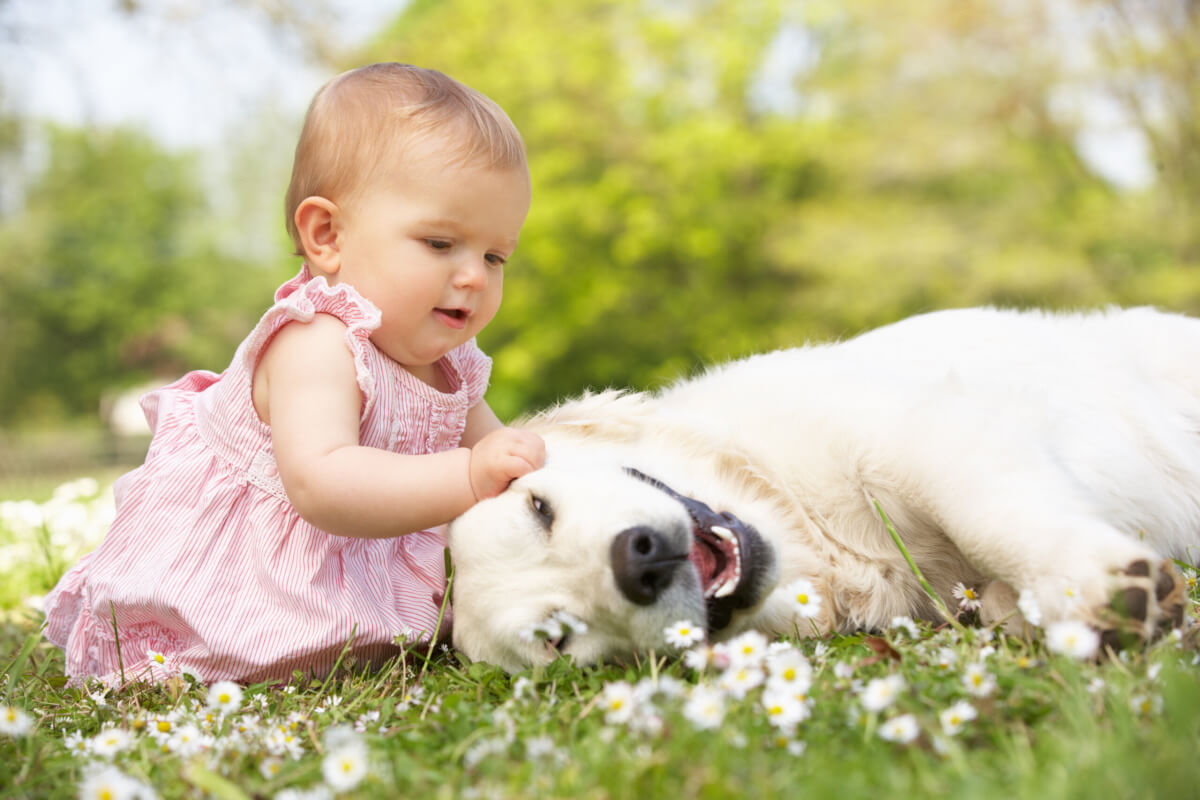
(Credit: Photo by Monkey Business Images on Shutterstock)
In a Nutshell
- Specific bacteria and fungi found in dust from dog-owning homes each individually explained between 10% and 23% of the association between dog keeping and lower illness rates in infants; when three particular bacteria were examined together, they explained up to 25% of the reduction in antibiotic use linked to having a dog in the house.
- One bacterial type in particular, Pasteurella, showed the strongest association with fewer weeks of fever and less antibiotic use in babies.
- Simply having more bacteria or a greater variety of microbes in house dust did not explain the health benefit; it was the presence of specific types that mattered.
Owning a dog might do more for a newborn’s health than anyone expected, and the clue could be hiding in the dust on the floor. A new study found that specific types of bacteria and fungi linked to dogs, present in household dust, appear to partly explain the well-documented link between dog ownership and fewer respiratory infections in infants during their first year of life.
For years, researchers have noted a pattern: babies who grow up around dogs seem to catch fewer respiratory infections, run fewer fevers, and need fewer courses of antibiotics. Scientists largely accepted the observation but had little explanation for it. This new research takes an important step toward answering why, pointing to the microscopic world living inside dog-owning homes as a likely piece of the puzzle.
Writing in Pediatric Allergy and Immunology, Finnish researchers tracked 368 children from before birth through their first year of life, collecting weekly health reports from parents and analyzing the tiny organisms living in floor dust collected when the babies were about two months old. What they found suggests that specific microbes present in house dust in dog-owning homes, likely associated with dogs, may help explain why those infants tend to fare better, though the researchers caution that the biological mechanism remains unclear.
What Researchers Found in Dog-Home Dust
Participants came from two Finnish birth groups that enrolled mothers during pregnancy, with births occurring between September 2002 and May 2005. Of the 368 children included in the final analysis, about a third lived in homes with at least one dog. Parents filled out weekly questionnaires from when their babies were about 2 months old until the children turned 1, reporting on fevers, ear infections, antibiotic use, and overall health. That added up to more than 15,000 weeks of recorded health data across the group.
Dust samples were vacuumed from living room floors at the two-month mark and sent for genetic analysis to identify which bacteria and fungi were present and in what amounts. Researchers examined 12 bacterial groups and 2 fungal groups that had previously been identified as more common in homes with dogs.
Among those 14 groups, eight individually accounted for between 10% and 23% of the association between dog ownership and at least one health outcome, whether that was fewer weeks with fever, less antibiotic use, or more weeks when the baby was simply healthy. When three specific bacteria were studied together, they accounted for up to 25% of the reduction in antibiotic use associated with having a dog in the house.
Dog-Linked Bacteria Behind Healthier Babies
One bacterial group, Pasteurella, stood out as the strongest single predictor. It showed the strongest association with fewer weeks of fever and with less antibiotic use. Pasteurella commonly lives in the mouths of dogs and cats but is typically not present in the normal microbial flora of humans, so its presence in house dust likely reflects direct contact between the pet and indoor surfaces.
Another group, Collinsella, was consistently associated with better health across all four outcomes measured: more healthy weeks, less antibiotic use, fewer ear infections, and fewer weeks with fever. Other research has linked this group to lower obesity risk in children and reduced severity of certain illnesses in adults, though its specific role in infant respiratory health remains poorly understood.
Critically, the health advantage did not come from sheer quantity or variety of microbes. “Specific dog-associated bacterial and fungal genera in house dust, but not richness, explained partly the associations between dog keeping and lower prevalence of respiratory infections,” the authors wrote.

Why the First Year of Life Matters So Much
Researchers targeted the first year of life for good reason. That period is considered a critical window for immune system development. Repeated respiratory infections during infancy are known to raise the long-term risk for asthma, making anything that reduces early illness potentially valuable well beyond just keeping babies comfortable.
Prior studies have suggested that farm-raised children who grow up around livestock benefit similarly from richer microbial environments at home. This study builds on that idea, showing that the microbial fingerprint associated with having a dog in the home may offer a similar protective effect in ordinary households, not just on farms.
That said, researchers are careful to note that this study observed associations, not causes. An observational study cannot confirm that dog-associated dust microbes directly improve infant health; it can only show a statistical association. The study also involved Finnish families in a specific cultural and environmental context, and the findings may not translate directly to other populations.
Only one dust sample per home was collected, and no samples were taken from the children’s airways, so researchers could not confirm whether these microbes were actually reaching the infants’ respiratory systems. Families with dogs also tend to spend more time outdoors and may have different daily routines that independently affect children’s health, factors that are difficult to fully account for. About 30% of families in the study lived on farms, a higher proportion than is typically found in an American study population, and farms have their own distinct microbial environments.
Researchers also point out that only the DNA of microbes was analyzed, not their activity, meaning it is not yet possible to say which organisms are doing something biologically active versus simply sitting in the dust. Future research, they suggest, should examine whether dog-associated microbes can be found directly in infants’ airways, and whether these protective effects persist beyond the first birthday.
Even with those caveats, the research offers early evidence, within a specific mediation framework, that certain dog-associated microbes in house dust may be one measurable factor that partly explains the observed link between dog ownership and a lower prevalence of respiratory infections in infants during their first year of life.
Disclaimer: This article summarizes findings from an observational study and is intended for general informational purposes only. Observational research can identify associations between factors but cannot prove that one causes the other. The results described here reflect a specific group of Finnish families and may not apply to other populations. Nothing in this article is medical advice. Readers should consult a qualified healthcare professional before making decisions about pet ownership, their child’s health, or infection prevention.
Paper Notes
Limitations
Researchers note several important constraints on interpreting these findings. Only one floor dust sample was collected per home, which means seasonal variation in microbial content could not be fully captured, even though season of birth was factored into the statistical models. No samples were taken from children’s airways, so it remains unknown whether these dog-associated microbes actually reached the infants directly. Information on viruses was not available. Ear infection diagnoses were reported by parents rather than verified through medical records, which introduces the possibility that some mild cases were missed or misattributed. The study was limited to Finnish families in a specific geographic and cultural setting, which limits how broadly the findings can be applied. Because this is an observational study, it cannot establish direct cause and effect. Researchers also acknowledge that dog ownership comes with other behavioral factors, such as more time outdoors and structured daily routines, that could independently affect children’s health and could not be entirely controlled for.
Funding and Disclosures
Microbiota sequencing and analyses were supported by the Academy of Finland as part of the PROBIOM consortium project, grant numbers 296814 and 296817, and by Juha Vainio Säätiö, grant number 201710468. The LUKAS study work was supported by additional grants from the Academy of Finland (grants 139021, 287675, 308253, and 308254), the Juho Vainio Foundation, Päivikki and Sakari Sohlberg Foundation, the Foundation for Pediatric Research, EVO/VTR funding, the Yrjö Jahnsson Foundation, Maatalousyrittäjien eläkelaitos (Mela), the Finnish Cultural Foundation, the European Union, Kuopio Area Respiratory Foundation, Tampere Tuberculosis Foundation, and the Finnish Institute for Health and Welfare. Funding organizations were not involved in study design, data collection, analysis, interpretation, or manuscript preparation. Authors reported no conflicts of interest.
Publication Details
Authors: Jenni M. Mäki, Pirkka V. Kirjavainen, Martin Täubel, Pauli Tuoresmäki, Eija Piippo-Savolainen, Katri Backman, Juha Pekkanen, Anne M. Karvonen
Journal: Pediatric Allergy and Immunology
Year: 2026, Volume 37, Article e70408
Paper Title: “The role of dog keeping in the home microbiota and its impact on children’s health”
DOI: 10.1111/pai.70408


