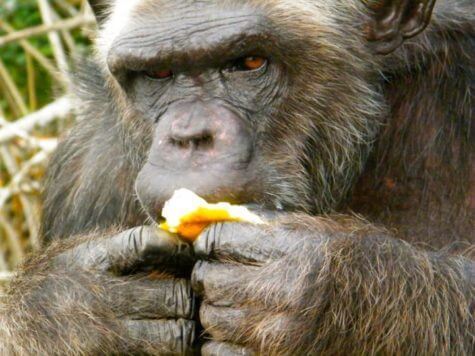
(Photo credit: Cecile Sarabian, HELP Congo, Kyoto University)
KYOTO, Japan — Chimpanzees, like many wild animals, have many behaviors that we, as humans, would likely consider to be downright disgusting. Wild chimps are known to pick through feces for seeds and re-ingest them. In fact, chimps in captivity have sometimes eaten their own feces or the feces of others. So if what seems so naturally vomit-inducing to us is no big deal to them, what does gross a chimp out?
Researchers at Kyoto University in Japan sought out to answer that very question.
In the cases of poop-eating, chimps usually only mess with their own feces or the feces of close family relatives, which don’t present as much of a risk of infectious disease to their bodies as the feces of other animals and chimps not related to them.
Researchers say that avoiding potentially dangerous biological contaminants is the primary evolutionary reason for the sensation of disgust in most intelligent mammals. The Kyoto University team, studying chimpanzees at the Centre International de Recherches Médicales de Franceville in Gabon, Africa, found that exposure to bodily excrement that typically grosses out humans affected their feeding choices.
A series of experiments revealed chimps delaying eating food items when placed on top of replica feces compared to a less graphic piece of brown foam. The chimps also generally stayed away from the smell of biological contaminants, and recoiled from food items related to soft, moist soil substrates.
“If chimpanzees and other primates can discern contamination risk via different cues, individuals with higher sensitivities to feces and other bodily fluids may be less infected, which could have important health benefits,” says Cecile Sarabian, the lead author of the study, in a university release. “Moreover, such results may have implications for animal welfare and management. We can better inform staff and keepers about the adaptive value of such sensitivity and its flexibility, as well as identify which individuals may be more at risk of infection and therefore require more attention.”
The researchers tested several of the chimps’ senses: touch, smell, and sight. They gave chimps food in opaque boxes with moist and slimy substances on top of their food versus dry and brittle. They found that generally, the chimps hesitated when they touched something wet and moist in their food box.
“While anyone watching the reactions of these chimpanzees in the tactile experiments can empathize with them, it’s premature to say that they feel the same as we might in that situation,” notes Andrew MacIntosh, senior author on the study. “What’s great about these experiments, though, is that the observed responses are functionally similar to what ours would be, providing evidence that the mechanism underlying their behavior could be similar to ours.”
The full study was published Nov. 8, 2017 in the journal Royal Society Open Science.


