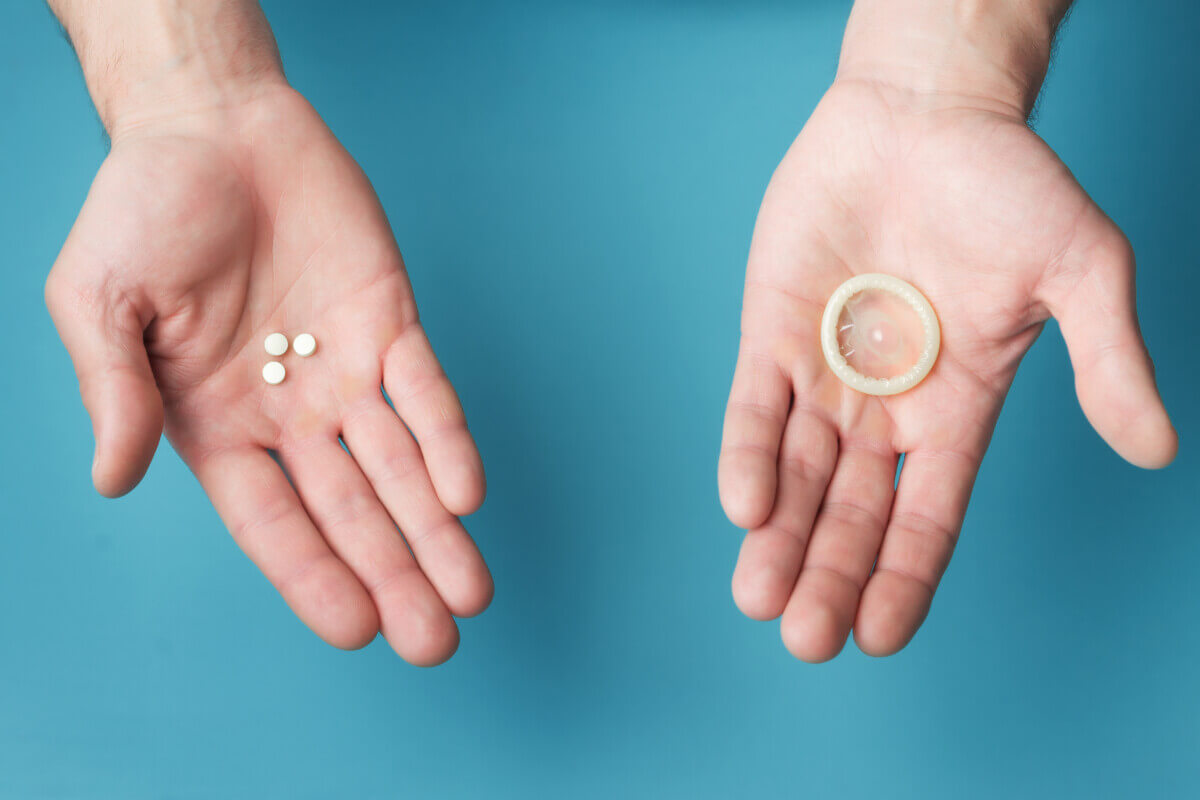
(© TanyaJoy - stock.adobe.com)
Is A Reversible, Hormone-Free Male Contraceptive Finally Within Reach?
In A Nutshell
- Scientists used a drug in mice to temporarily interrupt a key stage of sperm production, then watched fertility recover after the drug was stopped.
- The work points to a promising new target for nonhormonal male contraception: a narrow window during meiosis, the stage where sperm cells halve their chromosomes.
- The mice largely recovered sperm production, fertility, and testis structure, and the researchers did not see major lasting problems in the offspring measures they checked.
- Still, this is not a male pill ready for people. The drug used here is a research tool, and much more safety testing would be needed before any human treatment.
For decades, men have had exactly two birth control options: condoms or vasectomy. Women, meanwhile, shoulder the vast majority of contraceptive responsibility through pills, patches, implants, injections, and intrauterine devices, along with all the side effects that come with them. Nearly 44% of pregnancies worldwide are unintended, a number that makes the case for new options hard to ignore.
Now, a team of researchers believes they’ve found the ideal biological window for a male contraceptive to act: a brief, specific stage in sperm production where a drug can shut down fertility and then, once stopped, let everything return to normal. Their study, published in the Proceedings of the National Academy of Sciences, used a drug called JQ1 in mice to show that temporarily disrupting a specific checkpoint in sperm development halts sperm production without causing lasting damage to fertility, genetic health, or offspring.
The fact that JQ1 works as a contraceptive was already known from earlier research. What’s new is the depth of evidence showing why it works, how the body recovers, and where in the chain of sperm production a future male contraceptive should aim. Working from the ground up, the researchers mapped out molecular and genetic recovery in fine detail, producing what amounts to a roadmap for a safe, reversible, hormone-free male contraceptive.
How Male Birth Control Could Target the Right Stage of Sperm Production
Making sperm is a surprisingly involved, multi-week process. Stem cells in the testes divide and eventually become mature sperm through three major phases. First, stem cells multiply. Then, during a middle phase, cells shuffle their genetic material and divide to create cells with half the normal number of chromosomes, the defining feature of sperm and eggs. Finally, those cells undergo dramatic physical remodeling to become the streamlined, swimming cells we all recognize.
The challenge for contraceptive developers has always been choosing the right moment to step in. Targeting stem cells risks permanent damage to the body’s ability to make sperm at all. Targeting sperm after they’re already formed risks some still being functional enough to cause pregnancy. The middle phase offers what the researchers describe as a natural checkpoint: specific enough to block sperm formation, but early enough that the stem cell supply stays intact and ready to restart production once the drug is removed.
Within that middle phase, the researchers focused on a protein called BRDT, found only in the testes. BRDT acts like a master switch during a moment when cells activate a burst of gene activity needed to transition into the final remodeling phase. Without that burst, the later steps of sperm production collapse.
Three Weeks On, Then Off: Testing a Male Contraceptive in Mice
The research team gave adult male mice daily injections of JQ1 for three weeks, then divided the animals into groups. Some were analyzed immediately after treatment, while others were given time to recover for six weeks, thirty weeks, or were examined as the first-generation offspring of treated fathers.
The results during treatment were clear. Testes shrank. Sperm counts plummeted. Under the microscope, the tubes inside the testes where sperm are made showed a visible depletion of mature sperm cells. Using a technique that reads gene activity in thousands of individual cells, the team confirmed that cells progressed normally through the early stages of sperm production but hit a wall right at the transition to mature sperm. The burst of gene activation that normally occurs at the checkpoint was blunted in treated animals.
The drug wasn’t destroying cells across the board, though. The researchers found only limited cell death, not the widespread destruction that would signal toxic damage. When they checked the liver and kidney, two organs that often bear the brunt of drug side effects, they found only minimal, temporary changes and normal tissue appearance. Within the testes, the support cells that nurture developing sperm were unaffected in both number and function.
The drug was also precise. Genes directly controlled by BRDT showed altered activity, while genes not controlled by BRDT remained unchanged, evidence that JQ1 was acting through its intended target rather than broadly poisoning the cell.

The Recovery
Six weeks after the last injection, roughly one full cycle of mouse sperm production, the picture had changed completely. Testis weight and sperm counts bounced back to normal. The tissue looked indistinguishable from mice that had never been treated. The burst of gene activity at the checkpoint had returned. Markers of proper chromosome behavior during the middle phase of sperm production all normalized.
The research team devised what they called a “healing metric” to measure recovery at the molecular level, tracking what fraction of disrupted genes returned to normal after the drug was stopped. The numbers were encouraging: 98.5% of genes in stem cells, 95.4% in developing sperm cells, and 95.8% in mature sperm returned to baseline. The one cell type that lagged slightly, cells in the middle phase itself, still showed 73.4% recovery, consistent with a brief delay in restarting the gene activation burst.
A small set of genes in mature sperm remained somewhat altered at the six-week mark, related to energy production and fertilization. This correlated with a modest increase in abnormally shaped sperm. But these residual effects proved temporary.
Long-Term Safety and the Next Generation
The most reassuring data came from the long-term and next-generation analyses. Males examined thirty weeks after their last injection showed completely normal testes, sperm counts, and sperm appearance. Their offspring, the first generation born to fathers who had been treated, were equally normal by every measure the researchers checked: testis size, sperm production, tissue structure, chromosome behavior, and the molecular markers of healthy sperm development.
Fertility testing told the same story. Treated males experienced a brief delay in producing their first litter and had smaller initial litters after the drug was stopped, exactly what you’d expect as sperm production ramped back up. Later litters were normal in size and timing, showing complete restoration of reproductive function.
One important safety question for any drug targeting the middle phase of sperm production is whether it causes chromosome errors that could lead to miscarriage or birth defects. During this phase, chromosomes must physically exchange segments and then separate cleanly. Errors in this process are a leading cause of conditions like Down syndrome.
The researchers found that JQ1 treatment did modestly reduce the number of exchange points during this phase. But this didn’t appear to translate into chromosomes separating incorrectly: the researchers found no evidence of errors, though they note they can’t completely rule out rare issues in the mature sperm population. When the team counted chromosome markers in sperm cells after recovery, the vast majority showed the expected count of twenty, matching the twenty mouse chromosomes, confirming that cells were dividing accurately. Exchange-point counts fully normalized by thirty weeks and remained normal in offspring.
What This Means for Male Birth Control
This study does not deliver a ready-made male birth control pill. JQ1 itself blocks not just BRDT but also related proteins found throughout the body, making it unsuitable for direct use in humans without modification. The researchers are upfront about this limitation, noting that JQ1 served as a “probe compound,” a tool to test a concept rather than a finished product.
What the study delivers may be more valuable at this stage: proof that there exists a precise, temporary, and recoverable point in sperm production where a drug can intervene without apparent lasting harm, at least in mice. The checkpoint governed by BRDT satisfies every criterion the researchers laid out for an ideal contraceptive target. It produces a defined arrest, it’s reversible, and it preserves chromosomal integrity. BRDT is found only in the testes in both mice and humans, making it a promising starting point for designing more selective drugs.
The road from mouse study to medicine cabinet is long and uncertain. The researchers acknowledge that chronic use, which any real-world contraceptive would require, could produce effects not captured by a three-week treatment window. But in a field that has struggled for decades to move beyond condoms and vasectomy, this work offers something that has been in short supply: a clear molecular framework for what a safe, reversible male contraceptive should target, how to measure whether it’s working, and how to confirm that it’s truly wearing off.
Paper Notes
Limitations
This study was conducted entirely in mice, and the researchers caution that translation to humans will require extensive additional safety assessment. The treatment regimen lasted only three weeks, whereas real-world contraceptive use would likely be chronic; the effects of prolonged or repeated dosing across multiple sperm production cycles were not evaluated. JQ1 acts on proteins beyond BRDT, which limits its specificity and clinical applicability. While the researchers found no increase in chromosomal errors at the sperm cell stage, they note they cannot wholly rule out the possibility of increased chromosomal abnormalities in the resulting mature sperm population. The study used a single mouse strain (DBA/2J), and results may vary across genetic backgrounds. One single-cell sequencing replicate from the treatment-control group was identified as a technical outlier and was excluded from certain analyses, though it was retained for others.
Funding and Disclosures
The authors declare no competing interest. This work was supported, in whole or in part, by the Gates Foundation (grants INV-00371 and INV-038185). The article is a PNAS Direct Submission and is distributed under Creative Commons Attribution License 4.0 (CC BY).
Publication Details
The paper, titled “Meiotic prophase I disruption as a strategy for nonhormonal male contraception using small-molecule inhibitor JQ1,” was published April 7, 2026, in Proceedings of the National Academy of Sciences (PNAS), Volume 123, Number 15. The DOI is 10.1073/pnas.2517498123. The study was authored by Stephanie Tanis, Leah E. Simon, Adriana K. Alexander, Tegan S. Horan, Maria de las Mercedes Carro, Samantha Jane Bonnett, Audrey Xie, Roni Ben-Shlomo, Connor E. Owens, Charles G. Danko, Jelena Lujic, and Paula E. Cohen. Correspondence should be directed to Paula E. Cohen at [email protected]. Stephanie Tanis and Leah E. Simon contributed equally to the work.


