
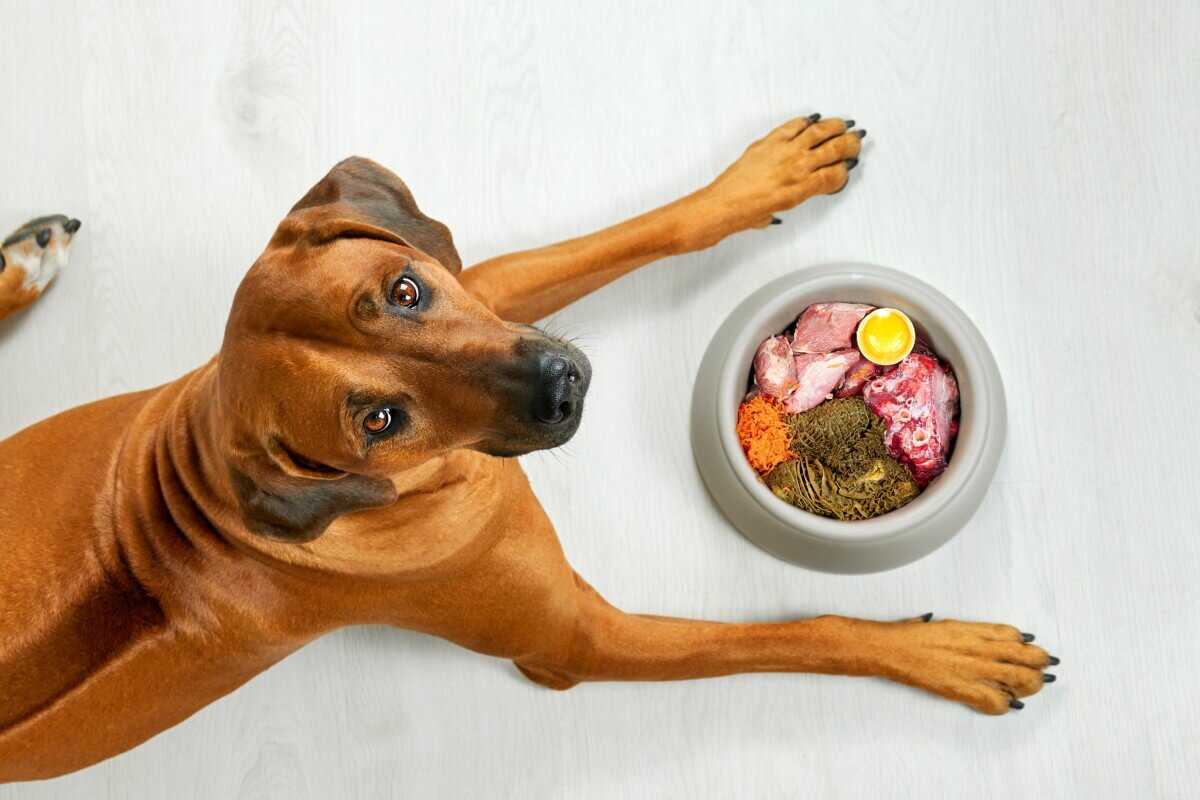
(© New Africa - stock.adobe.com)
In A Nutshell
- Finnish researchers fed 46 Staffordshire Bull Terriers either high-carb kibble (48.4% carbohydrates) or carb-free raw meat diets for about 4.5 months, then compared their blood work.
- Dogs eating kibble showed increases in long-term blood sugar markers, total cholesterol, and body weight. One dog’s blood fats climbed so high they couldn’t be measured using standard formulas.
- Dogs eating raw meat showed decreases in blood sugar, cholesterol, and a marker linked to insulin function. Their bodies also shifted to burning fat for energy instead of carbohydrates.
- This was a small study in one breed using specific commercial diets. Whether these metabolic changes affect long-term health in dogs remains unknown.
Most dog owners don’t think twice about the carbohydrates in their pet’s food. But a study from Finland found that dogs eating high-carb kibble showed markedly different blood chemistry than those eating a carbohydrate-free raw diet after about five months. The differences appeared in markers linked to blood sugar control, cholesterol, and how dogs burn energy.
Researchers at the University of Helsinki tracked 46 Staffordshire Bull Terriers, dividing them between a high-carbohydrate kibble diet and a low-carbohydrate raw meat-based diet. Blood tests revealed distinct metabolic differences between the two groups that raise questions about how modern dog foods align with what dogs evolved to eat.
Dogs on the kibble diet, which contained 48.4% carbohydrates from rice and maize, experienced increases in long-term blood sugar markers, total cholesterol, and body weight. Dogs eating raw meat-based diets with essentially zero carbohydrates showed decreases in blood sugar, cholesterol, and markers linked to insulin sensitivity over the course of the study.
“Considering that dogs originate from carnivorous wolves and do not have a requirement for carbohydrates, it may be questioned whether high-carbohydrate diets are beneficial to their health,” the researchers wrote in their paper, published in The Veterinary Journal.
Dogs Evolved to Eat Meat, Not Grains
Domestication gave dogs extra copies of a gene called AMY2B, which produces an enzyme that helps digest starch. The number of these gene copies varies widely among breeds, similar to variations seen in human populations.
Studies also show dogs naturally prefer fat and protein over carbohydrates when given a choice. Yet the most common commercial dog foods contain significant amounts of starches from grains and potatoes, in part because starch is needed to form kibble during manufacturing and grains tend to cost less than animal proteins.
At the study’s conclusion, kibble-fed dogs had significantly higher levels of blood fats and cholesterol compared to those eating raw meat. In one kibble-fed dog, a particular cholesterol measurement could not be calculated because the dog’s blood fat levels were too high for the standard formula. This happened despite the raw diet containing much more saturated animal fat.
When glucose is abundant, dogs’ bodies can convert that excess sugar into fats and cholesterol. That may help explain why the higher-carb diet led to these shifts. Similar patterns occur in humans who consume high amounts of refined carbohydrates.
Blood Sugar Changes Over Time
One particularly notable finding involved a marker called HbA1c, which acts like a snapshot of average blood sugar levels over the preceding 2-3 months. This marker increased in kibble-fed dogs but remained stable in those eating raw meat.
Actual blood sugar levels dropped in the raw-fed group during the trial while staying unchanged in kibble eaters. Glucagon, a hormone that raises blood sugar when levels drop too low, decreased significantly in raw-fed dogs but remained stable in the kibble group.
Another marker combining blood sugar and blood fats decreased significantly in raw-fed dogs, suggesting improved insulin function. The authors note this marker has been used in human research but is new to canine studies, so they interpret the finding cautiously.
Blood fats called triglycerides trended lower in raw-fed dogs and were significantly higher in kibble-fed dogs at the study’s conclusion. Elevated triglycerides in dogs have been linked to insulin resistance, inflammation, obesity, diabetes, pancreatitis, and liver disease.
A Different Fuel Source
Dogs eating raw meat showed significantly elevated levels of beta-hydroxybutyrate, a ketone body that serves as an alternative fuel source when carbohydrates are scarce. Both diet groups saw increases in this marker, but raw-fed dogs had much higher levels by the study’s end, suggesting their bodies had shifted to burning fat for energy instead of sugar.
This metabolic state, called nutritional ketosis, takes longer to achieve in dogs than in humans. In human studies, ketogenic diets have been shown to reduce inflammation, improve cell energy production, and help manage insulin resistance, obesity, and Type 2 diabetes. Whether dogs experience similar benefits remains an open question.
Kibble-fed dogs gained an average of 0.53 kg during the trial, while raw-fed dogs maintained stable weights, though the difference between groups was not statistically significant at the study’s end.

What This Means for Dog Owners
The kibble used was Hill’s Science Plan Canine Adult Sensitive Skin with Chicken, a mainstream commercial diet. Raw diets consisted of commercial MUSH Vaisto formulas containing meat, offal, bones, fish, eggs, vegetables, fruits, and various supplements formulated to meet complete nutritional requirements.
Previous research has reported that dogs eating raw meat-based diets have better dental, ear, and skin health compared to kibble-fed dogs. They also show lower levels of an enzyme that can indicate liver stress and higher markers suggesting improved gut health and immune function.
Raw feeding has gained popularity among dog owners but remains controversial in veterinary medicine due to potential risks from bacterial contamination and nutritional imbalances in improperly formulated homemade diets. The raw diets in this study were commercial products designed to be nutritionally complete.
This study did not evaluate cardiovascular outcomes or long-term health effects, so the clinical meaning of the cholesterol changes in dogs remains unknown.
The study also focused exclusively on Staffordshire Bull Terriers, a heavily muscled breed. Since muscle tissue plays a major role in how the body processes sugar and energy, findings may not apply equally to all breeds. Dogs ranged in age from 1 to 13 years, and all had eaten different diets before the trial began, which could have influenced results.
The metabolic differences revealed in this research suggest kibble and raw meat diets push canine physiology in fundamentally different directions. Whether either pattern better serves long-term health awaits further research.
Disclaimer: This article is general information for pet owners. It is not medical advice. Talk with your veterinarian before changing your dog’s diet.
Paper Summary
Methodology
Researchers conducted a diet intervention study with 46 client-owned Staffordshire Bull Terriers divided into two groups. One group ate Hill’s Science Plan kibble containing 48.4% carbohydrates (from rice and maize), 27.5% protein, and 17.4% fat on a dry matter basis. The other group consumed commercial MUSH Vaisto raw meat-based diets containing essentially no carbohydrates (0%), 38-42.5% protein, and 44.8-50% fat. Dogs followed their assigned diets for a median of 136 days (range 50-188 days). Researchers collected fasting blood samples before and after the intervention and measured glucose, glycated hemoglobin (HbA1c), insulin, glucagon, triglycerides, total cholesterol, HDL, LDL, VLDL, beta-hydroxybutyrate, HOMA-IR, and the triglyceride-glucose index. Body weight was also recorded. Statistical analyses compared the two diet groups at baseline and study end, and examined changes within each group over time.
Results
Kibble-fed dogs showed significant increases in HbA1c, total cholesterol, beta-hydroxybutyrate, and body weight. Raw-fed dogs showed significant increases in beta-hydroxybutyrate and significant decreases in glucose, glucagon, total cholesterol, and triglyceride-glucose index. At study end, kibble-fed dogs had significantly higher concentrations of triglycerides, total cholesterol, HDL, LDL, and VLDL compared to raw-fed dogs. Raw-fed dogs had significantly lower glucagon and triglyceride-glucose index values, plus higher beta-hydroxybutyrate concentrations than kibble-fed dogs. No significant changes occurred in insulin or HOMA-IR for either group.
Limitations
The study included a relatively small sample size of 46 dogs. Participants came from varying previous diets and included both healthy dogs and those with atopic dermatitis. Dogs lived at home rather than in controlled facilities, creating potential for dietary variation. Age ranged from 1-13 years, which could affect energy metabolism. Trial duration varied considerably (50-188 days). Some blood samples were frozen for up to 10 years before analysis, though measured biomarkers are generally stable during long-term frozen storage. Glucagon may be less stable and its concentrations could be underestimated. The study examined only Staffordshire Bull Terriers, a heavily muscled breed, which may limit generalizability. Body composition was not assessed, so researchers could not determine whether weight changes reflected fat or lean muscle mass.
Funding and Disclosures
The Swedish Cultural Foundation in Finland provided primary funding (grant 13/3307-1304). MUSH Ltd. and Berner Ltd. donated food for the trial but had no role in study design, data collection and analysis, publication decisions, or manuscript preparation. Authors declared no competing financial interests or personal relationships that could influence the reported work.
Publication Information
Holm, S., Baarman, E., Anturaniemi, J., Hemida, M., Salin, S., Vuori, K.A., Moore, R., & Hielm-Björkman, A. (2025). “The effect of a kibble diet versus a raw meat-based diet on energy metabolism biomarkers in dogs,” The Veterinary Journal, 314, 106462. doi:10.1016/j.tvjl.2025.106462


