
(© AntonioDiaz - stock.adobe.com)
In A Nutshell
- Comfort meets performance: Sensors embedded in loose, baggy clothing outperformed tight-fitting wrist and body sensors by up to 40% in motion tracking accuracy
- Faster recognition: Fabric-mounted sensors needed about 80% less movement history to accurately identify what someone was doing
- The wobble works: Billowing, rippling fabric creates richer movement data than rigid sensors: turning “noise” into valuable signal
- Real-world potential: Applications range from fall detection for the elderly to safer human-robot collaboration in factories, all without uncomfortable wearables
Fitness trackers, smartwatches, medical monitors all have something in common. They’re uncomfortable. The wristband digs into your skin. The chest strap chafes. The electrode tape pulls at your arm hair. According to every engineer who designed them, they need to be that way. Sensors must sit tight against your body to work properly, right?
Research now indicates that may not be the case after all.
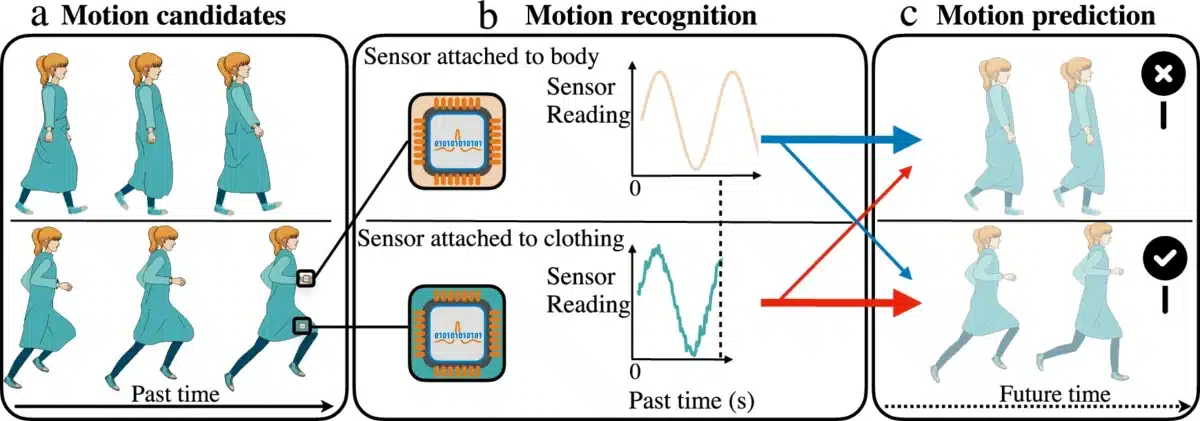
Scientists at King’s College London just discovered that loose, baggy clothing can track your movement better than sensors strapped tightly to your skin. In some tests, fabric-mounted sensors showed up to 40% better accuracy. And they needed far less movement history to get it right: about 80% less in some tests.
The finding, published in Nature Communications, challenges a long-held assumption in wearable tech design. Turns out, all that wobbling fabric everyone was trying to eliminate? That’s not noise. That’s signal.
The Comfort Problem
If you’ve ever worn a fitness tracker all day, you know the drill. By evening, there’s a groove in your wrist. Your skin is sweaty underneath. You can’t wait to take it off.
Medical patients have it worse. Stroke survivors doing rehab exercises at home need sensors taped to multiple points on their arms and legs. Elderly people at risk of falling could benefit from 24/7 monitoring, but who wants to live with devices strapped to their body around the clock?
Factory workers collaborating with robots need motion tracking for safety, but not if it means donning a bunch of uncomfortable gear before every shift.
Lead researcher Tianchen Shen wondered if the entire industry had been thinking about this backwards.
The Baggy Shirt Experiment
The team started with a simple mechanical arm that swung back and forth at different speeds. They attached a strip of regular cotton fabric to it and stuck sensors on both the rigid arm and the loose fabric.
When the arm moved at two similar speeds (hard to tell apart) the fabric sensor nailed it after watching for just a quarter of a second. The rigid sensor lagged behind in the same timeframe, especially in the hardest-to-tell-apart cases. In these frequency pairs, the fabric-mounted sensors consistently outperformed the rigid-mounted ones.
Next came a robot arm wearing a fabric sleeve. Same story. The sleeve sensor outperformed the rigid sensor, especially when the robot traced two nearly identical paths.
Then 22 human volunteers wore sensor-embedded shirts and reached for buttons at different positions. One sensor sat on the wrist. Another sat on the loose sleeve. In the hardest-to-distinguish reaches, the sleeve sensor sometimes outperformed the wrist by around 10 to 15 percentage points.
Why Baggy Works Better
Think about how your clothes move when you swing your arm quickly. The fabric doesn’t just go where your arm goes. It billows. It ripples. It lags behind, then catches up. All that extra motion creates a richer picture of what you’re doing.
A rigid sensor only knows: arm went up, arm went left, arm tilted forward. A fabric sensor knows all that plus: fabric rippled in this pattern, billowed that way, created these secondary movements. More information means easier recognition.
In these tests, faster movements made the difference more dramatic. Quick movements make fabric flutter and flow. Slow movements reduce the effect, though fabric still wins.
In these experiments, placement along the fabric didn’t show a clear impact on accuracy. The researchers tried different positions: all the loose sensors beat the body-mounted ones.
What This Means for You
Imagine your grandmother lives alone. She’s at risk for falls, but she refuses to wear one of those clunky medical alert devices. Now picture her in a regular cardigan with embedded sensors; comfortable, washable, no setup required. The sensors track her movements, detect loss of balance, and call for help before she hits the floor. Because they require less movement history to make accurate predictions, they could respond more quickly.
Stroke survivors could do rehab exercises at home in a normal long-sleeve shirt instead of scheduling clinic visits for motion analysis. Toss the shirt in the laundry when you’re done. No tape residue on your skin. No complicated positioning.
Virtual reality gamers could get more responsive gameplay. Every millisecond of lag matters when you’re trying to catch a virtual ball or dodge a virtual punch. Faster motion prediction means smoother, more immersive experiences.
Factory workers could wear sensor-embedded uniforms that help robots predict and avoid collisions without adding extra equipment to the workday.
The Catch
Before you throw away your Apple Watch, know that this tech isn’t ready for store shelves yet. The researchers used specialized tracking equipment tethered to a base station, not the kind of tiny wireless sensors in consumer devices. They did test standard accelerometers (the kind in fitness trackers) and got similar results, but more validation is needed.
All the experiments used 100% cotton. Stretchy fabrics, heavy materials, or synthetic blends might behave differently.
The movements tested were fairly simple: reaching for buttons, tracing patterns, back-and-forth swings. Complex full-body activities like running or playing basketball might present new challenges.
Higher airflow in lab tests reduced fabric sensor performance, though in the tested temperature and humidity ranges, the researchers found no significant effect.
When Sensors Meet Fashion
The path from lab discovery to actual smart clothing involves solving practical problems. Sensors need to survive the washing machine. They need power sources and wireless connections. Clothes need to fit different body types while staying appropriately loose.
But the core insight changes the game: the thing engineers spent decades trying to eliminate turned out to be exactly what they needed. Comfort and accuracy don’t have to trade off against each other.
Nature might have known this all along. Spiders sense prey through web vibrations: the web acts like loose fabric, amplifying tiny movements into rich information. Dancers across cultures wear flowing garments that make their movements more visible and expressive.
Maybe humans have always understood intuitively what technology is just now discovering. Sometimes loose is better than tight.
Disclaimer: This article is based on peer-reviewed research. While the findings are scientifically rigorous, the technology described is still in the research phase and not yet available as consumer products. The applications and implications discussed represent potential future uses pending further development and validation.
Paper Notes
Study Limitations
The research used tethered electromagnetic tracking systems rather than portable wearables, though supplementary tests with accelerometers showed similar patterns. The study focused on relatively simple movements and binary classification tasks. All tests used 100% woven cotton fabric; different textile materials might produce varying results. Long-term durability, washing effects, and sensor placement stability were not examined.
Funding and Disclosures
This work received partial support from King’s College London, the China Scholarship Council, and the Engineering and Physical Sciences Research Council (grant EP/M507222/1). The authors declare no competing interests. The human reaching experiment received ethical approval from King’s College London (MRPP-23/24-40031), and all participants provided informed consent.
Publication Details
Authors: Tianchen Shen, Sacha Morris, Irene Di Giulio, and Matthew Howard | Journal: Nature Communications | Title: Human motion recognition and prediction using loose cloth | Volume/Issue: Volume 17, Article 807 (2026) | DOI: https://doi.org/10.1038/s41467-025-67509-7 | Affiliations: Department of Engineering and School of Basic & Medical Biosciences, King’s College London, London, England, UK | Published: January 20, 2026 (online); Received July 10, 2024; Accepted December 3, 2025 | License: Open Access under Creative Commons Attribution 4.0 International License | Data and Code Availability: All data and custom MATLAB scripts are deposited in the Figshare repository at https://figshare.com/s/4b69b5734100c9762fed


