
Credit: Kim Britten on Shutterstock
In A Nutshell
- Century-old hair reveals dramatic change: Researchers analyzed childhood hair saved by families from 1916 to 2024 and found people in Utah’s Wasatch Front today have nearly 100 times less lead in their hair than before the EPA was created in 1970.
- Peak exposure was in the 1960s: People who grew up in that decade had 121 times more lead in their hair than people today, largely due to leaded gasoline and industrial smelters that operated without modern pollution controls.
- The decline took decades: Lead levels didn’t drop overnight. They fell gradually as regulations phased out leaded gasoline (1974-1987), closed smelters, and addressed lead paint and pipes, and kept declining for 30 years after the main sources were eliminated.
- The findings arrive at a critical moment: As the EPA considers scaling back enforcement of environmental regulations, this study documents what happened when such regulations were established and maintained over multiple decades.
Your grandparents likely had far more lead in their hair than people do today, at least if they lived in heavily polluted regions like Utah’s Wasatch Front. And if you’re wondering why that matters, consider that lead damages brains, lowers IQ, harms kidneys, and affects nearly every organ system. There’s no safe level of exposure. None.
A study using century-old childhood hair documents something politicians have debated for decades: environmental regulations appear to work. Researchers at the University of Utah analyzed hair saved by families over the past 108 years and found that residents in their region today carry dramatically less lead than people did before the Environmental Protection Agency was created in 1970. The reduction is undeniable: from an average of 50 parts per million in the 1970s to less than 1 part per million today.
The findings arrive amid renewed debate about environmental protections. On March 12, 2025, the EPA announced plans to scale back enforcement of several regulations, though the agency characterized the move as ensuring clean air, land, and water for US residents. The hair analysis offers evidence that the regulatory framework built over the past 50 years corresponded with measurable declines in lead exposure.
The Evidence Hidden in Family Albums
The study, published in Proceedings of the National Academy of Sciences, depended on something surprisingly sentimental: childhood hair kept in memory boxes and albums. Families who had saved locks from their children’s haircuts decades ago donated those samples alongside fresh hair from the same people today. This allowed scientists to track how exposure changed across individuals’ lifetimes and historical periods.
All the participants lived along Utah’s Wasatch Front, near Salt Lake City. The area once hosted two of the nation’s largest lead smelters, which operated from 1872 until 1972. If regulations could drive declines in a heavily polluted region like this, they may have mattered elsewhere too, though results in other areas might differ.
Hair is an ideal pollution tracker. As it grows, it absorbs lead from the air, water, and dust, creating a permanent record of exposure. The researchers measured the lead content to see how much people were breathing in and ingesting during different eras.

Photo used by permission, Utah Historical Society.)
When Lead Was Everywhere
The oldest samples, from 1916 through the 1960s, contained striking amounts of lead: averaging between 43 and 60.5 parts per million depending on the decade. One person’s hair from the 1940s topped out at nearly 100 parts per million. Today’s hair samples average 0.5 parts per million.
Then something changed. In 1970, Congress created the EPA and gave it authority to regulate pollution. The agency went after the two biggest sources: industrial smelters and leaded gasoline.
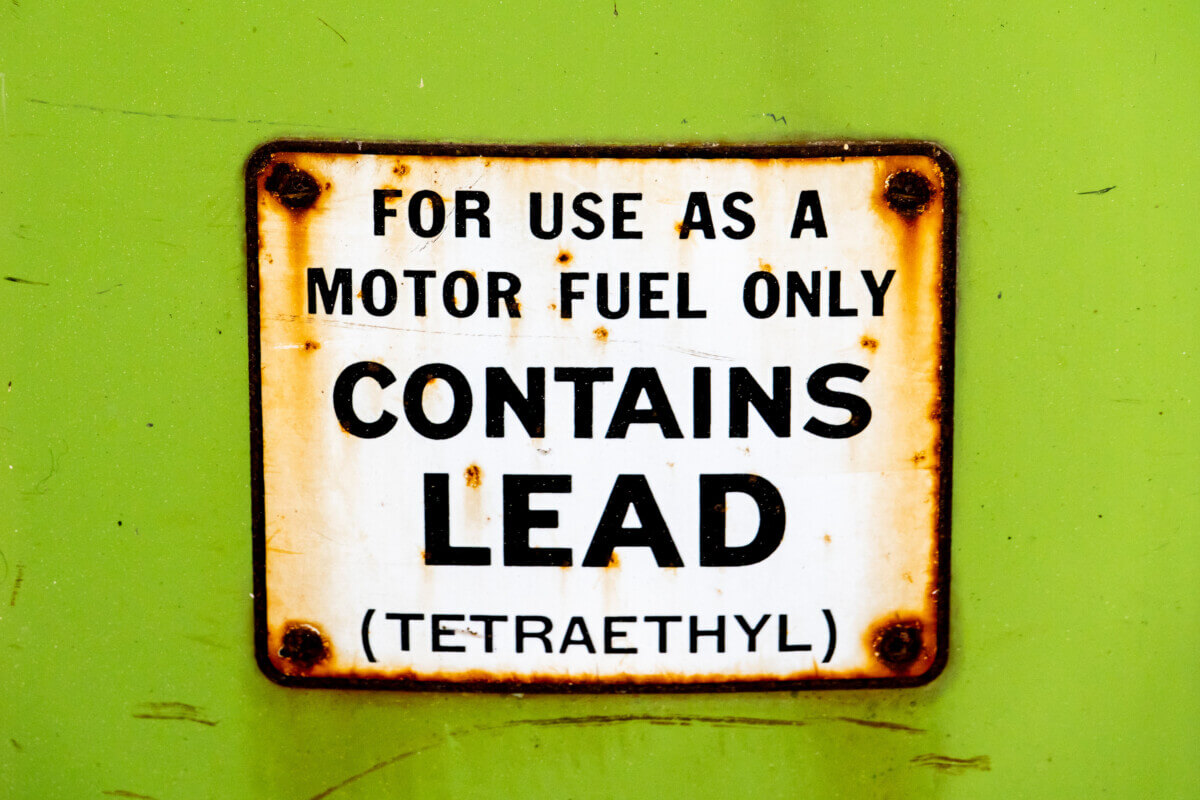
Salt Lake City’s massive smelting operations shut down in 1972. But leaded gasoline was everywhere. Since the 1920s, gas companies had been adding tetraethyl lead to fuel as an “antiknock” agent. By 1970, every gallon contained about 2.2 grams of lead. With Americans burning through 89 billion gallons a year, the study’s authors calculated this meant an average of about 960 grams of lead per person per year as a national emissions proxy.
The Phase-Out That Changed Everything
Starting in 1974, the EPA required gas stations to sell unleaded fuel. The industry argued this would wreck car engines and devastate the economy. They were wrong. The phase-out took more than a decade (lead content dropped to 1 gram per gallon by 1981 and was essentially eliminated by 1987) but it corresponded with a dramatic decline in human exposure.
The hair samples document the transformation. Before 1970, average lead levels sat between 43 and 60.5 parts per million. In the 1980s, as leaded gas disappeared, levels dropped to about 15 parts per million. By the 1990s, they fell to under 10. In the 2000s, they hit 2.3. Today’s samples average 0.5 parts per million.
Comparing the pre-EPA period to today shows an 86-fold reduction. People who grew up specifically in the 1960s (the peak contamination decade) had 121 times more lead in their hair than people growing up today.
Why the Decline Kept Going
Notably, lead levels kept dropping for 30 years after leaded gas disappeared. Lead sits in soil and dust for decades, getting kicked up long after the original source is gone. Water pipes made with lead or lead solder continue contaminating drinking water. The crisis in Flint, Michigan in 2015 showed how this type of legacy contamination still poses risks.
But overall exposure kept falling. New regulations tackled lead paint in old buildings and required water systems to monitor lead in pipes. The study’s authors note that these ongoing regulatory efforts likely contributed to the continued decline.
Environmental regulations don’t deliver instant results. They take years, sometimes decades, to show their full effect. But when maintained and enforced consistently, they correspond with measurable declines in exposure.
What Happens Next
The researchers published their findings as those regulations face new scrutiny. While the current administration hasn’t directly rolled back lead protections, it has proposed “implementation flexibilities” that could affect enforcement of the Lead and Copper Rule of 2024, which requires water systems to replace old lead pipes and sets stricter standards for children’s exposure.
The paper’s authors write that “this low level of lead exposure is likely due to the environmental regulations established by Environmental Protection Agency.” Their analysis suggests the dramatic improvement resulted from deliberate policy choices, often made over fierce corporate opposition, backed by federal enforcement that lasted decades.
Lead is particularly harmful to children, whose bodies absorb it more readily and whose developing brains are more vulnerable. For kids growing up in the 1960s and 70s in the Wasatch Front region, high lead exposure was the norm. Today’s children face far lower exposure, not by chance but because of regulatory changes.
A Record of What Changed
Salt Lake City’s experience shows how local and national regulations worked together. The closure of local smelters combined with the nationwide phase-out of leaded gas created conditions where lead exposure could finally decline.
The century-long dataset clearly indicates when environmental regulations were established and enforced, lead exposure declined. When maintained over time, exposure kept declining. The study’s authors caution that lead already in soil, dust, and pipes can keep exposure risks alive, and that weakening enforcement could threaten the progress documented in their study.
For families who saved those locks of childhood hair in memory books, the samples turned out to document more than personal milestones. They recorded a transformation so substantial that kids today in the Wasatch Front region live in a fundamentally different chemical environment than their grandparents did. That difference, the authors argue, appears to have followed from regulatory decisions made over industry objections and maintained for decades.
Whether we continue to maintain that regulatory framework is now an open question.
Disclaimer: This article is based on a peer-reviewed study that analyzed hair samples from residents of Utah’s Wasatch Front region. The findings document dramatic declines in lead exposure in this specific geographic area that corresponded with the establishment and enforcement of EPA regulations. Results may differ in other regions with different pollution histories. The study measured lead in hair as a proxy for environmental exposure but did not directly measure blood lead levels or specific health outcomes. Readers should consult the original research paper for complete methodological details and limitations.
Paper Notes
Study Limitations
The study focused on residents of Utah’s Wasatch Front, an area with particularly high lead exposure before 1970 due to major smelting operations. Declines in this region might be more dramatic than in areas without nearby industrial sources. Sample sizes were small for some decades, particularly 1916-1959, and exact counts can’t be reported for groups under 11 participants due to Utah privacy rules. Hair analysis measures exposure but doesn’t directly translate to blood lead levels or specific health outcomes. All participants came from families in longevity studies, which may not represent the broader population. The study couldn’t account for individual factors like occupation or behavior that might affect lead exposure independently of environmental sources.
Funding and Disclosures
The research received support from the Utah Population Database at Huntsman Cancer Institute (funded by Huntsman Cancer Foundation and National Cancer Institute grant P30 CA2014), the University of Utah’s Program in Personalized Health, Utah Clinical and Translational Science Institute, University of Utah Center on Aging, and the Center for Genomic Medicine at the University of Utah. The authors declared no competing interests. The University of Utah Institutional Review Board approved the study under protocols IRB 00043093 and IRB 0065564, and all participants provided informed consent with identity protection through deidentification procedures.
Publication Details
“Lead in archived hair documents a decline in lead exposure to humans since the establishment of the US Environmental Protection Agency” by Thure E. Cerling (Department of Geology and Geophysics, School of Biological Sciences, University of Utah), Diego P. Fernandez (Department of Geology and Geophysics, University of Utah), and Ken R. Smith (Department of Family and Consumer Studies, Huntsman Cancer Institute, University of Utah). Published in Proceedings of the National Academy of Sciences (PNAS), February 2, 2026, Volume 123, Number 6, article e2525498123. DOI: https://doi.org/10.1073/pnas.2525498123. Received September 13, 2025; accepted December 26, 2025. Edited by B. Turner II, Arizona State University. Open access under Creative Commons Attribution License 4.0 (CC BY). Correspondence: [email protected]. Supporting information:https://www.pnas.org/lookup/suppl/doi:10.1073/pnas.2525498123/-/DCSupplemental.


