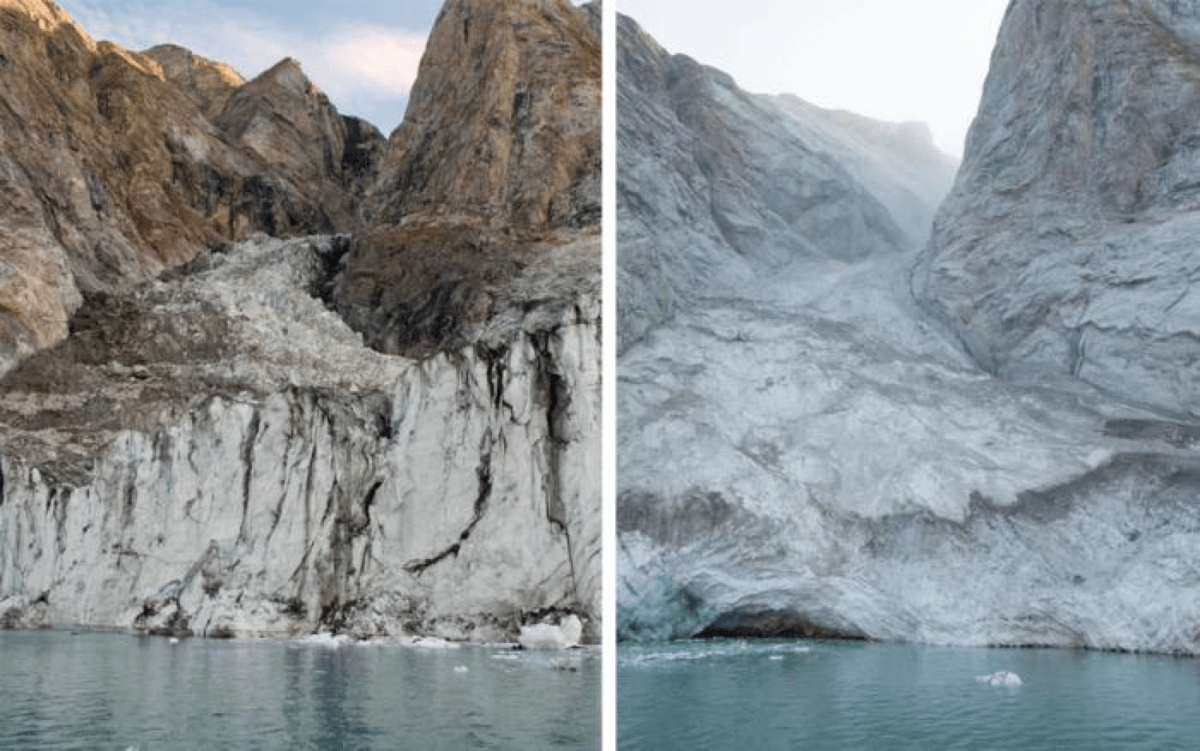
From left: before (August 2023) and after (September 2023) photos of the mountain peak and glacier, taken from the fjord. (Credit: Søren Rysgaard / Danish Army)
LONDON — Picture this: A tsunami taller than the Tower of Pisa, a fjord transformed into nature’s bathtub, and the entire Earth vibrating like a tuning fork for over a week. It might sound like the plot of a disaster movie, but it’s the reality of an extraordinary event that unfolded in Greenland, leaving scientists scrambling for explanations.
On September 16, 2023, a colossal mountain peak in the pristine wilderness of East Greenland crumbled into a remote fjord, unleashing a tremendous chain of events. This wasn’t just any landslide – it was a climate change-induced catastrophe that shook the Earth for an astonishing nine days.
The story begins with a mystery. Seismologists around the world detected an unusual signal rippling through the Earth’s crust. Unlike the typical “rumbles” and “pings” of earthquakes, this vibration sang a monotonous hum at a single frequency. It persisted for days, traveling from the Arctic to Antarctica, leaving experts scratching their heads. They dubbed it a “USO” – an unidentified seismic object.
Meanwhile, news trickled in of a massive tsunami in a remote Greenland fjord. As scientists pieced together the puzzle, they uncovered a sequence of events more dramatic than anyone could have imagined.
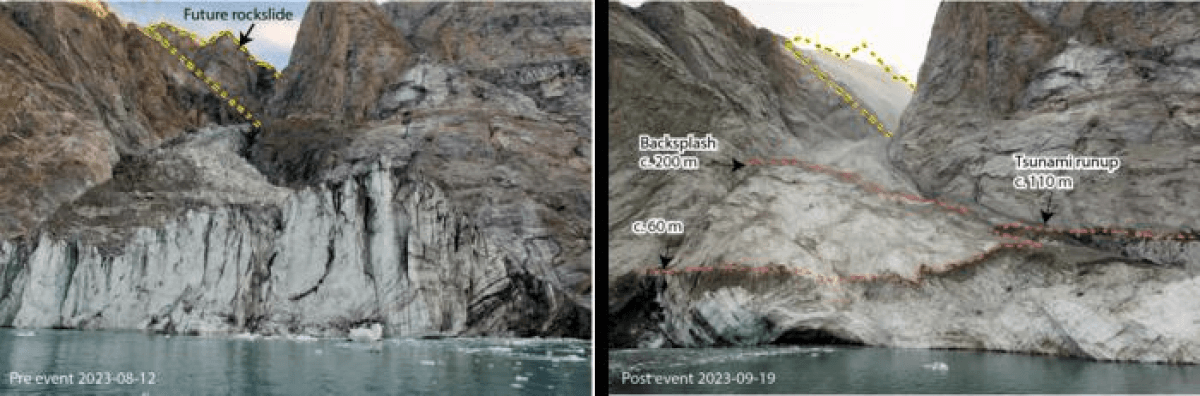
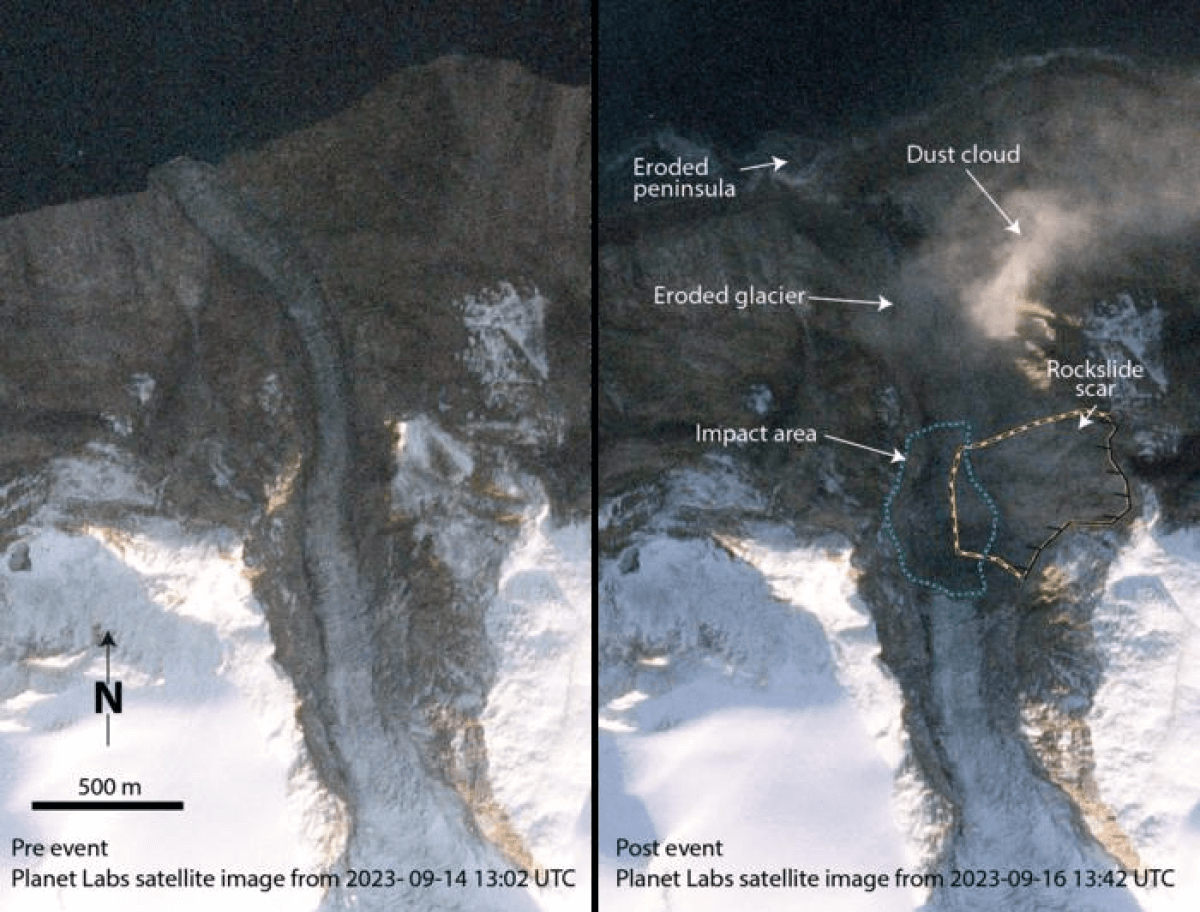
High above Dickson Fjord, a 1.2-kilometer-high mountain peak had been slowly destabilizing. As climate change caused the glacier at its base to thin, the rocky face lost its support. In a catastrophic moment, 25 million cubic meters of rock and ice – enough to fill 10,000 Olympic-sized swimming pools – came crashing down into the fjord below.
The impact, described in the journal Science, was cataclysmic. A wall of water shot 200 meters (an astonishing 656 feet!) into the air – nearly as tall as the Golden Gate Bridge. A tsunami wave up to 110 meters high (about 361 feet) surged across the fjord, gradually settling into a rhythmic sloshing motion known as a seiche.
What makes this event truly remarkable is how long this sloshing persisted. The seiche maintained a nearly constant frequency of 10.88 mHz (corresponding to a period of approximately 92 seconds), gradually decreasing in amplitude over nine days. This means that the water in the fjord was oscillating back and forth, completing one full cycle about every 92 seconds. This rhythmic motion transferred energy to the surrounding bedrock, generating seismic waves that traveled around the planet. The consistency and duration of this signal were unprecedented, allowing it to be detected by seismometers worldwide for over a week.
Dr. Stephen Hicks of UCL Earth Sciences, a co-author of the study, expresses his initial bewilderment. “When I first saw the seismic signal, I was completely baffled. Even though we know seismometers can record a variety of sources happening on Earth’s surface, never before has such a long-lasting, globally traveling seismic wave, containing only a single frequency of oscillation, been recorded,” he says in a statement.
The event’s far-reaching impacts were sobering. Seventy kilometers away, four-meter-high waves battered a research base on Ella Ø island, destroying valuable infrastructure and cultural heritage sites. Fortunately, the base was unoccupied at the time, but the incident points to the dangers to coastal communities and infrastructure. Moreover, had tourist cruise ships – which frequently ply these waters – been in the area, the consequences could have been devastating.
This incident marks the first documented large, tsunamigenic landslide in East Greenland, highlighting how climate change is reshaping polar landscapes in unexpected and potentially hazardous ways. As Dr. Kristian Svennevig from the Geological Survey of Denmark and Greenland notes, “As a landslide scientist, an additional interesting aspect of this study is that this is the first-ever landslide and tsunami observed from eastern Greenland, showing how climate change already has major impacts there.”
As glaciers thin and retreat due to warming temperatures, they can destabilize surrounding rock faces, increasing the likelihood of large landslides. When these landslides occur near water bodies, they have the potential to trigger tsunamis and long-lasting seiches, as dramatically demonstrated in this case.
The study of this extraordinary event was made possible by an unprecedented collaboration of 68 scientists from 40 institutions across 15 countries. They combined data from seismometers, infrasound sensors, field measurements, satellite imagery, and advanced computer simulations to reconstruct the cascade of events.
This research not only solves a geophysical mystery but also serves as a stark reminder of the complex interplay between Earth’s systems in a warming world. As climate change accelerates, monitoring and early warning systems in previously stable regions will become increasingly crucial to protect vulnerable communities and infrastructure.
“Our study of this event amazingly highlights the intricate interconnections between climate change in the atmosphere, destabilization of glacier ice in the cryosphere, movements of water bodies in the hydrosphere, and Earth’s solid crust in the lithosphere,” says Dr. Hicks.
The nine-day Earth hum may have ceased, but its impact on scientific understanding and public awareness continues to grow. The Dickson Fjord event has become a powerful symbol of our planet’s dynamism and the unexpected consequences of climate change. As we face an uncertain environmental future, this extraordinary occurrence reminds us of the critical need for comprehensive Earth observation, multidisciplinary research, and global cooperation in addressing the challenges that lie ahead.
Paper Summary
Methodology
The research team employed a multidisciplinary approach to study this complex event. They analyzed seismic data from global networks to characterize the unusual long-period signal. Satellite imagery and field observations, including data from the Danish military who inspected the site days after the event, provided crucial information about the landslide and tsunami impacts. Advanced mathematical models were used to simulate the tsunami and resulting seiche, incorporating detailed bathymetry data of the fjord. These models helped explain how the water motion in the fjord generated the observed seismic waves.
Results
The study confirmed that a 25-million-cubic-meter landslide triggered a mega-tsunami with an initial height of up to 200 meters. This tsunami evolved into a seiche with a period of about 90 seconds, closely matching the 92-second period of the observed seismic signal. The seiche persisted for nine days, generating vibrations detectable by seismometers worldwide. The researchers’ models successfully recreated the width and depth of the fjord at high resolution, demonstrating how the rhythm of the water mass moving back and forth matched the seismic signal.
Limitations
The remote location of the event limited immediate field observations, requiring heavy reliance on satellite and remote sensing data. The study was also constrained by the lack of high-frequency water level data within Dickson Fjord itself. Additionally, uncertainties in near-shore bathymetry data may have affected the precision of the tsunami and seiche simulations.
Discussion and Takeaways
This event underscores the complex interactions between climate change, glacial retreat, landslides, and tsunamis in polar regions. It demonstrates how local geological events can have global geophysical impacts and highlights the need for improved monitoring systems in remote, potentially hazardous areas. The findings suggest that similar events could occur in other fjord systems, emphasizing the importance of risk assessment and preparedness in these regions. The study also showcases the value of interdisciplinary and international scientific collaboration in understanding complex natural phenomena.
Funding and Disclosures
The research involved scientists from 40 institutions across 15 countries, indicating a broad base of support and collaboration. While specific funding details were not provided in the press release, it’s likely that various national and international research agencies contributed to this large-scale study. No conflicts of interest were disclosed.


