(© vchalup - stock.adobe.com)
EDMONTON, Alberta — Roughly one in six couples hoping to conceive encounter fertility issues. In the United States, estimates show that 10 percent of adult men are infertile. Now, a new diagnostic test developed in Canada may be capable of identifying functional sperm in infertile men. The research team says this new test holds major implications for assisted reproductive technology in general and could potentially change how doctors treat male infertility.
“Male infertility is a recognized issue and deserves scientific and clinical attention,” says Andrei Drabovich, an assistant professor of laboratory medicine and pathology at the University of Alberta and corresponding author of the study.
Health professionals agree that the most common cause of severe male infertility is a condition called nonobstructive azoospermia (NOA), which results in the absence of sperm within the ejaculate, caused by poor sperm (spermatozoa) development. While there’s no denying that assisted reproductive technology has improved considerably over the past five decades, Prof. Drabovich explains that extracting sperm from men with NOA can take up to 10 hours in an operating room – and even then, success is far from guaranteed.
“Sometimes surgeons can only extract a few intact spermatozoa during a surgery that takes many hours,” Drabovich notes in a media release.
This is why researchers decided to develop a noninvasive method aimed at diagnosing NOA and determining if these men harbor any intact sperm capable of fertilizing an egg.
“Tests that show the presence or absence of intact spermatozoa in semen can give a good clue of the total numbers of spermatozoa in the patient,” Prof. Drabovich comments. “If there are intact spermatozoa in the ejaculate that is a green light for urologist and the surgeon to go ahead with the surgery. However, it is an extreme challenge to find intact spermatozoa in a field of debris.”
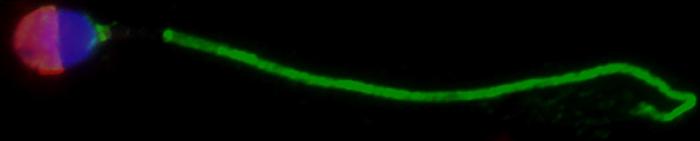
Prof. Drabovich and his team performed mass spectrometry on semen collected from a group of men with normal fertility, as well as additional male patients considered infertile with biopsy-confirmed obstructive azoospermia or NOA.
That analysis led researchers to uncover two proteins: AKAP4 and ASPX. Both are found in intact sperm in men with NOA. Researchers showed that ASPX is located in the head of sperm while AKAP4 is found in the tail. This was accomplished using a method called imaging flow cytometry.
During imaging flow cytometry, a machine capture images of singular cells. After those samples are tested, computational algorithms help the researchers mine the millions of images of cell debris and underdeveloped sperm in order to identify a small number of intact sperm cells.
The roles of AKAP4 and ASPX are not fully understood. So, Prof. Drabovich plans to perform further research investigating how precisely they contribute to sperm function. Researchers also believe this work may one day lead to new male birth control drugs.
“We want to see if we can flip the story and try to work on male contraceptives,” Prof. Drabovich concludes. “If we know the function of the protein, we may be able to inhibit it to create a nonhormonal male contraceptive, which is a much desired type of drug at the moment.”
The study is published in the journal Molecular & Cellular Proteomics.


