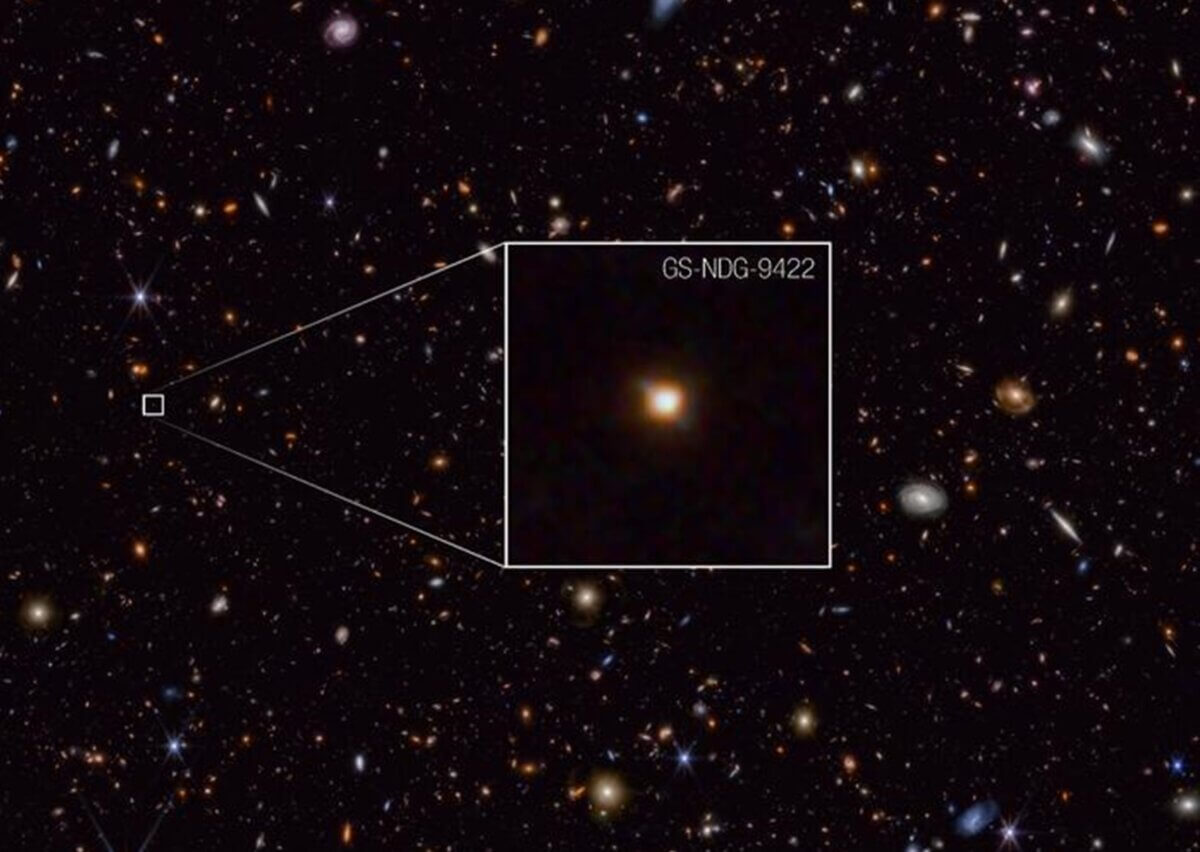
What appears as a faint dot in this James Webb Space Telescope image may actually be a groundbreaking discovery. Detailed information on galaxy GS-NDG-9422, captured by Webb’s NIRSpec (Near-Infrared Spectrograph) instrument, indicates that the light we see in this image is coming from the galaxy’s hot gas, rather than its stars. Astronomers think that the galaxy’s stars are so extremely hot (more than 140,000 degrees Fahrenheit, or 80,000 degrees Celsius) that they are heating up the nebular gas, allowing it to shine even brighter than the stars themselves. (Credit: NASA, ESA, CSA, STScI, Alex Cameron (Oxford))
OXFORD, United Kingdom — Astronomers have identified a galaxy that seems to defy the laws of stellar physics. This cosmic oddball, named GS-NDG-9422, resides a staggering 12.9 billion light-years away, offering us a glimpse into the universe when it was merely 900 million years-old. What makes this galaxy truly extraordinary is its peculiar spectrum of light, which has left scientists scratching their heads and proposing intriguing theories about its nature.
The study, led by Alex J. Cameron of the University of Oxford and published in the Monthly Notices of the Royal Astronomical Society, presents a detailed analysis of GS-NDG-9422’s spectrum. This spectrum, essentially the galaxy’s light signature, reveals an unexpected feature: a sharp downturn in ultraviolet light at a specific wavelength. This characteristic is so unusual that it has sparked a debate about the galaxy’s composition and the processes occurring within it.
The researchers propose that GS-NDG-9422 harbors extremely hot stars, with surface temperatures exceeding 140,000 degrees Fahrenheit (80,000 degrees Celsius). To put this in perspective, typically hot, massive stars in our local universe have temperatures ranging between 70,000 to 90,000 degrees Fahrenheit (40,000 to 50,000 degrees Celsius). These scorching stellar bodies could be responsible for generating an intense radiation field that ionizes the surrounding gas, creating a nebula that outshines the stars themselves.
“It looks like these stars must be much hotter and more massive than what we see in the local universe, which makes sense because the early universe was a very different environment,” says Harley Katz, a co-author of the study from the University of Oxford and the University of Chicago, in a statement.
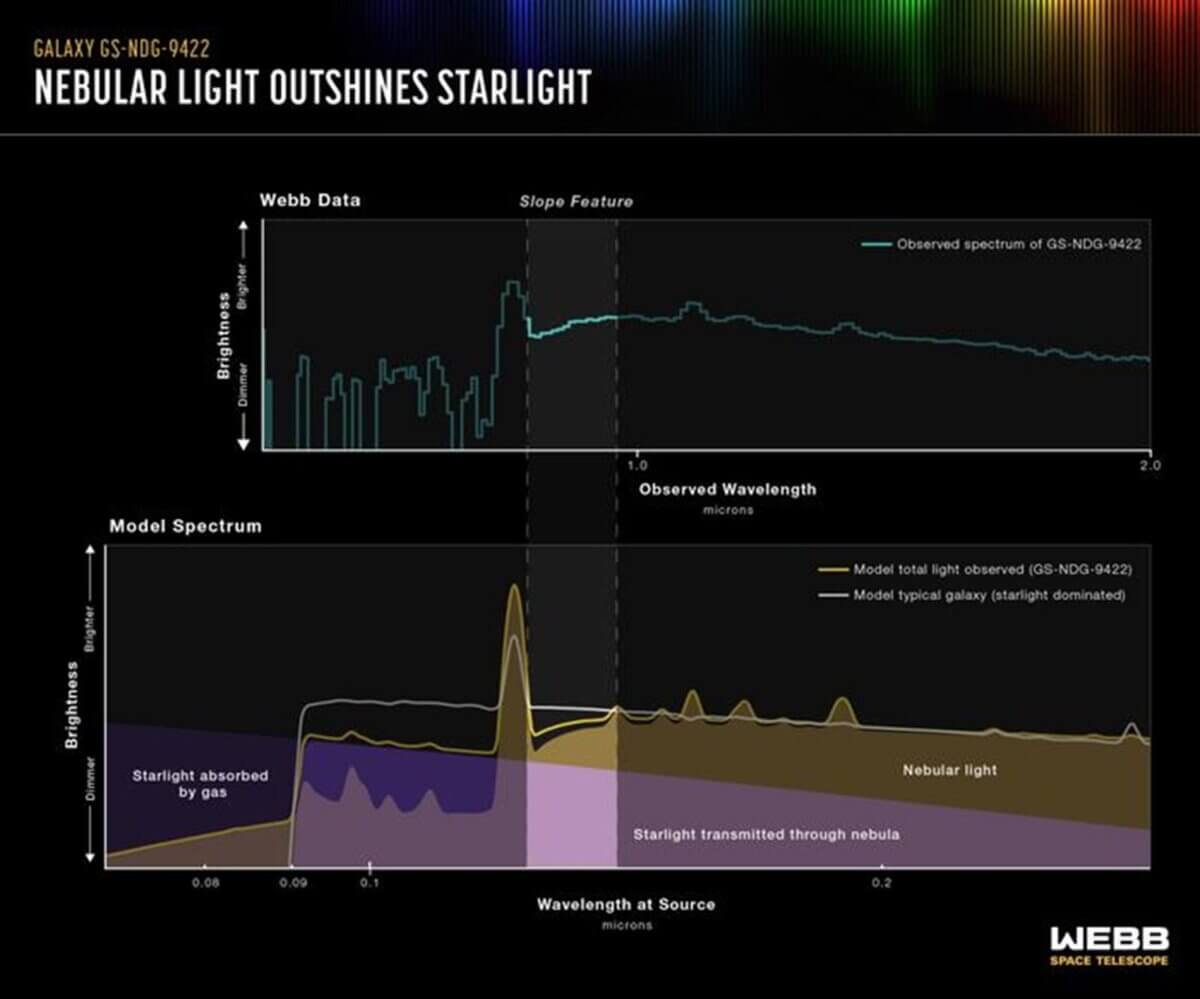
The research team suspects that GS-NDG-9422 is undergoing a brief phase of intense star formation within a dense gas cloud, producing a large number of massive, hot stars. This cloud is bombarded with so many photons of light from the stars that it glows extraordinarily bright.
This discovery is not just a curiosity; it has far-reaching implications for our understanding of how galaxies evolved in the early universe. The phenomenon of nebular gas outshining stars is particularly intriguing because it has been predicted to occur in environments hosting the universe’s first generation of stars, known as Population III stars.
While GS-NDG-9422 does not contain these primordial stars due to its chemical complexity, it may represent a transitional phase in galactic evolution.
“The exotic stars in this galaxy could be a guide for understanding how galaxies transitioned from primordial stars to the types of galaxies we already know,” Katz explains.
The study was made possible by the unprecedented capabilities of the James Webb Space Telescope (JWST). This next-generation observatory, with its superior sensitivity and resolution, allowed astronomers to capture detailed spectra of this distant galaxy, unveiling its mysterious nature.
Interestingly, GS-NDG-9422 may not be alone in its peculiarity. The researchers identified two other galaxies with similar spectral features: the Lynx Arc at a distance of 11.5 billion light-years, and A2744-NDG-ZD4, which is even more distant at 13.1 billion light-years away. These findings suggest that such exotic galaxies might be more common in the early universe than previously thought.
As with any groundbreaking discovery, this study raises as many questions as it answers. How common are such galaxies in the early universe? And what can they tell us about the evolution of the cosmos? Cameron and his team are actively working to identify more galaxies with similar characteristics to better understand the conditions in the universe within its first billion years.
“It’s a very exciting time, to be able to use the Webb telescope to explore this time in the universe that was once inaccessible,” Cameron says. “We are just at the beginning of new discoveries and understanding.”
Paper Summary
Methodology
The researchers used data from the JWST’s Near-Infrared Spectrograph (NIRSpec) to analyze the spectrum of GS-NDG-9422. They examined various emission lines in the spectrum, which provide information about the galaxy’s gas composition and temperature. To understand the unusual ultraviolet turnover, they created computer models of cosmic gas clouds heated by very hot, massive stars. These models were then compared to the observed spectrum to find the best explanation for the galaxy’s unique features.
Key Results
The study found that GS-NDG-9422 has an unusually strong ultraviolet turnover in its spectrum, which is best explained by the presence of very hot stars (temperatures around 140,000 degrees Fahrenheit) and intense star formation within a dense gas cloud. The galaxy’s gas appears to outshine its stars, a phenomenon predicted in environments hosting the universe’s first generation of stars. Similar spectral features were identified in two other distant galaxies, suggesting that such objects might be more common in the early universe than previously thought.
Study Limitations
The main limitation of this study is that GS-NDG-9422 is currently the only well-studied example of this phase of galaxy development. More galaxies with similar characteristics need to be identified and analyzed to determine if these conditions are common or rare in the early universe. Additionally, the conclusions are based on models and interpretations of the overall galactic spectrum rather than direct observations of individual stars.
Discussion & Takeaways
The discovery of GS-NDG-9422 provides a potential missing link in our understanding of galactic evolution, bridging the gap between the universe’s first stars and well-established galaxies. If confirmed, the presence of extremely hot, massive stars and gas outshining stars could have significant implications for models of galaxy evolution and the production of heavy elements in the cosmos. The study also highlights the importance of advanced telescopes like JWST in probing the early universe and uncovering unexpected phenomena.
Funding & Disclosures
The research was funded by the European Research Council (ERC) under the European Union’s Horizon 2020 Research and Innovation program. The James Webb Space Telescope, which provided the crucial data for this study, is a joint project of NASA, ESA, and the Canadian Space Agency.


