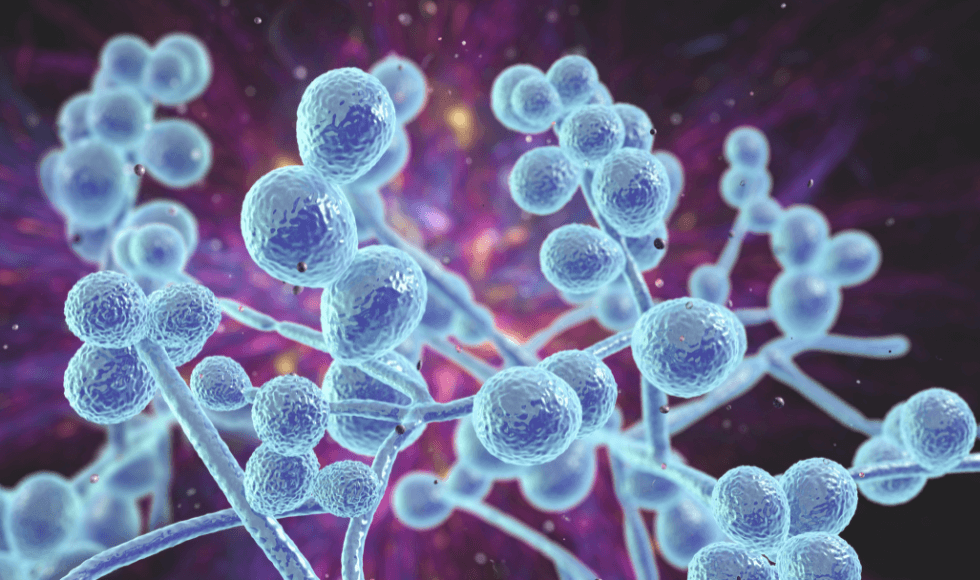
(Shutterstock image/McMaster University)
In a Nutshell
- Candida auris binds directly to hair and settles into hair follicles, making it far harder to clear from skin than its close fungal relatives.
- By exposing a cell-wall material called chitin, the fungus triggers an immune response that weakens the skin’s defenses rather than strengthening them.
- Dialing that immune signal up or down in mice raised or lowered how much fungus the skin carried, tying the reaction directly to the fungus’s staying power.
Most germs that land on human skin are wiped out within days. Candida auris, a drug-resistant fungus behind deadly hospital outbreaks worldwide, does something stranger. It recruits the skin’s own immune system to help it stay put, turning the body’s defenses into a tool for its survival.
That matters because C. auris has become one of the most stubborn infection-control problems in modern medicine, and until now, no one fully understood why. A new study published in Science lays out how the fungus pulls it off.
Candida auris was first identified in Japan in 2009 and has spread steadily to hospitals and long-term care facilities worldwide. Unlike many dangerous fungi, it does not make healthy people visibly sick right away. Instead, it can live on a person’s skin for months, sometimes indefinitely, and that quiet colonization is a major route of person-to-person transmission. For anyone with a weakened immune system, the consequences can be severe. Prior clinical studies, cited in the paper as background, report mortality rates for bloodstream infections between 30 and 70%, reflecting reported ranges across patient populations rather than a guaranteed outcome in any single case. In clinical practice to date, no method has reliably cleared C. auris from the skin.
How Candida auris Outsmarts the Skin’s Defenses
To see how C. auris pulls this off, researchers at the University of California, San Francisco compared it head-to-head with Candida albicans, a close relative that also lives on human bodies but is cleared from the skin far more efficiently. Both species were applied to mouse skin, and the team tracked where the fungi spread, how long they persisted, and how the immune system responded.
Candida albicans vanished within days. C. auris was still present at the end of the 30-day observation window. Part of the reason was physical. In lab tests, C. auris bound to human hair roughly 30 times more readily than C. albicans did. In mice, it clustered around hair follicles, often settling into the follicular opening or deeper inside. Animals with fewer hairs carried less of the fungus, and hairier mice carried more.
More consequential was what the immune system did next. Candida albicans elicited a response mediated by the signaling molecule interleukin-17A. That response behaves like a well-functioning security system, thickening the skin’s protective barrier, calling in reinforcements, and killing the fungus. Candida auris triggered something else, a response dominated by a different signaling molecule, interferon-gamma. Interferon-gamma is normally useful against deeper infections, but in the skin’s outer layer it does close to the opposite of what is needed. Rather than reinforcing the barrier, it suppresses the antimicrobial and barrier-defense programs that normally help the skin clear the fungus, effectively lowering the skin’s guard.
The Molecular Trick Hidden in Candida auris
Researchers traced this misdirection to the fungus’s outer coating. Fungi are wrapped in a cell wall built from several layered materials, one of which is chitin, the same tough substance found in insect shells and crab exoskeletons. Chitin turned out to be a major trigger of the unhelpful response.
Grown under conditions that mimic human skin, salty, nutrient-poor, and at body temperature, C. auris changed its cell wall and displayed more chitin on its surface than it did in standard lab conditions. Candida albicans, placed in the same environment, instead exposed more of a different wall component, one that triggers the protective response that clears the fungus. When C. auris shows chitin instead, the immune system switches to the response that leaves the door open.
Several experiments confirmed chitin’s role. Injecting purified chitin particles into mouse skin, with no fungus present, produced the same unhelpful response on its own. Engineered strains of C. auris that displayed less chitin drew a weaker reaction and colonized skin less, while strains built to display more chitin drew a stronger reaction and colonized more. Adjusting the interferon-gamma signal directly followed the same logic.

Why Hospital Decolonization Keeps Failing
Microscopy showed where all of this plays out. Immune cells activated by C. auris naturally gather around hair follicles, exactly where the fungus concentrates. The signal those cells release acts on the skin cells lining the follicle, switching off the genes that would normally produce germ-killing compounds and reinforce the barrier. When researchers engineered mice whose skin cells could not receive that signal, the fungus colonized less.
There is an added wrinkle. The same immune signal that allows C. auris to persist on the skin remains protective during bloodstream and deep-tissue infections. The fungus has essentially found a loophole, exploiting a normally helpful signal in the one place where it suppresses antifungal defenses rather than boosts them.
All four major genetic lineages of C. auris circulating globally produced the same immune-skewing effect, though with varying intensity. In a separate experiment, researchers used a 3D human keratinocyte culture, a lab model built from human skin cells rather than tissue from patients, and found that these cells responded to the interferon-gamma signal much as mouse skin did. That result is suggestive, but it falls short of confirming it in humans, and whether the same mechanism drives C. auris persistence in human patients remains an open question.
For years, hospital infection-control teams have struggled to decolonize patients carrying C. auris, with little success. This research offers a biological reason. The fungus uses hair follicles as an important refuge, spaces that are hard to reach and, thanks to the immune response it provokes, poorly defended.
Pinpointing chitin exposure as a major lever opens possible paths for new treatments, whether by blocking the fungus’s ability to remodel its cell wall on skin or by steering the immune response toward the type that actually clears it. Until such a treatment exists, one point is clear. C. auris does more than hide from the immune system. It turns that system against the host.
Disclaimer: This article summarizes findings from a single peer-reviewed study and is intended for general information, not medical advice. Much of the research was conducted in mouse models and laboratory cultures of human cells, and the authors note that further work is needed to confirm the extent to which the results apply to people. Anyone with questions about Candida auris exposure, infection, or treatment should consult a qualified healthcare professional.
Paper Notes
Limitations
The study was conducted primarily in mouse models, and while some experiments involved human hair and human skin cell cultures, direct evidence from human patients was limited. Researchers used a focused set of C. auris clinical isolates representing four major genetic lineages, which may not capture the full diversity of currently circulating strains. The authors note that additional work will be required to establish how fully the mechanisms observed in mice translate to human colonization and infection. The precise molecular receptor through which the immune system senses chitin on the fungal surface was not identified in this study.
Funding and Disclosures
Funding sources and financial disclosures were not detailed in the content provided to this publication. Institutional affiliations for the research team are listed under Publication Details below.
Publication Details
Authors: Eric Dean Merrill, Victoria Prudent, Pauline Basso, Emilie Rapp, Parna Moghadam, Abram Rodriguez, Ethan Hung, Charlotte Hurabielle, Jeffrey Cheng, Raymond Jaihyun Cho, Brook Abegaze, Amanda Buck, Kennedi Pyper, Alessandra Veinbachs, Elina K. C. Wells, Tiffany C. Scharschmidt, Michael D. Rosenblum, Ari B. Molofsky, and Suzanne M. Noble. Corresponding authors: [email protected], [email protected], [email protected].
Institutional affiliations include: Department of Dermatology, Department of Microbiology & Immunology, Department of Laboratory Medicine, and Department of Medicine at the University of California, San Francisco; Veterans Affairs Medical Center, San Francisco; Hôpital Saint Louis, AP-HP, Paris, France; and the Division of Rheumatology, Department of Internal Medicine, UCSF.
Journal: Science
Paper Title: “The fungal pathogen Candida auris exposes chitin to trigger IFNγ and persist in hair follicles”
Citation: E. D. Merrill et al., Science 393, eadu6688 (2026).
Publication Date: August 6, 2026


