
(ID 61212637 © Kaspars Grinvalds | Dreamstime.com)
NOTRE DAME, Ind. — Your fitness tracker might be helping you count steps and monitor your heart rate, but it could also be exposing you to potentially harmful chemicals, according to new research. Scientists have discovered that many popular smartwatch bands contain surprisingly high levels of a concerning chemical called PFHxA (perfluorohexanoic acid), which can be absorbed through the skin.
In a comprehensive study of 22 watch bands from various brands and price points, researchers found that many bands advertised as containing “fluoroelastomers” – a type of synthetic rubber designed to resist sweat and skin oils – had significant levels of PFHxA that could easily transfer to the wearer’s skin. This is particularly concerning given that an estimated 21% of Americans wear smartwatches or fitness trackers, often for more than 11 hours per day.
“This discovery stands out because of the very high concentrations of one type of forever chemical found in items that are in prolonged contact with our skin,” says Graham Peaslee, the study’s corresponding author, in a statement.
Think about that for a moment: millions of people are wearing these devices against their skin for extended periods – in one 2020 study cited by the researchers, participants wore their devices for a median of 11.2 hours per day. The bands tested in the study spanned numerous manufacturers and price points, though specific brands weren’t named in the research.
PFHxA belongs to a broader family of synthetic chemicals called PFAS (per- and polyfluoroalkyl substances), often referred to as “forever chemicals” because they persist in the environment and the human body for extended periods. While PFAS have been used in everything from non-stick cookware to food packaging and cosmetics, their presence in watch bands worn directly against the skin presents a unique exposure scenario.
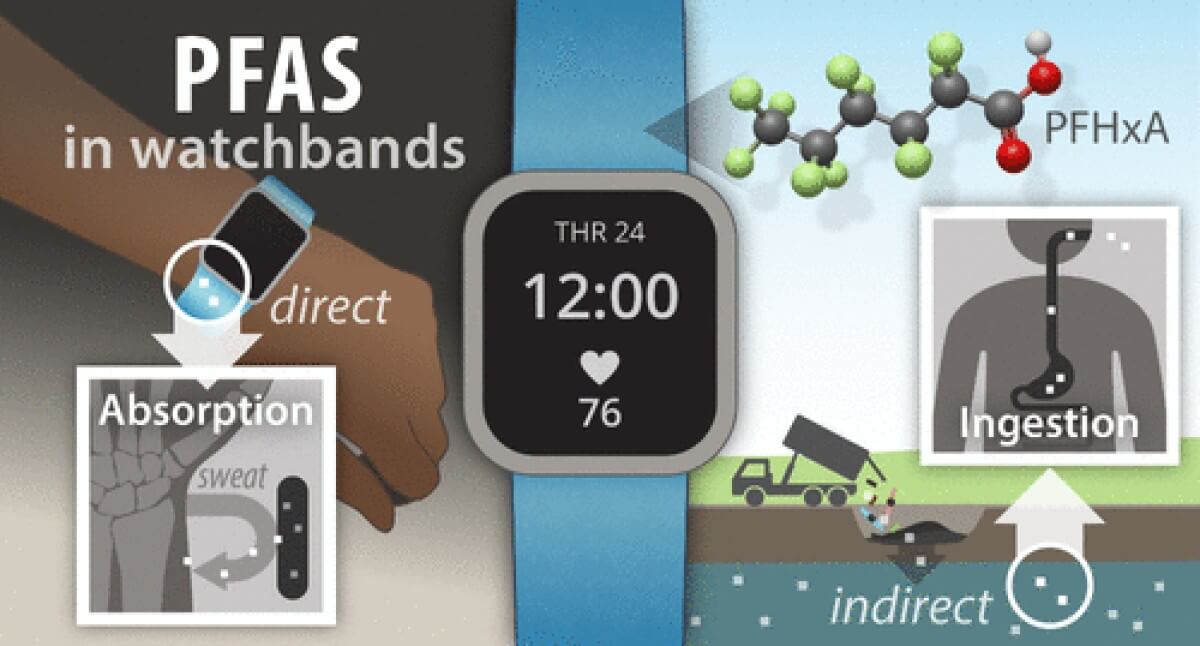
The research team, led by scientists from the University of Notre Dame, first screened the watch bands for total fluorine content using a specialized technique called particle-induced gamma-ray emission spectroscopy. All 13 bands advertised as containing fluoroelastomers showed significant fluorine content, and interestingly, two additional bands that weren’t advertised as containing fluoroelastomers also contained fluorine. This suggests that fluoroelastomers may be more widespread in these products than product descriptions indicate.
What’s particularly striking is the price factor: all watch bands priced above $30 contained significant levels of fluorine, while most mid-range bands ($15-30) also tested positive. Only the cheapest bands (under $15) were consistently free of these chemicals, suggesting that fluoroelastomers are considered a “premium” material feature. The concentrations found in these watch bands are unprecedented for wearable consumer products.
“The most remarkable thing we found in this study was the very high concentrations of just one PFAS — there were some samples above 1,000 parts per billion of PFHxA, which is much higher than most PFAS we have seen in consumer products,” notes Peaslee.
To put this in perspective, the researchers’ previous work on cosmetics found median PFAS concentrations of around 200 parts per billion (ppb), while some watch bands in this study exceeded 16,000 ppb.
The timing of the study, published in Environmental Science & Technology Letters, is particularly relevant. Both U.S. and European regulatory bodies have recently taken steps to address PFHxA concerns. In 2023, the U.S. Environmental Protection Agency identified several health risks associated with PFHxA exposure, including potential effects on liver function, development, blood formation, and the endocrine system. Meanwhile, the European Union has moved to restrict PFHxA in various consumer products, citing extensive environmental and human exposure data.
What makes this exposure route of great concern is that these watch bands are often marketed specifically for sports and fitness use, meaning wearers are likely to be sweating while using them. In one relevant study cited by the researchers, scientists found that about 86% of PFHxA that could be extracted from children’s car seats using organic solvents could also be extracted with synthetic sweat. Additionally, a recent study using artificial skin models showed that shorter-chain PFAS like PFHxA had higher absorption rates than longer-chain PFAS, with one type of short-chain PFAS being absorbed at a rate of 58.9%.
The researchers emphasize that more comprehensive studies are needed to fully understand the implications of this exposure pathway. Scientists don’t yet fully understand how readily PFHxA transfers into the skin or its potential health effects once absorbed, though recent studies suggest that a significant percentage could pass through human skin under normal conditions.
So what should consumers do?
“If the consumer wishes to purchase a higher-priced band, we suggest that they read the product descriptions and avoid any that are listed as containing fluoroelastomers,” suggests lead author Alyssa Wicks.
If you’re concerned, the researchers recommend opting for lower-cost wristbands made from silicone instead.
Paper Summary
Methodology
The researchers took a three-pronged approach to studying these watch bands. First, they used a specialized technique to measure total fluorine content by bombarding samples with protons and measuring the resulting gamma rays. Then, they extracted chemicals from the bands using a modified version of a standard extraction method called QuEChERS, followed by analysis using liquid chromatography-mass spectrometry to identify specific PFAS compounds. Finally, they performed an additional test called direct total oxidative precursor (dTOP) assay on six selected bands to look for potential PFAS precursors that might break down into PFHxA.
Key Results
Of the 22 watch bands tested, 15 contained significant levels of fluorine (>1%). All expensive bands (>$30) and most mid-range bands ($15-30) contained these chemicals, while cheaper bands (<$15) did not. PFHxA was the most commonly detected specific compound, found in 41% of samples with concentrations ranging from undetectable to 16,662 ng/g. Some samples also contained other PFAS compounds, though at much lower levels.
Study Limitations
The study didn’t identify specific brands or models of watch bands tested. The sample size (22 bands) was relatively small, and some bands were donated rather than purchased new. The researchers also couldn’t fully explain why their additional oxidation test (dTOP) produced lower PFAS levels than their initial extraction method, suggesting there might be more complex chemical interactions at play.
Discussion & Takeaways
The key finding is that many smartwatch bands, particularly more expensive ones, contain significant levels of PFHxA that can be easily extracted, suggesting potential skin exposure for wearers. This is especially concerning given how long people typically wear these devices and the fact that exercise and sweating might increase chemical transfer. Recent regulatory actions and health studies suggest PFHxA exposure should be minimized, making this a potential public health concern requiring further investigation.
Funding & Disclosures
The study was funded by the University of Notre Dame. The authors declared no competing financial interests, suggesting the research was conducted independently without industry influence.


