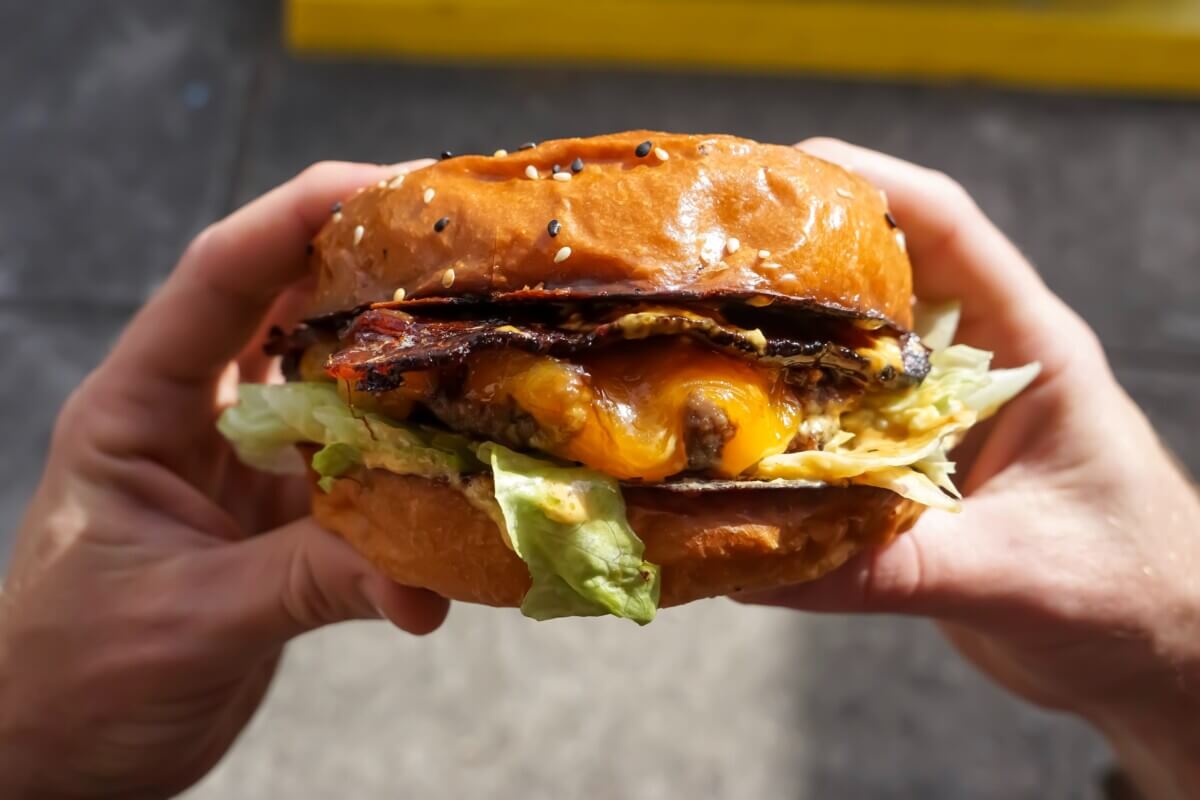
Photo by Carles Rabada on Unsplash
Stanford’s BurgerAI Passed a Real Restaurant Taste Test. Its Inventors Say the Burger Is Just the Beginning
In A Nutshell
- Stanford researchers used a custom AI to generate burger recipes optimized for taste, sustainability, or nutrition, then tested them in blind taste tests with 101 people at a San Francisco restaurant.
- Two AI-designed “delicious burgers” matched or outscored a reference version of the Big Mac on flavor and overall liking ratings.
- A mushroom-only AI burger had an environmental impact score more than ten times lower than the Big Mac’s, though tasters rated it worse on taste and texture.
- A bean-based AI burger scored nearly twice as high as the Big Mac on a federal nutrition measure, but also ranked significantly lower with tasters for flavor, texture, and overall appeal.
Researchers at Stanford University built an AI tool called BurgerAI and trained it on thousands of burger recipes. It learned the statistical patterns of what makes food taste good, then used that knowledge to build burgers optimized for taste, sustainability, or nutrition. Real people ate them at an active restaurant in San Francisco. In blind taste tests, the AI’s two best-tasting burgers matched or outperformed a reconstructed reference version of the Big Mac on specific flavor and liking measures, though the more sustainable and more nutritious burgers fared worse with tasters.
Without ever seeing McDonald’s proprietary recipe, the AI independently recreated a reference Big Mac (built from four open-source recreations, since the official formula is private) through pure statistical learning. It then generated entirely new burgers optimized for taste, environmental impact, or nutrition, testing all of them in blind taste tests with 101 participants.
This work points to a fundamentally new way of designing food, one built not on guesswork but on a machine learning the hidden patterns of human taste and searching deliberately for something tastier, healthier, and easier on the planet.
Teaching a Machine to Taste
Taste doesn’t follow a rulebook. What makes a burger delicious comes from layered interactions between dozens of ingredients: the way fat plays against acid, how salt amplifies flavor, why some textures feel satisfying and others don’t.
Stanford’s team, writing in npj Science of Food, built a custom AI model that learned the underlying structure of burger design, working with 146 possible ingredients and their quantities across thousands of recipes people actually made and ate. The result was a model that internalized something like the grammar of burgers, not just a list of common ingredients but the deeper logic of how they fit together.

AI Recreated a Reference Big Mac Recipe Without Seeing the Official Formula
One of the most telling parts of the study was what the researchers call “rediscovery.” They asked: if this AI generates burger recipes at random from what it learned, would it ever land on a reconstruction of the Big Mac on its own?
It did. The AI reproduced a reference version of the Big Mac’s ingredients and quantities through pure statistical learning. It took an average of 7.3 million randomly generated samples across ten independent attempts before a match appeared, confirming the AI didn’t memorize recipes but learned a vast space of possibilities, within which the Big Mac sits in a high-probability region because of its cultural dominance and broad appeal.
From there, the researchers generated genuinely new burgers. Two “delicious burgers” were handed to an executive chef to turn into actual meals, then served blind to 101 participants at an active San Francisco restaurant.
Real People, Real Restaurants, Real Ratings for AI-Designed Burgers
Each participant rated all six burgers (the five AI-generated ones plus the actual Big Mac) on a 7-point scale for overall liking, flavor, and texture, with no one knowing which was which.
AI-designed delicious burgers held their own. One received significantly higher flavor ratings than the Big Mac (5.8 vs. 5.4). A second scored significantly higher for both overall liking (5.7 vs. 5.3) and flavor (5.8 vs. 5.4). Texture didn’t differ significantly from the Big Mac. Participants described the AI burgers as “meaty,” “moist,” and “smoky” more often than they used those words for the Big Mac.
Sustainable burgers told a more complicated story. A mushroom-only burger achieved an environmental impact score of 0.06, compared to the Big Mac’s score of 0.93, more than ten times lower. That score is a comparative estimate based on global database averages, not a precise real-world guarantee. Tasters rated it below the Big Mac for overall liking, flavor, and texture. A second sustainable burger blended mushroom with beef and performed on par with the Big Mac in taste ratings, though its environmental impact score of 1.02 was roughly comparable to the Big Mac’s.
Built around beans, the most nutritious burger scored nearly twice as high as the Big Mac on the Healthy Eating Index, a federal scoring system that measures how well a food aligns with national nutrition guidelines. It also cut the Big Mac’s environmental impact score by a factor of six. Tasters rated it significantly lower for liking, flavor, and texture, describing it as earthy, bland, dry, and grainy.
That trade-off (better for you but worse to eat) is one of the oldest problems in food science. The AI didn’t solve it. But the researchers argue the model makes those trade-offs easier to see and explore than ordinary trial-and-error cooking.
BurgerAI Is Just the Beginning
For the Stanford team, the burger was always a test case. “Most AI systems are trained to predict what already exists,” said Ellen Kuhl, the study’s senior author. “We wanted AI to invent what should exist next.”
Beyond food, the researchers say the same generative design framework could apply to pharmaceuticals, advanced materials, and other fields where competing objectives make the design space too vast for trial and error alone. BurgerAI can also generate personalized recipes tailored to an individual’s age, sex, body weight, and activity level.
“The burger is just the beginning,” Kuhl said. “We see food as a model system for a much larger vision: AI as a partner in scientific and engineering discovery.”
Paper Notes
Funding and Disclosures
According to the paper, the research was supported by the Schmidt Science Fellowship in partnership with the Rhodes Trust, the Stanford Doerr School of Sustainability Accelerator, the Stanford Bio-X Snack Grant Program, the Bezos Earth Fund, an NSF CMMI grant (number 2320933), and an ERC Advanced Grant (number 101141626). The authors declare no competing interests.
Limitations
The study’s authors are candid about what their model cannot yet do. The AI learned from recipes that primarily reflect Western-style burger traditions, meaning it carries the cultural and regional biases of that data. The model also works only with ingredient identities and quantities and doesn’t account for cooking methods, preparation steps, or the physical and chemical changes that happen when food is actually cooked. Environmental scores are based on global database averages and don’t reflect variations tied to specific farms, supply chains, or regional agricultural practices, so those numbers should be read as comparative estimates. The taste test involved 101 participants at one restaurant location, and broader studies across different populations and settings would be needed to confirm how widely these results generalize. The researchers also note they did not perform a formal statistical power calculation before the study, though they argue the sample size is comparable to or larger than those used in similar consumer food studies.
Publication Details
Paper Title: Generative artificial intelligence creates delicious, sustainable, and nutritious burgers | Authors: Vahidullah Tac (Department of Mechanical Engineering, Stanford University), Christopher D. Gardner (Prevention Research Center, Stanford University School of Medicine), and Ellen Kuhl (Department of Mechanical Engineering, Stanford University) | Journal: npj Science of Food, published in partnership with Beijing Technology and Business University and the International Union of Food Science and Technology | DOI: https://doi.org/10.1038/s41538-026-00953-x | Published: Received March 5, 2026; accepted June 14, 2026; published online June 26, 2026


