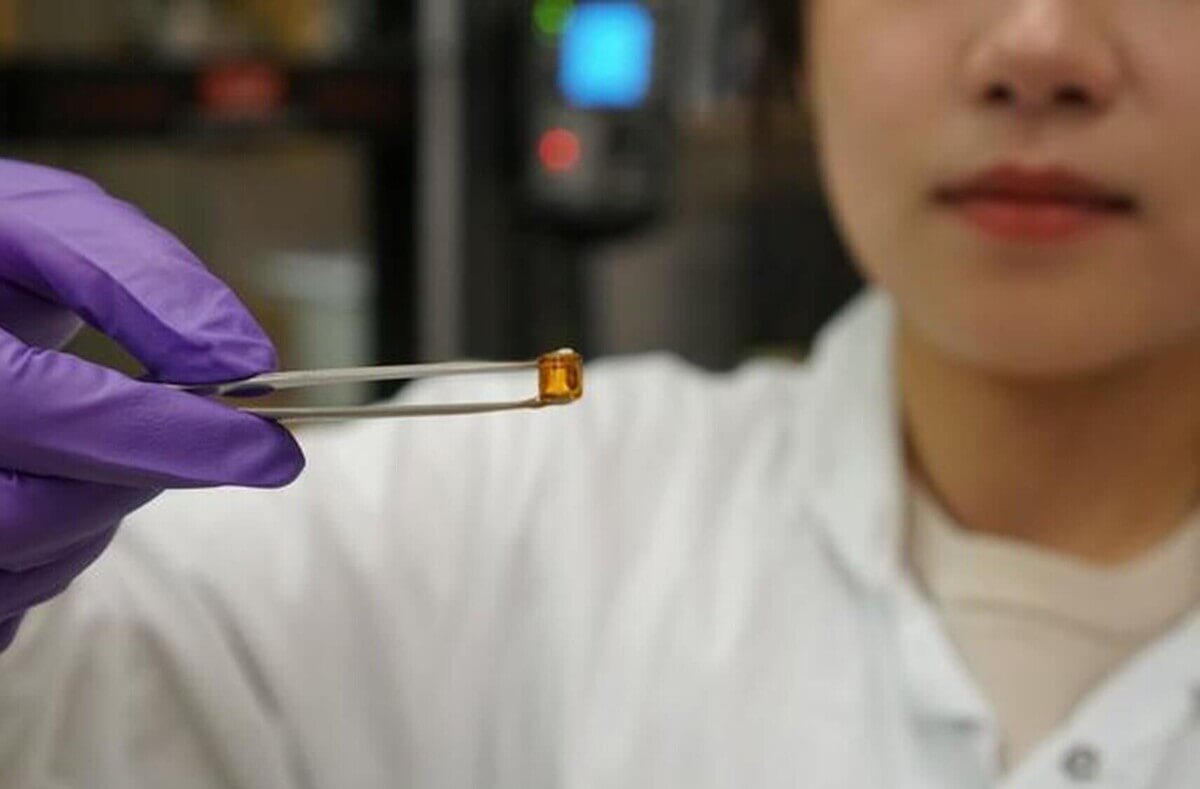
Dr. Linglan Fu holding the hydrogel (Credit: Alex Walls)
VANCOUVER, British Columbia — What if researchers could create a product that would encourage cartilage regeneration in the knee or hip joint and then biodegrade? A groundbreaking development in the creation of biodegradable implants for joint injuries has been achieved through the creation of a unique gel that combines both stiffness and toughness, according to researchers at the University of British Columbia (UBC).
Articular cartilage, which is found in knee and hip joints, plays a crucial role in ensuring smooth joint movement. However, damage to this cartilage can lead to pain, reduced functionality, and even arthritis. One potential solution lies in the use of artificial scaffolds made of proteins that aid cartilage regeneration as the scaffold biodegrades. The success of cartilage regeneration depends on the ability of the scaffold to mimic the biological properties of natural cartilage. So far, researchers have faced challenges in combining the seemingly incompatible properties of stiffness and toughness in these scaffolds.
The research outlines a new method developed by Canadian and Chinese scientists that addresses this challenge by utilizing a biodegradable gel.
“Cartilage is tricky. Articular cartilage repair represents an important medical challenge because naturally speaking, it doesn’t repair itself,” says Dr. Hongbin Li, a professor in the UBC Department of Chemistry and senior author of the study, in a university release.
The delicate balance required in biodegradable cartilage implants necessitates both stiffness and toughness, mirroring the properties of actual cartilage. Typically, stiff materials are resistant to bending or deformation but tend to be brittle and prone to breaking like glass. Conversely, tough materials resist breaking under stress but might be too soft for effective use in joints, akin to jelly, or even softer than natural cartilage. Dr. Li highlighted the current mismatch between the requirements of cells and the properties provided by protein-based implants, which results in suboptimal cartilage repair.
To overcome this hurdle, Dr. Li and his team developed an innovative approach to enhance the stiffness of a protein gel without compromising its toughness. They achieved this by tangling together the chains of a specific protein that forms the gel’s network.
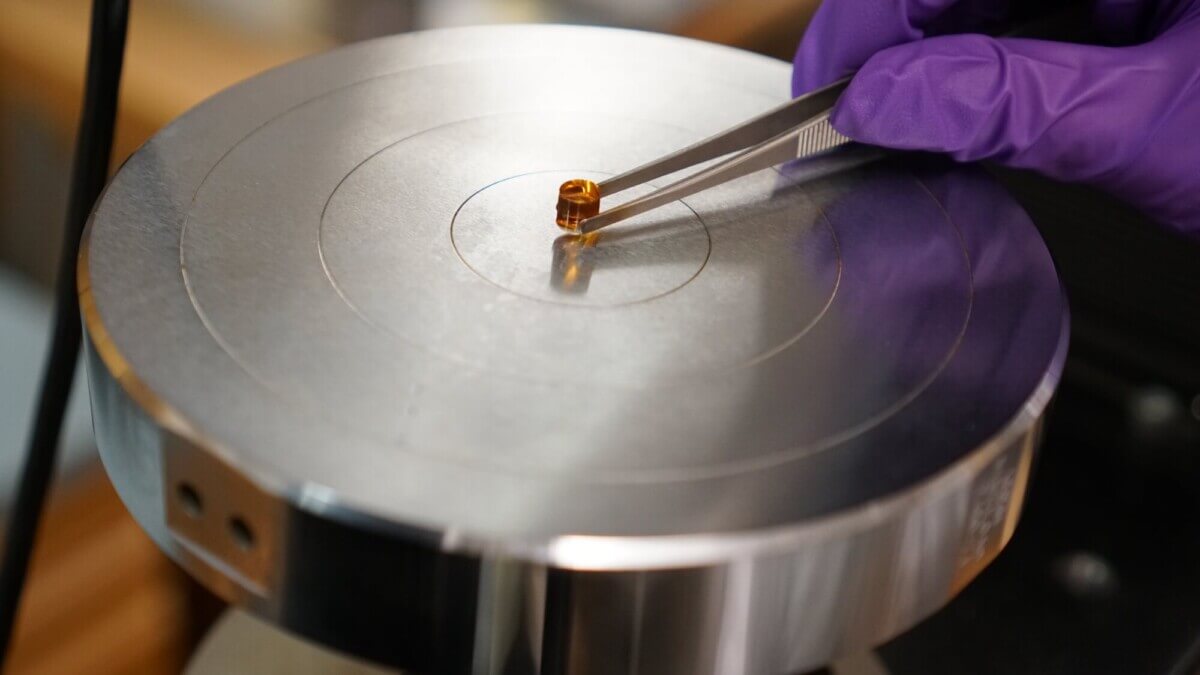
“These entangled chains can move, allowing energy, such as impact from jumping, to be dissipated, just like shock absorbers in bikes,” explains Dr. Linglan Fu, the first author of the study, who conducted the research during her doctoral studies in UBC’s Department of Chemistry.
The team also incorporated a method of folding and unfolding proteins, facilitating energy dissipation. The resulting gel demonstrated remarkable toughness, with the ability to resist being sliced by a scalpel, and exhibited greater stiffness compared to other protein hydrogels. Its compression resistance ranked among the highest achieved by similar gels and favorably compared to natural articular cartilage. Moreover, the gel rapidly regained its original shape after compression, much like real cartilage does after impact.
In an animal study involving rabbits, the gel implants showcased significant signs of articular cartilage repair after 12 weeks, with no remaining hydrogel and no rejection by the animals’ immune system. The researchers observed bone tissue growth similar to existing tissue and regenerated tissue adjacent to the original cartilage, yielding superior results compared to the control group.
Interestingly, a stiffer version of the gel exhibited better outcomes than a softer variant. This was likely due to the higher stiffness being more compatible with bone and cartilage tissues, providing a physical cue for effective regeneration. However, the researchers noted that excessive stiffness hindered the gel’s efficacy, likely due to slower degradation in the body.
“This just shows how complex this area of research is, and the need to take into account the many different physical and biochemical cues and factors when designing these scaffolds,” states Dr. Qing Jiang, a professor and surgeon at Nanjing University and co-author of the study.
While further animal testing is necessary, human trials remain a future consideration as the research is still in its preliminary stages. The next steps for the researchers involve conducting additional testing, refining the gel composition, and incorporating additional biochemical cues to further promote cell regeneration.
“By optimizing both biochemical and biomechanical cues together, we will see in the future whether these new scaffolds can lead to even better outcomes,” Dr. Li concludes.
The findings of this study offer a glimmer of hope for individuals suffering from joint injuries, paving the way for the development of biodegradable implants that can effectively mimic natural cartilage and promote successful regeneration.
The study is published in the journal Nature.


