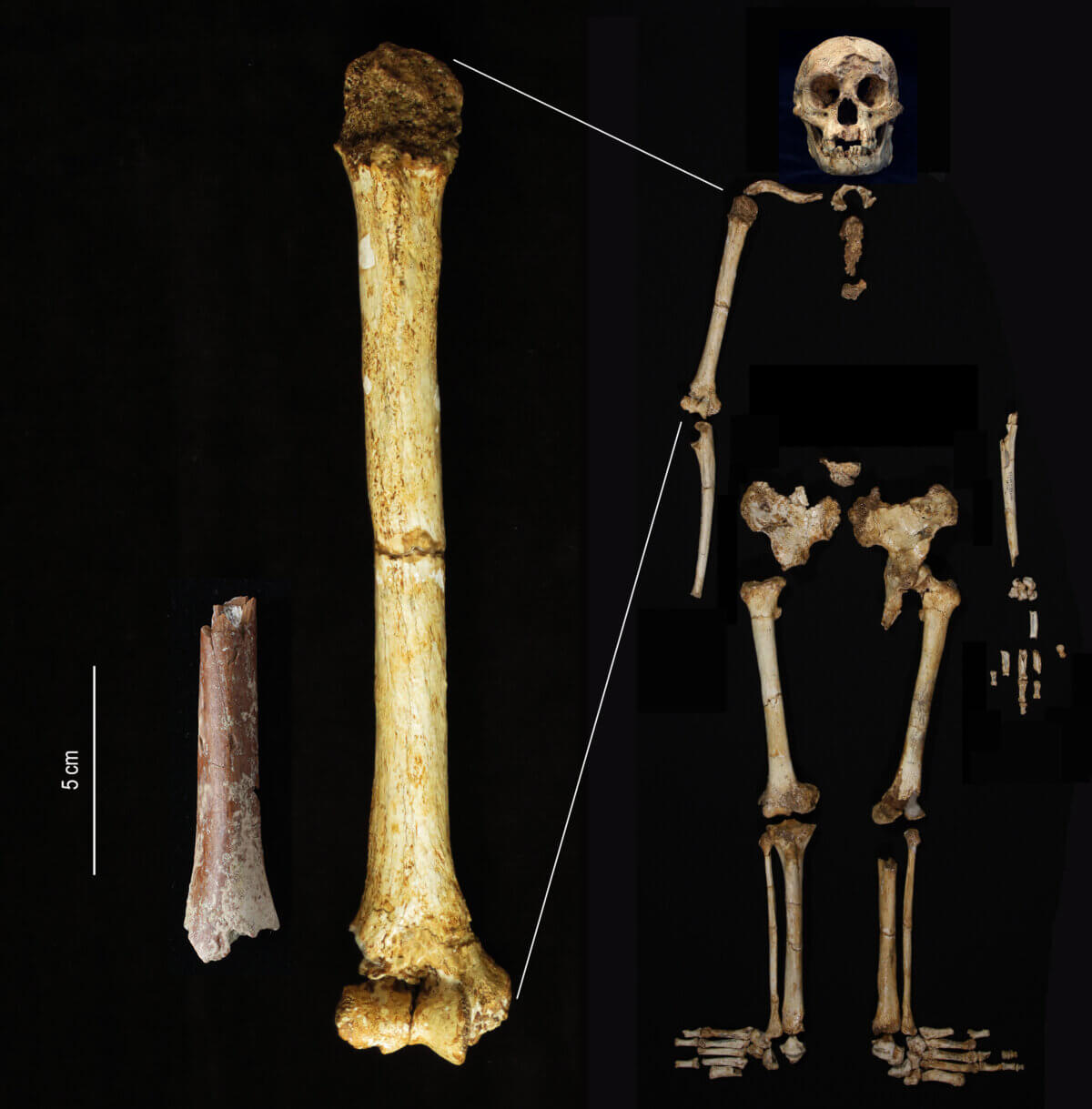
The Mata Menge humerus fragment (left) shown at the same scale as the humerus of Homo floresiensis from Liang Bua. (Photo credit: Yousuke Kaifu)
QUEENSLAND, Australia — Researchers have unearthed new fossil remains of an ancient human species that was remarkably small in stature on the Indonesian island of Flores. These newly found bones and teeth belong to the species Homo floresiensis, affectionately nicknamed “hobbits” due to their diminutive size. The fossils, dating back roughly 700,000 years, suggest that these ancient humans were even more petite than their later descendants.
The story of Homo floresiensis began in 2004 when archaeologists first discovered their remains in Liang Bua cave on Flores. Those initial findings, dated to around 60,000-100,000 years ago, already indicated a species of tiny humans standing only about 3.5 feet tall. But this new research in Nature Communications, led by Yousuke Kaifu and an international team of scientists, pushes back the timeline of their evolution and reveals that their ancestors were potentially even smaller.
The newly discovered fossils come from a site called Mata Menge, located in the So’a Basin of central Flores. They include a fragment of an upper arm bone (humerus) and two teeth – a baby tooth (deciduous canine) and an adult molar. What makes these finds particularly exciting is their age: at around 700,000 years old, they represent a much earlier stage in the evolution of Homo floresiensis.
The arm bone, despite being incomplete, tells a fascinating story. By analyzing its size and shape, researchers estimate that it belonged to an adult individual standing only about 3.4 feet tall – even shorter than the later Homo floresiensis specimens. This suggests that the species may have undergone a rapid and extreme reduction in body size soon after arriving on Flores, possibly within just 300,000 years of reaching the island.
“This 700,000-year-old adult humerus is not just shorter than that of Homo floresiensis, it is the smallest upper arm bone known from the hominin fossil record worldwide,” said Professor Adam Brumm from Griffith University’s Australian Research Centre for Human Evolution, a co-author of the paper, in a media release.
“This very rare specimen confirms our hypothesis that the ancestors of Homo floresiensis were extremely small in body size; however, it is now apparent from the tiny proportions of this limb bone that the early progenitors of the ‘Hobbit’ were even smaller than we had previously thought.”
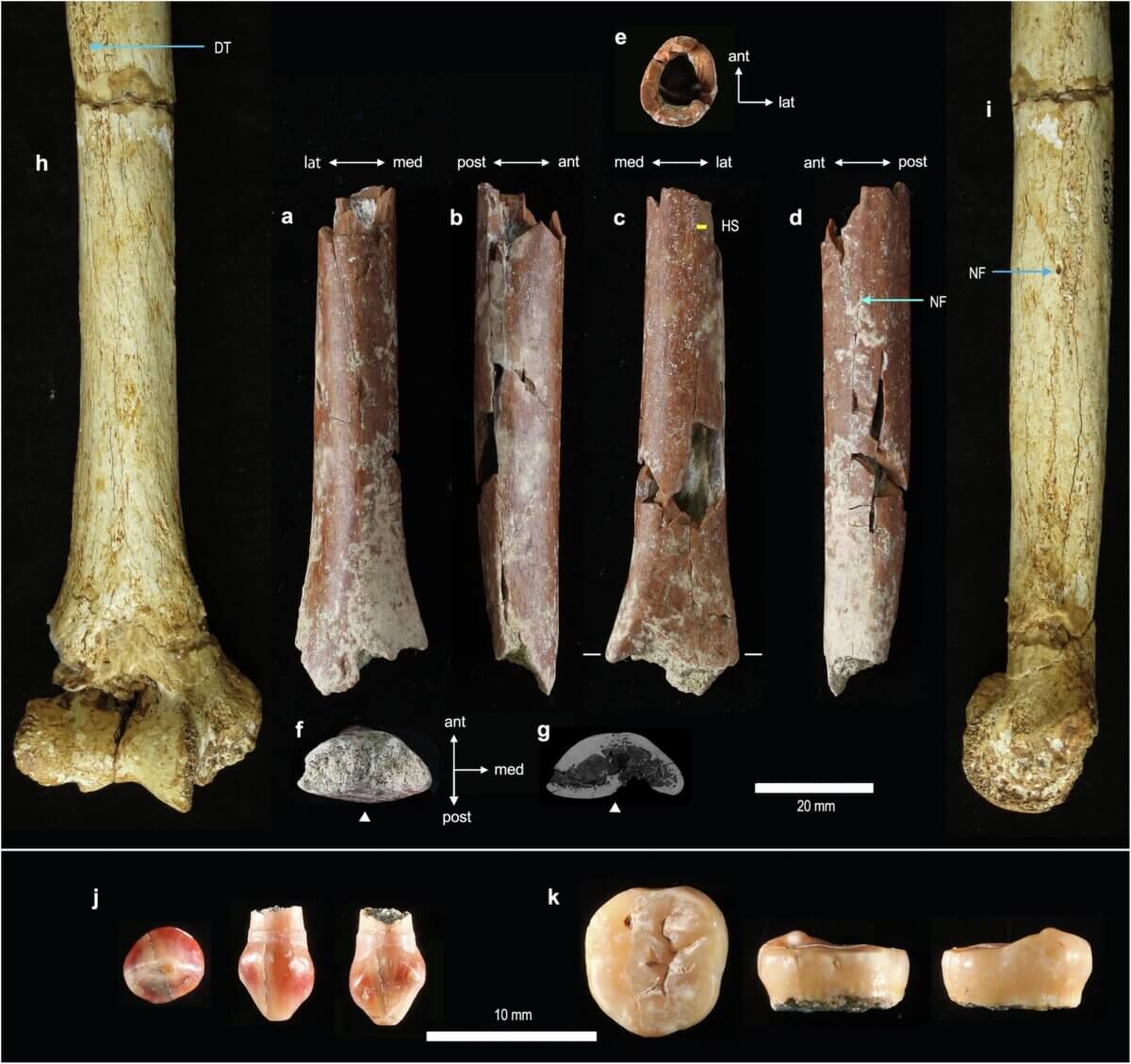
But it’s not just their overall stature that was small. The teeth found at Mata Menge are also remarkably tiny, falling well below the size range seen in modern humans. This indicates that Homo floresiensis was born small and stayed small throughout their lives.
The findings raise intriguing questions about how and why these ancient humans became so petite. One leading theory is that their small size was an adaptation to island life. Flores, being isolated and resource-limited, may have favored smaller individuals who could survive on less food. This phenomenon, known as island dwarfism, has been observed in other animals, but Homo floresiensis represents an extreme case in human evolution.
Interestingly, the researchers found that despite their tiny size, these early Homo floresiensis individuals lived alongside large predators like Komodo dragons and crocodiles. This suggests that their small stature wasn’t a significant disadvantage in terms of survival.
The new fossils also provide clues about the origins of Homo floresiensis. By comparing the shape and features of the teeth to those of other ancient human species, the researchers conclude that these “hobbits” likely evolved from early Asian Homo erectus – a larger-bodied human species that lived in nearby Java around 1.1 million years ago. This supports the idea that Homo floresiensis arrived on Flores by accident, perhaps swept there by a tsunami, and then rapidly adapted to their new island home.
These findings paint a picture of remarkable evolutionary change happening in a relatively short time. Within just a few hundred thousand years of arriving on Flores, these ancient humans had shrunk dramatically in size, developing unique adaptations to their island environment. Their lineage then persisted for hundreds of thousands of years, maintaining their small size until their mysterious disappearance around 50,000 years ago – possibly coinciding with the arrival of modern humans in the region.
“The evolutionary history of the Flores hominins is still largely unknown,” says Prof. Brumm. “However, the new fossils strongly suggest that the ‘Hobbit’ story did indeed begin when a group of the early Asian hominins known as Homo erectus somehow became isolated on this remote Indonesian island, perhaps one million years ago, and underwent a dramatic body size reduction over time.”
Paper Summary
Methodology
The researchers used a variety of techniques to study these ancient fossils. They carefully excavated the remains from layers of sandstone, then used advanced imaging techniques like CT scans to examine the bones and teeth in detail without damaging them. To determine the age of the fossils, they used a combination of dating methods, including analyzing the magnetic properties of the surrounding rocks and measuring radioactive decay in nearby volcanic minerals.
To estimate the size and shape of the original humerus, they compared it to a wide range of other human and primate arm bones. For the teeth, they measured their dimensions and analyzed their shape using sophisticated computer programs that can detect subtle differences in tooth structure.
Key Results
The key findings were that these 700,000-year-old Homo floresiensis fossils were even smaller than their later descendants. The arm bone suggests an adult standing only about 3.4 feet tall, while the teeth were tiny compared to those of modern humans and other ancient human species. The shape of the teeth, particularly the molar, was most similar to early Homo erectus fossils from Java, supporting the idea that Homo floresiensis evolved from this larger-bodied ancestor.
Study Limitations
As with any study of ancient fossils, there are some limitations to keep in mind. The sample size is small – just one arm bone fragment and two teeth – which makes it difficult to draw broad conclusions about the entire population. The fossils are also incomplete, requiring some estimation and comparison to reconstruct their original size and shape. Additionally, fossilization and the long burial process can potentially alter the remains, which researchers must account for in their analyses.
Discussion & Takeaways
The researchers conclude that Homo floresiensis likely evolved from early Asian Homo erectus, undergoing rapid and extreme body size reduction after arriving on Flores. This adaptation to island life happened quickly in evolutionary terms, within about 300,000 years. The small body size persisted for hundreds of thousands of years, suggesting it was a successful adaptation to the island environment.
The study challenges previous ideas about the origin of Homo floresiensis and provides new insights into how quickly and dramatically human evolution can occur in isolated environments. It also highlights the importance of island ecosystems in driving unique evolutionary adaptations. Future discoveries on Flores and other islands in the region could reveal more about the diversity of ancient human species and their evolutionary paths.


