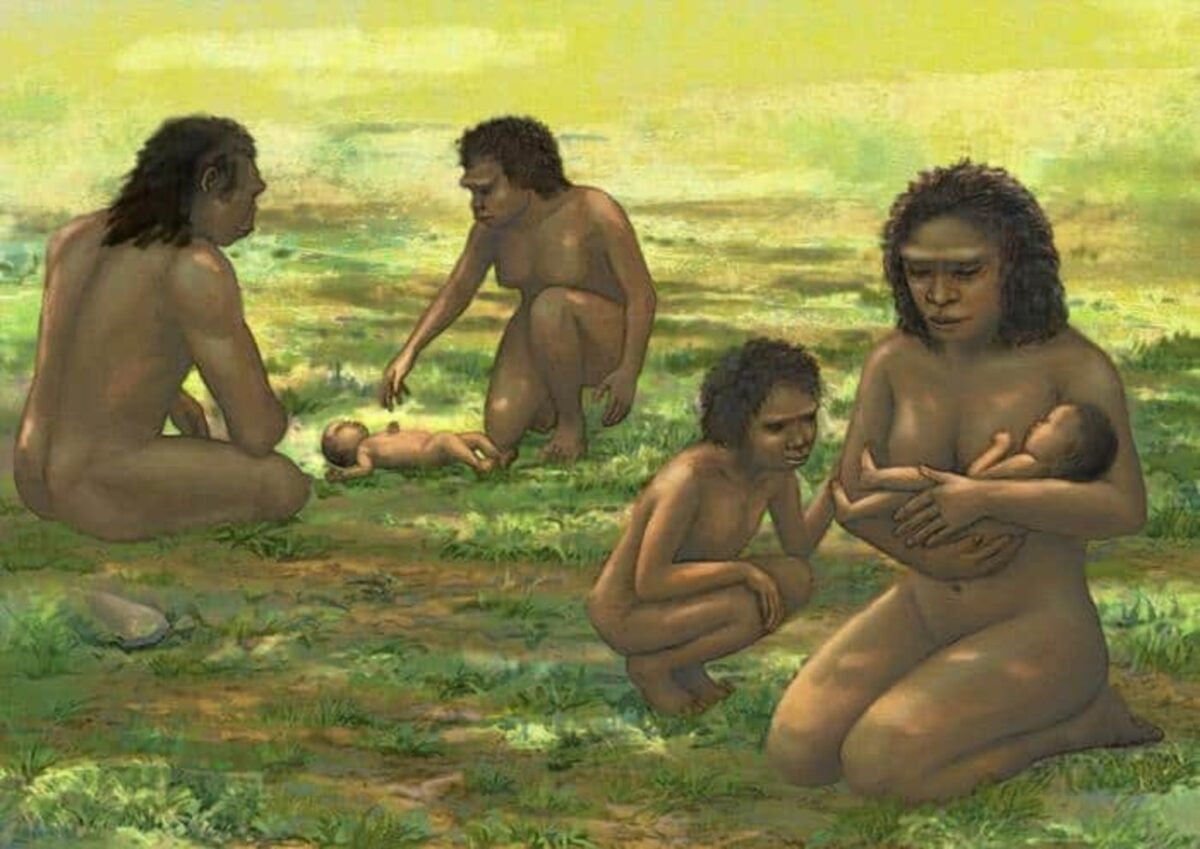
Like modern humans, from this research the team believes Homo erectus mothers held helpless newborns in their arms and shared the care with the father and other group members. Laying newborns with immature heads and neck muscles on the ground can cause deformational plagiocephaly. (Credit: Illustration by Utako Kikutani © Yousuke Kaifu CC BY)
In a Nutshell
- Soft-skulled, helpless babies leave a mark: a flat-head condition called deformational plagiocephaly turns up only in humans among living great apes, making it a fossil-readable clue to how dependent a species’ infants were.
- Six well-preserved skulls from Indonesia were tested; three, two Homo erectus and one Homo floresiensis, were lopsided beyond anything seen in nearly 1,000 ape skulls.
- The “Hobbit” (Homo floresiensis) had an Australopithecus-sized brain but a human-style helpless infancy, hinting the trait took hold before big brains, not because of them.
Bring a newborn home and the truth sets in fast: this tiny person cannot hold up their own head, cannot roll over, and cannot do much of anything except cry. That profound helplessness may reach far back into our family tree. According to a new study, some of our most ancient relatives, including a pint-sized species nicknamed the “Hobbit,” appear to have shared the distinctly human experience of a long, dependent infancy.
Researchers examining fossilized skulls from Indonesia found telltale signs of deformational plagiocephaly, a skull-flattening condition that develops when an infant’s head bones are soft and underdeveloped, and the baby spends long stretches lying on a flat surface, unable to move. In modern babies, this condition is a well-known side effect of helpless infancy. Finding its signature in ancient skulls points to these long-extinct human relatives raising babies whose helplessness resembled our own.
Reported in Proceedings of the Royal Society B, that finding speaks to how human social life may have taken shape. Helpless infants require constant care, feeding, and protection, a demand that would have pushed ancient parents toward cooperation and social bonds far beyond what most animals manage.
Why Human Babies Are Born So Helpless
To understand what makes this discovery matter, it helps to know why human babies are so helpless in the first place. Most primates, from macaques to gorillas, arrive in a relatively capable state. A newborn chimpanzee can hold up its own head and, within about two months, cling on its own to its mother’s fur. That clinging ability is critical: a mother who moves on all fours cannot cradle a baby the way a human parent can, so the infant must hold on for itself.
Human babies take about four months just to lift their heads and around 12 months to stand. Their skulls at birth are composed of thin, soft bones that have not yet fully fused, separated by soft spots called fontanelles. This immaturity is not a flaw; it is a feature. Because the human brain keeps growing rapidly for roughly the first year of life outside the womb, about 75 percent of human brain volume growth happens after birth, compared with 44 to 64 percent in great apes. Soft, pliable skull bones allow that growth to happen. Human babies are, in a sense, born earlier than other primate infants, a trade-off that makes the unusually large human brain possible.
That prolonged window of helplessness is also what creates deformational plagiocephaly. When a soft-skulled baby with weak neck muscles spends time lying on a flat surface, gravity gradually presses the skull into an uneven shape. The condition became far more common in the United States after 1992, when pediatricians began recommending that babies sleep on their backs to prevent sudden infant death syndrome.
Signs of Human-Like Helpless Infancy in Ancient Bone
To test whether ancient human relatives shared this vulnerability, the research team developed a method to quantify skull asymmetry across a large sample. Their dataset included 996 skulls from great apes (chimpanzees, bonobos, gorillas, and orangutans) and 508 human skulls drawn from present-day infants and skeletal remains from burial sites in Japan. By measuring how far skulls drifted from symmetry in two directions, front-to-back and side-to-side, the team pinned down a reliable range of natural variation for both groups.
Great apes showed relatively modest skull asymmetry across all ages and sexes. Human skulls ran far more variable, with some individuals showing dramatic lopsidedness well beyond anything in the ape sample. That gap, the researchers argue, reflects the uniquely human experience of lying helpless on a flat surface with a soft, growing skull. Based on the study’s evidence, the marked form of this condition appears to be unique to humans among living hominids.
With that baseline set, the team turned to six fossil skulls from Indonesia: five belonging to Homo erectus, an ancient human ancestor, and one belonging to Homo floresiensis, the small-bodied species from the Indonesian island of Flores nicknamed the “Hobbit” for its short stature and small brain.
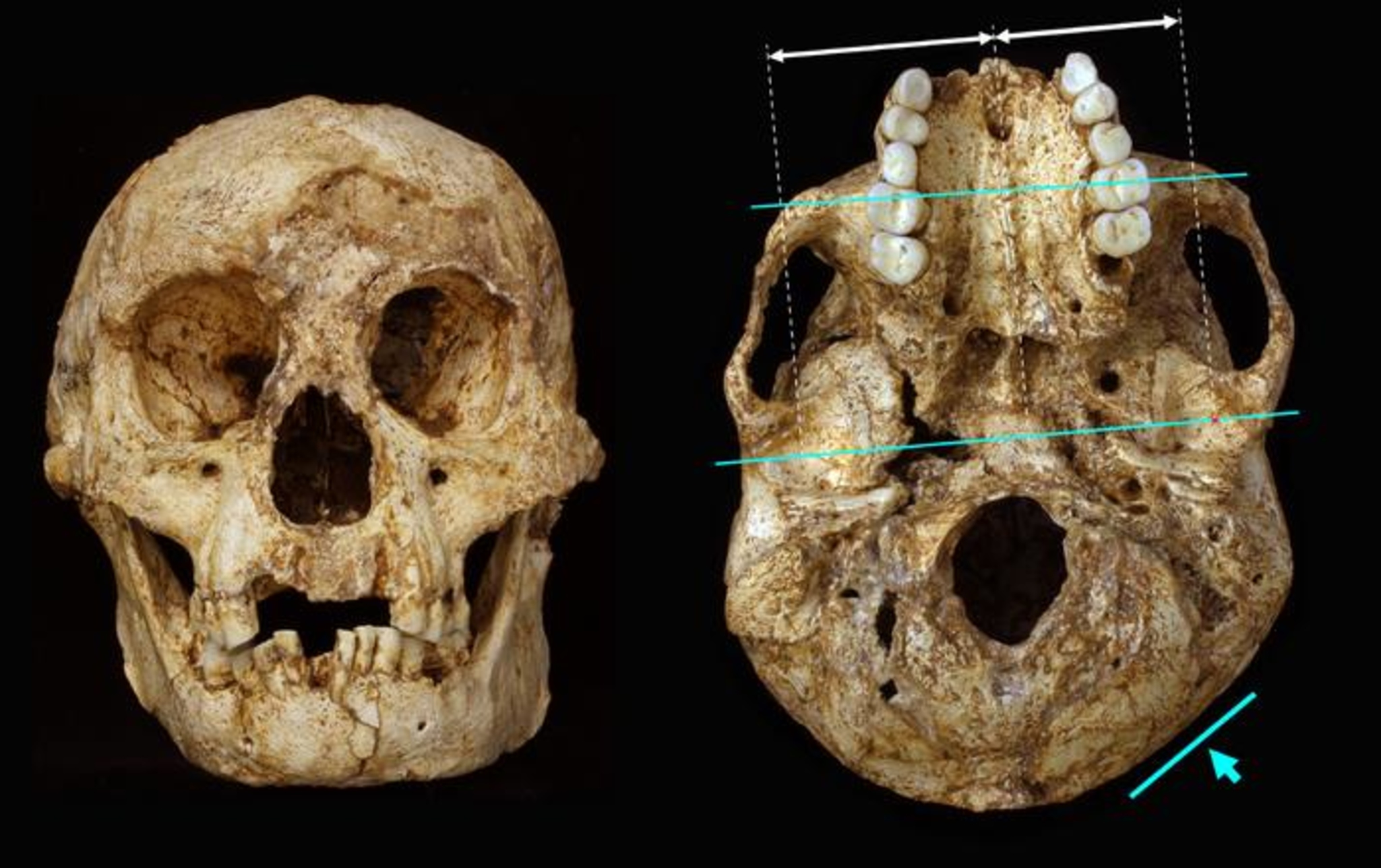
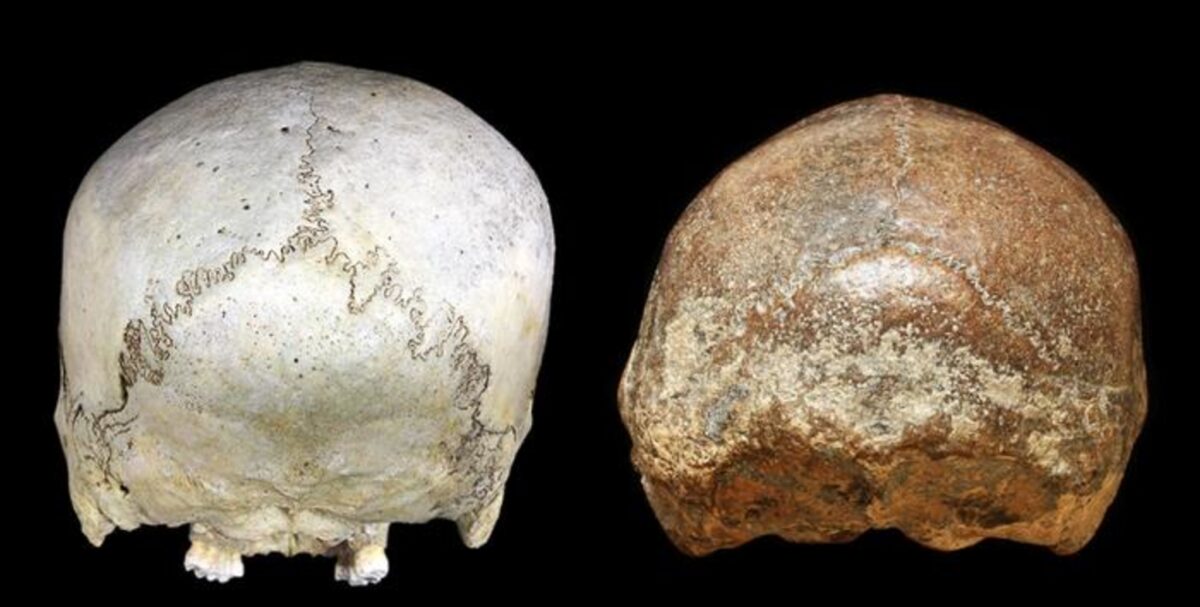
Three of the six showed skull asymmetry beyond even the outer edge of the great ape range. Two Homo erectus specimens, Ngawi 1 and Ngandong 12, showed side-to-side tilting of the skull. One Homo floresiensis skull, known as LB1, showed pronounced horizontal twisting of the entire braincase, a pattern reaching into the face, jaw, and teeth.
Before pinning these deformities on infant plagiocephaly, the researchers weighed a rival explanation: postmortem damage, the crushing and warping that happens to bones buried in sediment for thousands of years. They examined each specimen for it. LB1 was found with its top pointing upward, so ground pressure would have pushed straight down, not sideways, making it an unlikely cause of horizontal twisting. Its internal structures still lined up toward the midline, a sign that the asymmetry was present during life, and the twist extended into the jaw and tooth roots in a way that matches a known category of the flat-head condition. Ngawi 1 and Ngandong 12, meanwhile, showed asymmetry concentrated in the thick walls of the skull while the fragile base stayed intact, the opposite of what postmortem crushing usually does. Ngawi 1 also had a bony ridge above the ear canal that grew unevenly on each side, a feature that forms in life and cannot develop after death.
The ‘Hobbit’ Skull and Human-Like Helpless Infancy
Perhaps the most provocative finding involves Homo floresiensis itself. LB1’s brain measures 426 cubic centimeters, placing it within the estimated range of Australopithecus afarensis, the ancient ancestor known from the fossil “Lucy.” In body size, too, Homo floresiensis overlapped with that much older lineage.
Yet LB1’s skull points to the distinctly human pattern of helpless infancy. That matters because Australopithecus, based on separate research, appears to have had a more mature brain at birth, closer to an ape’s. So the shrinking brain in Homo floresiensis was likely not a simple slide back toward an ape-like condition, but a one-of-a-kind adaptation on an isolated island, with the species holding onto its human-like infant growth pattern even as its brain grew smaller.
Combined with earlier evidence that Neanderthals also showed signs of helpless infancy, the study points to at least four Homo lineages, scattered across the world between roughly 300,000 and 100,000 years ago, all raising babies that needed extensive care.
For the researchers, these lopsided skulls are not medical curiosities. Raising a helpless infant takes sustained, coordinated effort. Homo erectus groups in Java shared their range with tigers and leopards; Homo floresiensis on Flores contended with Komodo monitors and giant carrion birds. For the study’s authors, keeping a soft-skulled, immobile baby alive in those settings would have required protection and organized caregiving well beyond the capacity of a single parent, evidence that these archaic groups nurtured their dependent infants in some of the most dangerous places of the ancient world. A misshapen fossil skull, it turns out, can say a great deal about the social world around it.
Paper Notes
Limitations
The modern human sample comes almost entirely from Japanese individuals, including present-day infants and skeletal remains from historical burial sites. Researchers acknowledge that this regional sample may not capture the full range of skull asymmetry across all human populations, in part because sleep-positioning customs vary across cultures. Only six fossil skulls were examined, all from Indonesia, which limits how far the conclusions stretch to other ancient populations. Newborn great apes were sparsely represented in the comparison sample, though the researchers argue that this does not meaningfully alter their conclusions, given how the condition develops and persists over time. They also note that some contribution from postmortem processes cannot be entirely ruled out for any specimen, but they make the case that it was not the main driver of the observed asymmetries.
Funding and Disclosures
Funding came from the Japan Society for the Promotion of Science KAKENHI program (grant numbers 24657173 and 23K17404) and Child Health and Development Research funding (number 2021-A1). CT data from modern human infants were collected at the National Center for Child Health and Development in Tokyo between 2014 and 2018, with ethics approval from that institution’s review board (approval number 2021-139). The authors declare no competing interests and state that no AI-assisted technologies were used in the creation of the article.
Publication Details
Paper Title: “Cranial evidence for human-like helpless infancy in Homo erectus and Homo floresiensis“
Authors: Yousuke Kaifu, Wataru Yano, Makoto Hikosaka, Daisuke Shimizu, Takeshi Nishimura, Daisuke Kubo, Rusyad Adi Suriyanto, Jatmiko, Thomas Sutikna, Naoki Morimoto, and Iwan Kurniawan
Corresponding Author: Yousuke Kaifu, The University Museum, The University of Tokyo ([email protected])
Journal: Proceedings of the Royal Society B
Volume/Issue: 293, Issue 2075, Article 20261055
Published: 2026


