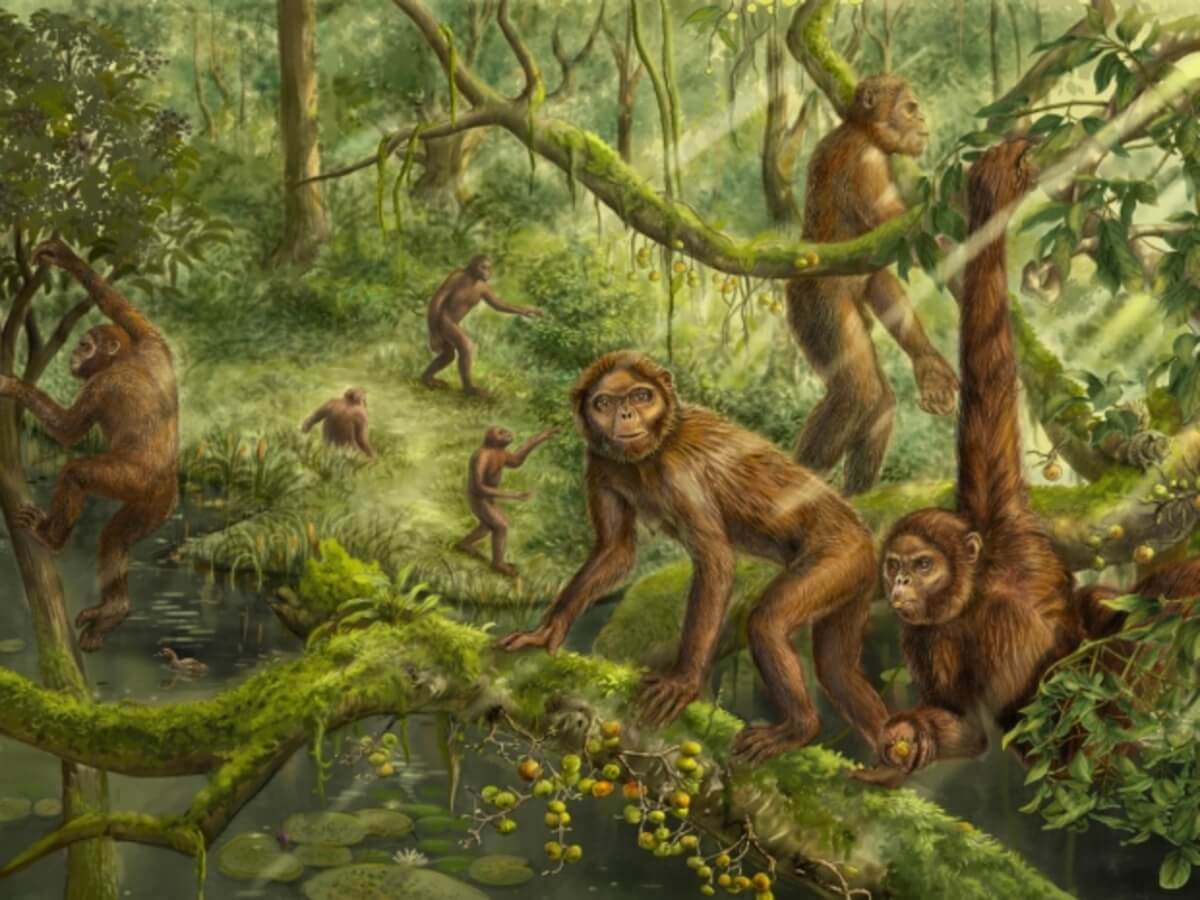
Reconstruction of the locomotor behavior and paleoenvironment of Lufengpithecus. (Illustration by Xiaocong Guo; image courtesy of Xijun Ni, Institute of Vertebrate Paleontology and Paleoanthropology, Chinese Academy of Sciences)
NEW YORK — A six-million-year-old ape’s ear is offering clues about how humans learned to walk. Unraveling the evolutionary steps that led to human bipedalism has been a subject of great interest but has remained somewhat elusive due to the limitations of past studies and the fossil record. However, a groundbreaking study by a team at New York University focuses on the ancient skull of an ape named Lufengpithecus to shed light on the evolutionary journey of humans walking.
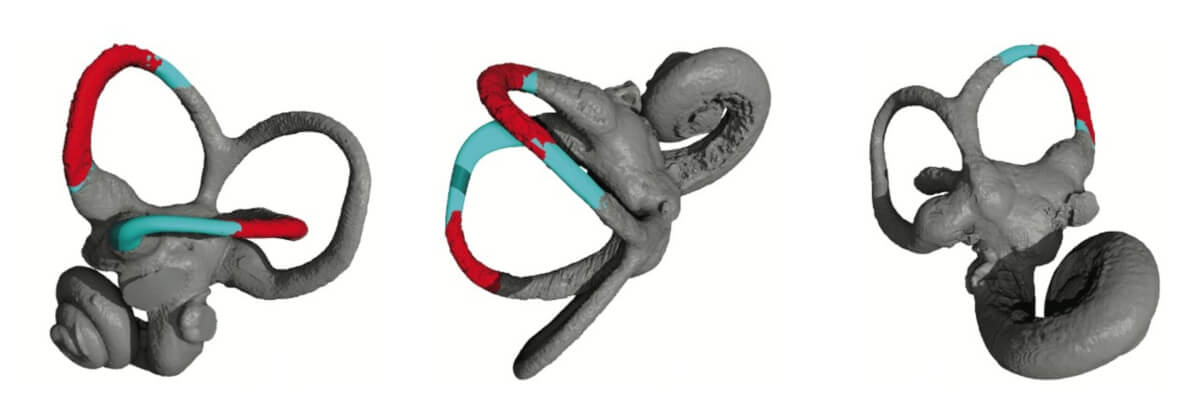
The study introduces a novel approach to exploring the origins of bipedal locomotion by analyzing the bony inner ear region of these ancient skulls using 3D CT scanning.
“The semicircular canals, located in the skull between our brains and the external ear, are critical to providing our sense of balance and position when we move, and they provide a fundamental component of our locomotion that most people are probably unaware of,” says study lead author Yinan Zhang, a doctoral student at the Institute of Vertebrate Paleontology and Paleoanthropology of the Chinese Academy of Sciences (IVPP), in a university release.
“The size and shape of the semicircular canals correlate with how mammals, including apes and humans, move around their environment. Using modern imaging technologies, we were able to visualize the internal structure of fossil skulls and study the anatomical details of the semicircular canals to reveal how extinct mammals moved.”
The research team, including Terry Harrison, a New York University anthropologist, and IVPP Professor Xijun Ni, who led the project, proposed a three-step evolution of human bipedalism. Initially, early apes moved in trees in a way similar to modern Asian gibbons. The last common ancestor of apes and humans then used a combination of climbing, clambering, and both arboreal (tree-based) and terrestrial (ground-based) movements. From this diverse locomotor repertoire, human bipedalism evolved.
Until now, studies of ape locomotion evolution mainly focused on limb, shoulder, pelvis, and spine bones. However, the diverse behaviors of living apes and the incomplete fossil record have made it challenging to form a clear picture of how human bipedalism originated. The discovery of Lufengpithecus skulls in China’s Yunnan Province in the early 1980s provided a unique opportunity to explore this question from a new angle, though initial assessments were hindered by the skulls’ heavy compression and distortion.
By utilizing advanced 3D scanning technologies, scientists were able to create virtual reconstructions of the inner ear’s bony canals. Comparing these reconstructions to scans from other living and fossil apes and humans, the team uncovered that early apes shared a locomotor repertoire ancestral to human bipedalism.
These findings offer an invaluable alternative to studying the postcranial skeleton (the skeleton excluding the skull) in understanding the evolution of apes and human movement. The study also suggests that the rate of evolutionary change in the bony labyrinth, a complex structure within the inner ear, may have been influenced by climate changes approximately 3.2 million years ago, potentially accelerating the evolution of ape and human locomotion.
“Most fossil apes and their inferred ancestors are intermediate in locomotor mode between gibbons and African apes,” explains Ni. “Later, the human lineage diverged from the great apes with the acquisition of bipedalism, as seen in Australopithecus, an early human relative from Africa.”
Researchers say this study not only contributes to our understanding of the evolutionary history of ape locomotion but also highlights the intricate relationship between climate change and the evolutionary process. It opens up new avenues for further investigation into how our ancestors adapted and evolved over millions of years.
“Cooler global temperatures, associated with the build up of glacial ice sheets in the northern hemisphere approximately 3.2 million years ago, correspond with an uptick in the rate of change of the bony labyrinth and this may signal a rapid increase in the pace of ape and human locomotor evolution,” notes Harrison.
The study is published in the journal The Innovation.


