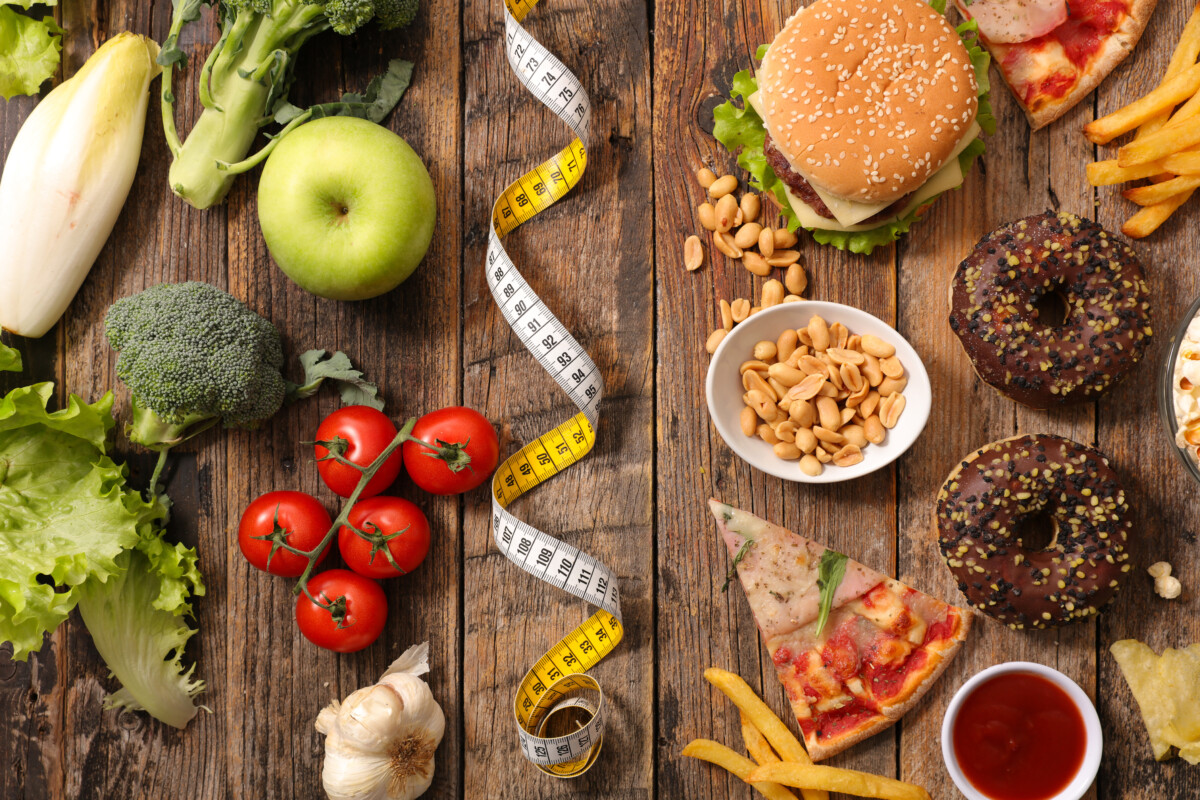
Healthy and unhealthy foods (© M.studio - stock.adobe.com)
Personalized Diets May Be the Next Step in Longevity Science
In A Nutshell
- Calorie cuts extend lifespan in lab animals, but a review argues food quality may offer another route to healthy aging.
- Carb quality, protein sources, fat type, and fiber appear to influence some of the same cell systems that calorie restriction affects.
- Higher fiber intake was tied to 10 to 23% lower death risk, though human studies show associations, not proof.
- Protein needs may shift with age, with less animal protein around ages 40 to 50 and more after 65.
Cutting calories has been known since the 1930s to extend the lives of lab animals, but a new review in The Innovation Nutrition argues that a different lever may do some of the same work: changing what ends up on the plate, rather than how much of it. After sifting through more than 30 large studies of human populations, plus animal and lab research, the authors conclude that food quality may offer another promising route to a longer, healthier life.
Five choices get the spotlight: the kind of carbohydrates, the sources of protein, specific amino acids (protein’s building blocks), the type of fat, and fiber. Oats, beans, fatty fish, and walnuts land on the favorable side of the review’s ledger, while butter, lard, and heavily processed food land on the cautionary side. The best mix, the authors add, likely shifts with age, sex, genes, and the bacteria living in the gut.
Calorie restriction has its own problems. Severe versions are “difficult to adopt and maintain,” the authors write, and may bring menstrual irregularities, brittle-bone fractures, and heart rhythm problems. The food-quality route carries a caveat too: much of the evidence that nutrients can extend lifespan comes from animals, while the human studies track diet and death rates, which shows associations rather than proof.
Food Quality May Help People Live Longer Without Calorie Cuts
This is a review, not an experiment with volunteers. Three researchers from Shanghai Jiao Tong University and the National University of Singapore pulled together existing evidence: long-term studies that follow people for years, analyses that combine many studies, and experiments in yeast, worms, flies, rats, and mice.
Much of the argument rests on four nutrient-sensing systems inside cells, which work like a fuel gauge. When certain nutrients are plentiful, these systems can push cells toward growth and dial down some repair and cleanup work, including clearing out damaged cell parts. When nutrients run leaner, as in calorie restriction, cleanup ramps up, a shift tied to slower aging in lab animals. The authors argue specific nutrients can nudge the same gauges.
Three human studies stand out: the PURE study (135,335 people across 18 countries), the ARIC study with a pooled analysis of more than 430,000 people, and the Nurses’ Health Study (women tracked for 32 years). Together, they linked both very low and very high carbohydrate intake to higher death rates. Moderate intake, around half of daily calories, carried the lowest risk, and swapping in plant-based foods helped.
Higher fiber intake was tied to 10 to 23% lower death risk, and an updated analysis of 64 studies covering more than 3.5 million people landed on 23% for the highest intake versus the lowest. Plant-rich eating patterns, such as the Mediterranean diet, were tied to roughly 10 to 25% lower risk after accounting for age, smoking, exercise, and weight, while the heaviest eaters of ultra-processed foods faced 15 to 30% higher death risk than the lightest eaters.

Ideal Diet to Live Longer May Change From Young Adulthood to Old Age
Rather than one diet for every adult, the review proposes age-based recommendations and a longevity food pyramid. Unlike the Mediterranean and USDA pyramids, it puts lifestyle habits at the base, including fluid intake, sleep, and regular exercise.
In early adulthood, the review treats 15 to 20% of daily calories from protein as appropriate for supporting growth and reproduction. Around ages 40 to 50, the authors favor less animal protein and more plant protein, partly because higher animal protein intake in middle age was linked to modestly higher death rates. After 65, protein should climb back to 15 to 20% of calories, preferably from fish and plants, to counter age-related muscle loss and frailty. Sex may matter too: high-fat feeding shortened male, but not female, mouse lifespans.
A midlife fiber goal of 40 to 60 grams a day sits well above current adult guidelines of 25 to 30 grams, and a table note in the paper calls it a “hypothesis-based upper range” rather than established guidance.
Glucose Monitors and Gut Tests May Tailor Diets, but Trials Must Follow
One study cited in the review found that two people eating identical meals could differ up to ten-fold in blood sugar, insulin, and blood fat responses, a gap predicted by gut bacteria, sleep, physical activity, and meal context rather than by the food alone.
Tools the review lists include continuous glucose monitors, genetic and other lab testing, gut bacteria testing, eating within set daily time windows, wearable trackers, and AI-assisted meal planning. Algorithms trained on glucose, gut bacteria, and lifestyle data already beat standard advice for blood sugar control, the authors report, but whether such tools improve long-term health still needs rigorous testing. A plan built on personal data could prove easier to stick with than a blanket rule, though that is still untested.
Even the authors call their frameworks “testable hypotheses.” Until long-term trials settle the question, the type of carbohydrate, protein, fat, and fiber on the plate deserves the same scrutiny as the calorie count.
Disclaimer: This article reports on published research and is intended for general information only. It is not medical or dietary advice. Readers should consult a qualified health professional before changing their diet or health routine.
Paper Notes
Limitations
This is a review, so it summarizes existing research and reports no new data. Much of the lifespan evidence behind its nutrient arguments comes from yeast, worms, flies, and rodents, and the authors acknowledge that results from short-lived animals do not always carry over to people. Human findings come largely from observational cohort studies, which link diet to death rates but cannot prove cause and effect, and the authors note that direct evidence tying low-glycemic diets to longer human lifespan remains limited. Short-term human trials of methionine restriction have shown metabolic improvements, but long-term safety and effects on muscle mass in older adults are unresolved. The authors also list three understudied groups: adults 75 and older, people of non-European genetic ancestry, and populations in low- and middle-income countries. The review rates the evidence behind its age-based targets as high for young and middle-aged adults and moderate for older adults, labels the midlife fiber target hypothesis-based, and describes its frameworks as testable hypotheses for future trials. Personalized tools such as AI-guided and wearable-integrated plans still need rigorous evaluation for long-term health outcomes.
Funding and Disclosures
Funding came from the National Key Research and Development Program of China (2023YFF1104204) and the National Natural Science Foundation of China (82171550). According to the paper, the funders had no role in study design, data collection and analysis, decision to publish, or preparation of the manuscript. The authors declare no competing interests. Jintao Huang drafted the manuscript, and all authors critically revised and approved it.
Publication Details
Titled “Beyond dietary restriction: Towards next-generation precision diets for healthy aging,” the paper was written by Jintao Huang (Department of Food Science and Engineering, School of Agriculture and Biology, Shanghai Jiao Tong University), Dejian Huang (National University of Singapore (Suzhou) Research Institute and the Department of Food Science and Technology, National University of Singapore), and Ziyun Wu (Shanghai Jiao Tong University, corresponding author, [email protected]). It is a review article published in The Innovation Nutrition, volume 1, issue 3, article 100034, with an issue date of October 28, 2026. The paper was received June 4, 2026, accepted August 19, 2026, and published online August 29, 2026, under an open access CC BY license. DOI: https://doi.org/10.59717/j.xinn-nutri.2026.100034. Citation: Huang J., Huang D. and Wu Z. (2026). Beyond dietary restriction: Towards next-generation precision diets for healthy aging. The Innovation Nutrition 1:100034.


