
(Photo by Kristina Paukshtite from Pexels)
BPA Harmed Rat Sperm in Weeks. A Bacteria-Based Food Ingredient May Offer Protection
In A Nutshell
- BPA, a chemical found in plastic food containers and metal can linings, triggered oxidative stress and reduced certain measures of sperm movement in male rats within weeks of exposure.
- A food ingredient made from heat-killed bacteria called FK-23 reduced several of those changes, including damage to sperm-related proteins and declines in the blood’s antioxidant defenses.
- BPA cut the blood’s free radical-neutralizing capacity by roughly half in two weeks; FK-23 restored it to near-normal levels.
- This was a rat study, and the results do not prove FK-23 protects human sperm. Researchers say it warrants further investigation as a potential dietary strategy against BPA exposure.
A plastic chemical found in food containers and packaging may disrupt sperm function and raise signs of oxidative stress, at least in rats. A food ingredient made from heat-killed bacteria could help counter it, according to a new study published in the Journal of Functional Foods.
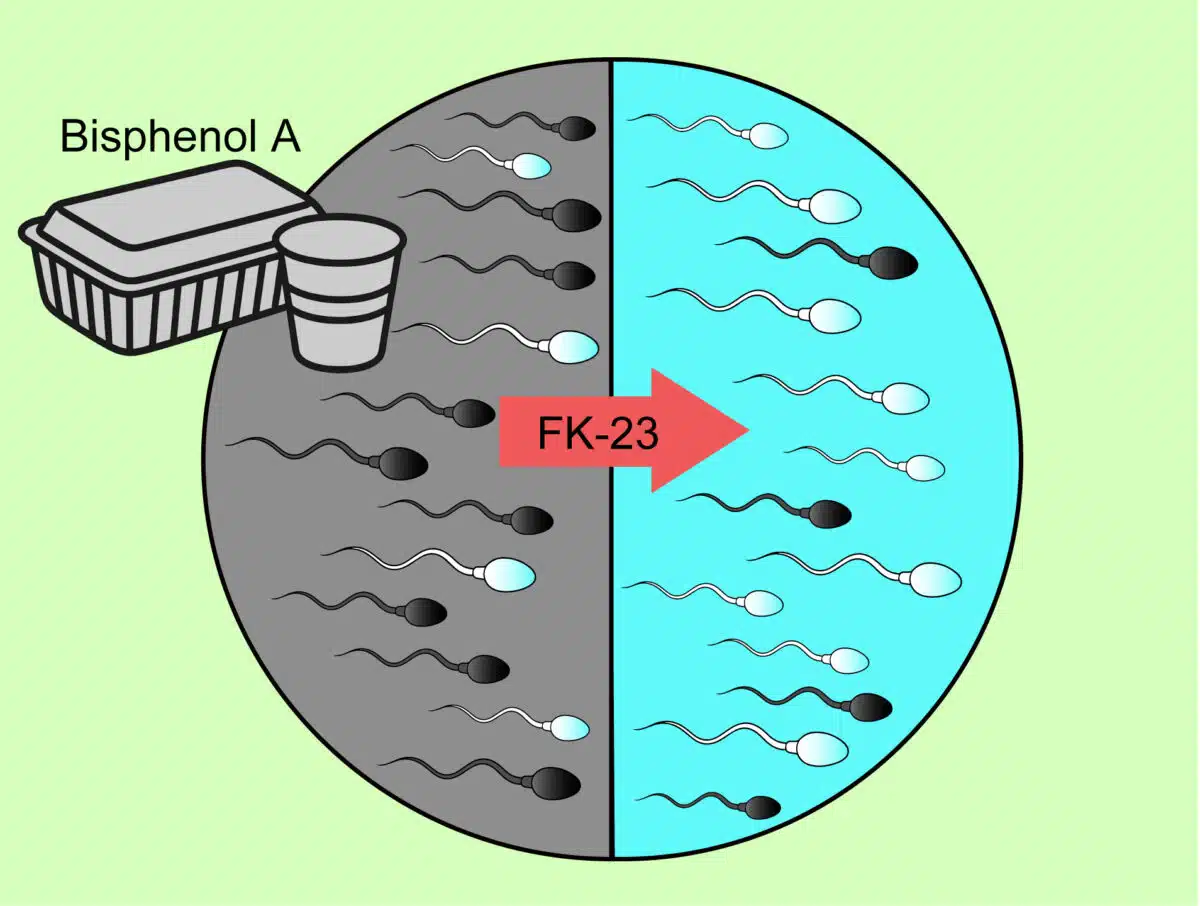
Researchers from Osaka Metropolitan University and other Japanese institutions found that exposing male rats to bisphenol A, commonly known as BPA, triggered a buildup of damaging molecules in sperm within just one week. By eight weeks, certain measures of sperm movement had declined. When rats also received a supplement made from heat-killed Enterococcus faecalis FK-23, a paraprobiotic ingredient used in functional foods in Japan, several of those changes were reduced, including oxidative stress markers and some measures of sperm movement. Paraprobiotics are heat-killed microorganisms that can no longer colonize the gut but may still produce beneficial effects in the body.
These findings arrive amid broader concern about male fertility and everyday chemical exposures. BPA is one chemical researchers have studied because it can interfere with hormones and oxidative stress pathways. This study does not prove FK-23 would work the same way in humans, but it offers one of the first direct tests of whether a food-based supplement could blunt BPA’s effects on sperm in a living organism.
BPA’s Hidden Effects on Sperm
BPA is one of the most widely produced industrial chemicals in the world. Found in hard plastics, food packaging, and the inner coatings of metal cans, it enters the body primarily through food and drink contact, but also through skin absorption and even under the tongue, routes that can bypass the liver’s normal filtering process and leave more of the active chemical in the bloodstream.
Once inside the body, BPA interferes with hormones and ramps up what scientists call oxidative stress, a form of internal chemical damage in which unstable molecules called free radicals attack healthy cells. In reproductive tissue, that damage can impair cells involved in sperm production and reduce the ability of sperm to move, which is critical for fertilization.
To test whether FK-23 could offer protection, researchers divided male rats into four groups: an untreated control group, one that received only FK-23 in their food, one that received BPA in their drinking water, and one that received both. BPA was given at 10 parts per million, translating to a daily dose of roughly 1 milligram per kilogram of body weight. On standard health measures, all four groups looked the same. Body weight, organ weight, food intake, and water consumption showed no differences. Chemical effects can show up in lab markers before they are obvious from the outside, and that is exactly what happened here.
BPA Damage Showed Up Fast
Within one week of BPA exposure, free radical production in the sperm had already climbed. By two weeks, tissue from the structure that stores and matures sperm showed a buildup of chemically damaged proteins, including mitochondrial proteins from the tiny structures inside cells that power sperm movement. Among those examined more closely was protein disulfide isomerase, or PDI, which helps cells fold proteins correctly and keep internal machinery running smoothly. BPA reduced PDI levels significantly, a sign the cell’s quality-control system was under strain. FK-23 treatment restored those levels.
By eight weeks, rats in the BPA-only group showed declines in specific aspects of sperm movement, particularly speed and how sperm heads oscillate, both of which matter for fertilization. Rats that received both BPA and FK-23 maintained those movement qualities much closer to untreated animals.
A Blood Test Tells a Bigger Story on BPA and Sperm Health
One of the more notable findings involved what was happening in the blood. Plasma naturally contains molecules that neutralize free radicals, acting like a body-wide chemical defense system. After two weeks of BPA exposure, that defensive capacity had dropped by roughly half. FK-23 supplementation reversed the decline, restoring capacity to near-normal levels. Rats given FK-23 alone, with no BPA, actually showed an increase above baseline, suggesting the supplement actively boosts antioxidant defenses even without a toxin present.
Because FK-23 appeared to work through the bloodstream rather than just in reproductive tissue, the researchers suggested it may act indirectly, possibly through immune or metabolic pathways, rather than functioning purely as a direct antioxidant.
Caveats Worth Knowing
Caution applies to these findings. The BPA dose, while lower than the level previously set as causing no observable harm in rats, still exceeds typical human exposure. Researchers acknowledged this directly, noting the dose was designed to produce measurable effects within a practical experimental window. Group sizes were small, between three and six animals, and the study tracked oxidative stress markers and sperm movement rather than actual fertility outcomes.
Worth noting: Nichinichi Pharmaceutical provided FK-23 and helped fund the work alongside Japanese government funding, a potential competing interest.
A food ingredient already used in functional foods and shown here to blunt several BPA-linked changes in rats remains a lead worth pursuing. Whether FK-23 can do in humans what it appeared to do in rats is a question this study cannot answer, but it gives scientists a concrete place to look.
Disclaimer: This article is based on a peer-reviewed animal study and is intended for informational purposes only. It does not constitute medical advice. The findings have not been replicated in humans, and no conclusions about human fertility, supplementation, or treatment should be drawn from this research.
Paper Notes
Limitations
The authors acknowledged several important limitations. The BPA dose used in the rat model exceeded typical human daily exposure levels and was selected to produce observable biological effects within a feasible experimental window, not to directly replicate human exposure conditions. The study did not clarify the underlying cause of BPA-induced decreases in plasma radical-scavenging capacity, nor did it determine whether FK-23 itself has direct radical-scavenging activity or whether the effect is mediated through metabolic byproducts. No histopathological tissue analysis was conducted; the study focused instead on functional and biochemical markers. Group sizes ranged from three to six animals, which readers should factor in when evaluating the strength of the findings.
Funding and Disclosures
This work was partially supported by JSPS KAKENHI (grant number 21K05426) from Japan, as well as grants from Nichinichi Pharmaceutical Co. Industry, Ltd., based in Mie, Japan. Nichinichi Pharmaceutical Co., Ltd. also provided FK-23 for the study, which represents a potential competing interest. No other conflicts of interest were declared. The authors disclosed that ChatGPT (OpenAI) was used to assist with phrasing and expression during manuscript preparation, and that English language editing was provided by Editage (Cactus Communications).
Publication Details
Paper title: Preventive effect of paraprobiotic Enterococcus faecalis FK-23 on bisphenol A-induced sperm toxicity | Authors: Yukiko Minamiyama, Shigekazu Takemura, Kanako Nakagawa, Hiroshi Ichikawa, Takeaki Ishizawa, Toshikazu Yoshikawa | Author affiliations: Department of Hepato-Biliary-Pancreatic Surgery and Department of Frontier Life-science, Graduate School of Medicine, Osaka Metropolitan University, Osaka, Japan; Department of Medical Life Systems, Graduate School of Life and Medical Sciences, Doshisha University, Kyotanabe, Japan; Kyoto Prefectural University of Medicine, Kyoto, Japan; Louis Pasteur Center for Medical Research, Kyoto, Japan | Journal: Journal of Functional Foods, Volume 138, 2026, Article 107205 | DOI: https://doi.org/10.1016/j.jff.2026.107205 | Published online: February 18, 2026


