
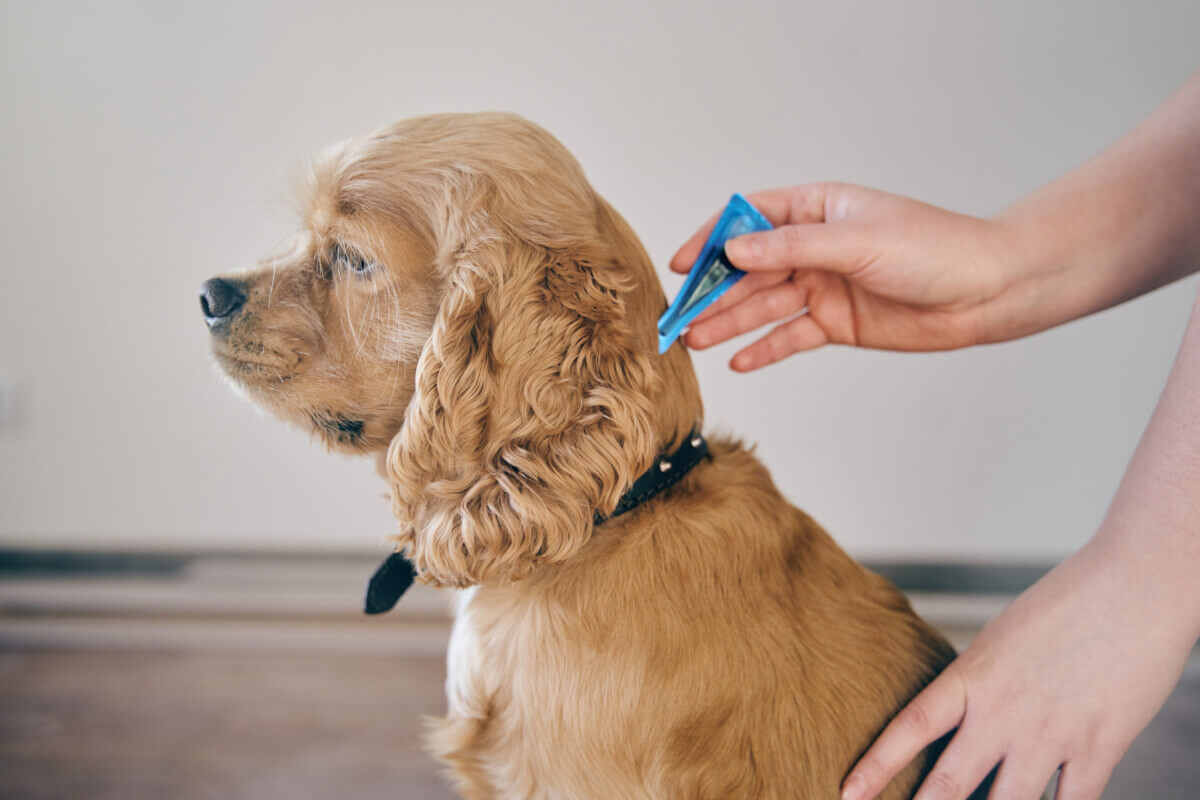
Credit: Pixel-Shot on Shutterstock
Flea meds stay active in pet feces for absurdly long periods, steadily polluting nearby areas.
In a Nutshell
- Pet owners can reduce impact by disposing of waste in sealed trash, especially during the first month after treatment
- Popular flea medications (Bravecto, NexGard, Credelio, Simparica) remain active in pet feces for 4 to 7 months after a single dose
- Up to 92% of dung-feeding insects could be exposed to lethal amounts from contaminated waste
- Regulators don’t require environmental safety testing for pet medications; only livestock treatments face such scrutiny
That monthly flea pill you give your dog or cat? It’s probably still coming out in their poop half a year later, and it might be killing the insects that are supposed to break down that waste.
French scientists tracked what happened after 40 cats and dogs received common flea treatments like Bravecto, NexGard, Credelio, and Simparica. They observed some pets were still excreting active pesticides more than 200 days after a single dose. When researchers calculated the risk to dung beetles and flies that naturally consume animal waste, they found that up to 92% could be exposed to lethal amounts. Their findings are published in Environmental Toxicology and Chemistry.
Most pet owners have no idea this is happening. The drugs wear off after 30 to 90 days, so fleas and ticks are no longer dying. Yet the medications keep trickling out in feces for months afterward, contaminating yards, parks, and anywhere else pets do their business.
Roughly 86% to 91% of pet owners in the United Kingdom use flea treatments at least once yearly, with similar rates likely across the United States and Europe. If even a fraction of those treatments end up poisoning beneficial insects, the cumulative impact could be massive.
The New Generation of Flea Medication
Modern flea medications work differently than older products. Drugs in the isoxazoline class target nerve receptors that exist only in invertebrates (fleas, ticks, mites, and unfortunately, lots of other insects too). That’s what makes them so effective for pets and generally safe for mammals.
Veterinarians love recommending these products because pet owners only need to remember a monthly pill or topical treatment. Some, like Bravecto, claim three-month protection. No daily applications, no messy sprays. Just pop a tablet and forget about it.
These drugs have half-lives ranging from roughly two to six weeks in the bloodstream, and most leave the body through feces rather than urine. Even more concerning, they exit as active compounds, still perfectly capable of killing bugs.
What the Study Found
Researchers at VetAgro Sup in France recruited 20 dogs and 20 cats (all owned by veterinary students who volunteered their pets). Each animal got a standard dose of one of four medications according to the label instructions. Then came the unglamorous part: owners collected feces for months, sometimes up to seven months, bringing samples in for laboratory analysis.
The drugs lingered far longer than anyone expected. In cats treated with topical fluralaner, traces showed up for 128 days. Dogs given oral lotilaner were still excreting it after 204 days (nearly seven months). Even the shorter-acting medications stuck around for 80 to 114 days.
To put that in perspective, if you treated your dog on January 1st with lotilaner, the medication could still be contaminating their waste in early August.
Scientists then ran thousands of computer simulations to estimate insect exposure. For the two most persistent drugs (fluralaner and lotilaner), 87% to 92% of dung-feeding insects eating contaminated dog feces would encounter doses high enough to kill them. The other two medications tested (afoxolaner and sarolaner) broke down more in the body before elimination, but still posed risks to 8% to 44% of exposed insects.
Even when researchers applied a 100-fold safety buffer) the standard approach for protecting wildlife) nearly every scenario showed dangerous exposure levels for the most persistent medications.
The Regulatory Blind Spot
Here’s what might surprise pet owners most: when pharmaceutical companies get these products approved, regulators don’t require any data on fecal contamination or effects on terrestrial insects. Environmental assessments focus almost entirely on whether pets swimming or getting bathed might contaminate water.
European drug authorities recently published a scientific opinion acknowledging this gap. They noted that basically nobody knows how much of these medications actually reaches the environment through pet waste, or what happens when it does. Earlier studies have found older flea chemicals like fipronil in rivers and streams across England, but the newer drugs haven’t been studied much.
Meanwhile, similar medications used in cattle face much stricter environmental scrutiny. European regulators have actually denied approval for some livestock treatments specifically because they harm dung beetles and other insects critical for breaking down manure. Pet medications get a pass despite contaminating the environment through the same pathway.
Why Dung Insects Matter
Most people don’t spend much time thinking about the bugs that eat animal poop. Still, dung beetles, flies, and similar species play crucial roles in ecosystems. They break down waste, recycle nutrients back into soil, and serve as food for birds and other wildlife.
Kill off enough of these insects, and the effects ripple outward. Waste piles up. Nutrients don’t cycle properly. Birds lose food sources. The problems cascade.
Scientists have documented alarming declines in insect populations worldwide in recent years. Pet pesticides might be one more stressor pushing bugs toward collapse.
Should Pet Owners Change Flea Medications?
None of this means you should stop protecting your pets from fleas and ticks. These parasites carry real diseases: lyme disease from ticks, tapeworms from fleas, and worse. In areas where these threats are significant, the medications offer legitimate benefits.
Some aspects, however, need to change:
First, product labels could include disposal guidance. Agricultural pesticides carry warnings about environmental contamination. Pet medications should too. During the first few weeks after treatment, when drug concentrations run highest, owners in areas where waste isn’t collected (rural properties, hiking trails) might consider bagging and trashing their pet’s feces rather than leaving it.
Second, veterinarians could do a better job matching treatments to actual risk. Does an indoor cat in Minnesota really need monthly flea prevention during winter? Probably not. Targeting treatments to seasons and areas where parasites pose real threats would reduce unnecessary environmental exposure.
Third, pharmaceutical companies could reformulate products or develop delivery systems that maintain protection without requiring such massive drug loads that persist for months.
The study’s authors found surprising variation between individual animals. Some dogs excreted high drug levels for nearly two months, while others cleared it much faster, possibly due to genetic differences in metabolism. Factors like whether dogs eat before taking pills also dramatically affect absorption (fasting can cut absorption by more than half for some medications).
Newer products combine isoxazolines with additional parasiticides for broader protection against intestinal worms. These combination drugs could compound environmental risks since multiple active ingredients exit through feces simultaneously, but no one has studied that scenario yet.

What Comes Next
This study provides the first hard data on how long modern flea medications persist in pet waste and the first estimate of risk to non-target species. Regulators, manufacturers, and veterinarians now have evidence that the status quo isn’t sustainable.
Pet owners who want to minimize environmental impact have limited options right now. The most practical step is disposing of waste in sealed trash during at least the first month after treatment, when concentrations peak. Some areas already require this for sanitation reasons, which may incidentally reduce pesticide distribution.
Longer term, the pet pharmaceutical industry needs to reckon with the same environmental standards applied to livestock treatments and agricultural pesticides. Until then, every flea pill comes with an invisible environmental cost that most pet owners never see, but insects eventually encounter.
Paper Notes
Study Limitations
The study included 20 dogs and 20 cats total (five animals per medication), generating data from more than 1,000 fecal samples over several months. This limited sample size may not capture the full range of individual variation seen in pet populations. Fecal composition varies naturally within and between bowel movements, introducing measurement uncertainty. The analytical method couldn’t distinguish between certain chemical forms of afoxolaner. For topical products applied to cat skin, researchers couldn’t track medication that never entered the bloodstream (remaining on fur or washing off during grooming). They also couldn’t monitor whether dogs ate before taking pills as recommended, which significantly affects absorption. Some animals had received different flea medications more than six months before the study, potentially influencing their metabolism. The study ended when drug levels dropped below detection limits, but elimination may not have been complete. Environmental risk calculations used toxicity data from surrogate insect species since dung beetle testing wasn’t available for all drugs.
Funding and Disclosures
The study used internal laboratory resources at VetAgro Sup in France. Authors declared no conflicts of interest. Pet owners provided informed consent and could withdraw their animals anytime. The local Animal Care and Use Committee approved the study protocol (numbers 2229 and 2230 for cats and dogs).
Publication Details
Authors: Philippe J. Berny (corresponding author), Bernadette España, Julie Auré, and Julia Cado, all affiliated with VetAgro Sup, Campus vétérinaire, Marcy l’Étoile, France | Journal: Environmental Toxicology and Chemistry, 2026 | Title: “Prolonged fecal elimination of isoxazoline antiparasitic drugs in dogs and cats: is there a risk for nontarget species?” | DOI: 10.1093/etojnl/vgaf285 | Citation: Berny, P. J., España, B., Auré, J., & Cado, J. (2026). Prolonged fecal elimination of isoxazoline antiparasitic drugs in dogs and cats: is there a risk for nontarget species? https://doi.org/10.1093/etojnl/vgaf285 | Date: Published online January 16, 2026; received March 21, 2025; revised October 23, 2025; accepted November 9, 2025


